
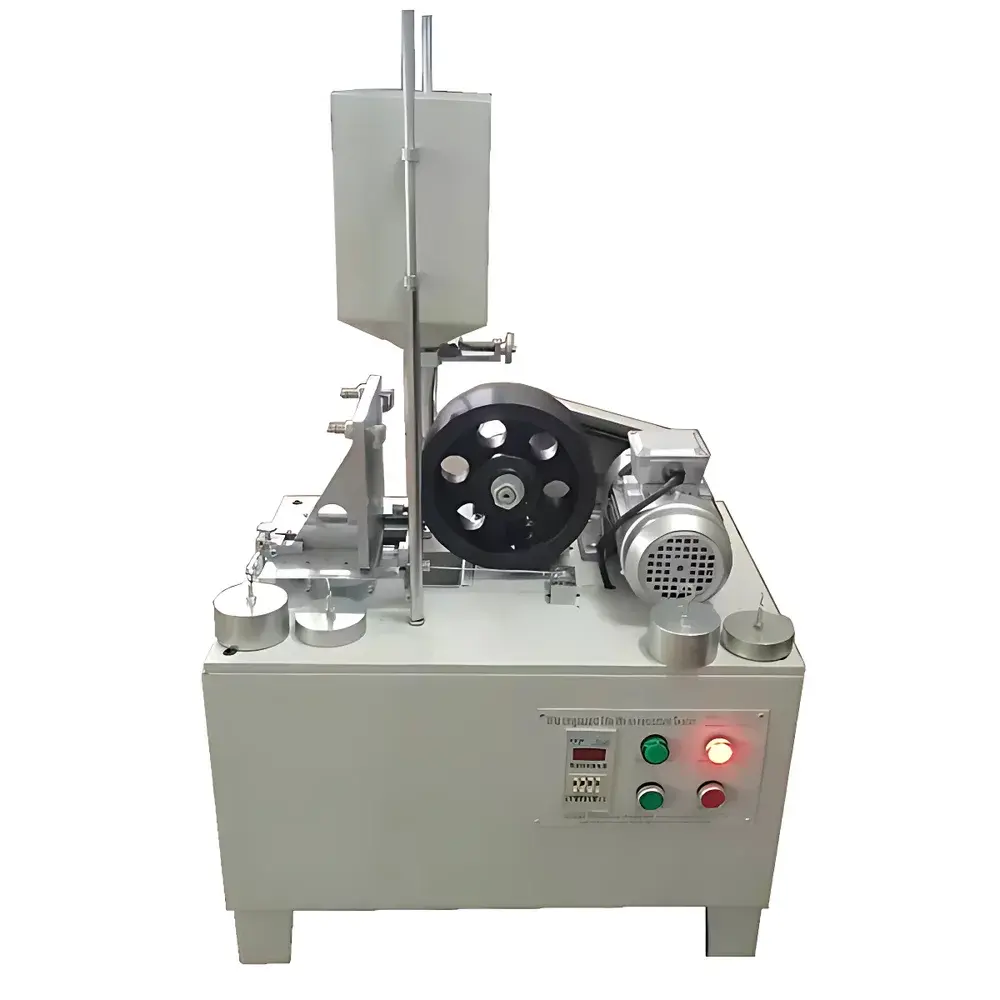
ZHENHUAFENXI WM Ceramic Unglazed Tile Abrasion Tester
| Brand | ZHENHUAFENXI |
|---|---|
| Origin | Hunan, China |
| Model | WM |
| Instrument Type | End-Face Tribological Tester |
| Rotational Speed of Abrading Wheel | 75 ± 4 rpm |
| Abrading Wheel 1 Diameter | 200 ± 0.2 mm, Thickness: 10 ± 0.1 mm, Hardness: ≥ HB 500 (per GB/T 3810.7–2006) |
| Abrading Wheel 2 Diameter | 200 ± 0.2 mm, Thickness: 70 ± 0.1 mm, Hardness: ≥ HB 500 (per GB/T 12988–1991) |
| Abrasive Feed Rate | 100 ± 10 g per 100 revolutions |
| Specimen Size | 100 × 150 mm |
| Abrasive Material | F80 white fused alumina (per ISO 8486–1986) |
| Hopper Capacity | > 5 L |
| Applied Loads | 2.5 kg (for GB/T 3810.7–2016), 14 kg (for GB/T 12988–1991) |
Overview
The ZHENHUAFENXI WM Ceramic Unglazed Tile Abrasion Tester is a precision-engineered end-face tribological testing system designed to quantify the abrasion resistance of unglazed ceramic tiles in strict compliance with international and national standards—including GB/T 3810.2–2016 (equivalent to ISO 10545-6), GB/T 3810.7–2016, and GB/T 12988–1991. It operates on the principle of controlled rotational wear, where a standardized abrasive wheel rotates against a flat tile specimen under constant normal load and regulated abrasive feed. The resulting wear depth or mass loss is measured to determine relative abrasion resistance—a critical quality parameter for floor tiles used in high-traffic commercial and industrial environments. Its mechanical architecture ensures repeatable contact geometry, stable load application, and consistent abrasive delivery—key prerequisites for inter-laboratory reproducibility and regulatory acceptance.
Key Features
- Two interchangeable abrading wheels: one thin (10 ± 0.1 mm) for standard tile evaluation per GB/T 3810.7–2016; one thick (70 ± 0.1 mm) for heavy-duty wear simulation per GB/T 12988–1991—both fabricated from hardened steel with surface hardness ≥ HB 500.
- Precisely regulated rotational speed: 75 ± 4 rpm, maintained via closed-loop DC motor control to minimize speed drift during extended test cycles.
- Automated abrasive dosing system delivering F80 white fused alumina (ISO 8486–1986) at 100 ± 10 g per 100 wheel revolutions, ensuring uniform abrasive replenishment and minimizing operator dependency.
- Dual calibrated dead-weight loading system: 2.5 kg for light-load testing (e.g., wall tiles) and 14 kg for floor-grade evaluation—each load applied via rigid lever arm and verified traceable to national mass standards.
- Integrated digital counter with programmable preset function: users define total revolutions or elapsed time; the system halts automatically upon reaching the threshold, supporting unattended operation and GLP-compliant test logging.
- Stainless-steel hopper with >5 L capacity enables uninterrupted testing over multiple specimens without manual refilling—reducing procedural variability and improving throughput.
Sample Compatibility & Compliance
The WM tester accommodates rectangular ceramic specimens measuring exactly 100 × 150 mm—standardized dimensions required by GB/T 3810 series methods. Specimens are clamped in a rigid aluminum holder ensuring planar alignment and eliminating edge lift during abrasion. All mechanical components—including wheel geometry, load application points, and abrasive delivery nozzles—are dimensionally validated against GB/T 3810.2–2016 Annex A and ISO 10545-6:2014 requirements. The instrument supports full traceability documentation for audit readiness, including calibration certificates for load cells, rotational encoders, and mass dispensing mechanisms. It is routinely deployed in QC laboratories serving ISO 9001-certified tile manufacturers and third-party testing facilities accredited to CNAS (China National Accreditation Service) and equivalent ILAC-MRA signatory bodies.
Software & Data Management
While the base WM model operates via embedded microcontroller logic with front-panel LED display and tactile controls, optional RS-232/USB interface enables integration with laboratory data management systems. Raw test logs—including start/stop timestamps, actual rpm, cumulative revolutions, and load selection—can be exported as CSV files for downstream statistical analysis (e.g., ANOVA of wear depth across batches). When paired with compliant LIMS or ELN platforms, the system supports electronic signatures, audit trails, and version-controlled method storage—facilitating adherence to GLP and pre-approval requirements under GB/T 27025–2019 (equivalent to ISO/IEC 17025). No proprietary software installation is required for basic operation, minimizing IT validation burden.
Applications
- Quality conformance testing of unglazed porcelain and stoneware tiles prior to shipment—ensuring compliance with Class PEI III–V ratings per ANSI A137.1.
- Comparative wear assessment during R&D of new body formulations or firing schedules—correlating abrasion depth with vitrification degree and quartz phase distribution.
- Supplier qualification audits for raw material suppliers (e.g., alumina grit consistency, binder homogeneity).
- Failure analysis of field-failed tiles—reproducing service conditions to isolate root causes such as insufficient densification or localized glaze defects (in adjacent glazed variants).
- Supporting CE marking documentation for tiles exported to EU markets, where abrasion resistance data feeds into EN 14411 Annex G assessments.
FAQ
What standards does the WM tester fully support?
GB/T 3810.2–2016, GB/T 3810.7–2016, GB/T 12988–1991, and ISO 10545-6:2014—all verified through dimensional inspection and performance validation reports.
Can the instrument accommodate non-standard specimen sizes?
No—the fixture and wheel alignment are engineered exclusively for 100 × 150 mm specimens. Deviations compromise contact mechanics and invalidate standard-compliant results.
Is F80 white fused alumina the only approved abrasive?
Yes—per ISO 8486–1986 and GB/T 3810.2–2016, F80 is mandatory; substitution with other grades (e.g., F100 or silicon carbide) invalidates test compliance.
How often must the abrading wheel be replaced?
Wheels are inspected before each test series for surface wear or cracking; replacement is required after 50,000 revolutions or upon visible deformation—documented in maintenance logs per GLP.
Does the system provide wear depth measurement capability?
No—the WM tester generates the worn specimen; depth measurement requires external instrumentation (e.g., stylus profilometer per GB/T 3810.6–2016), which is standard practice in accredited labs.



