
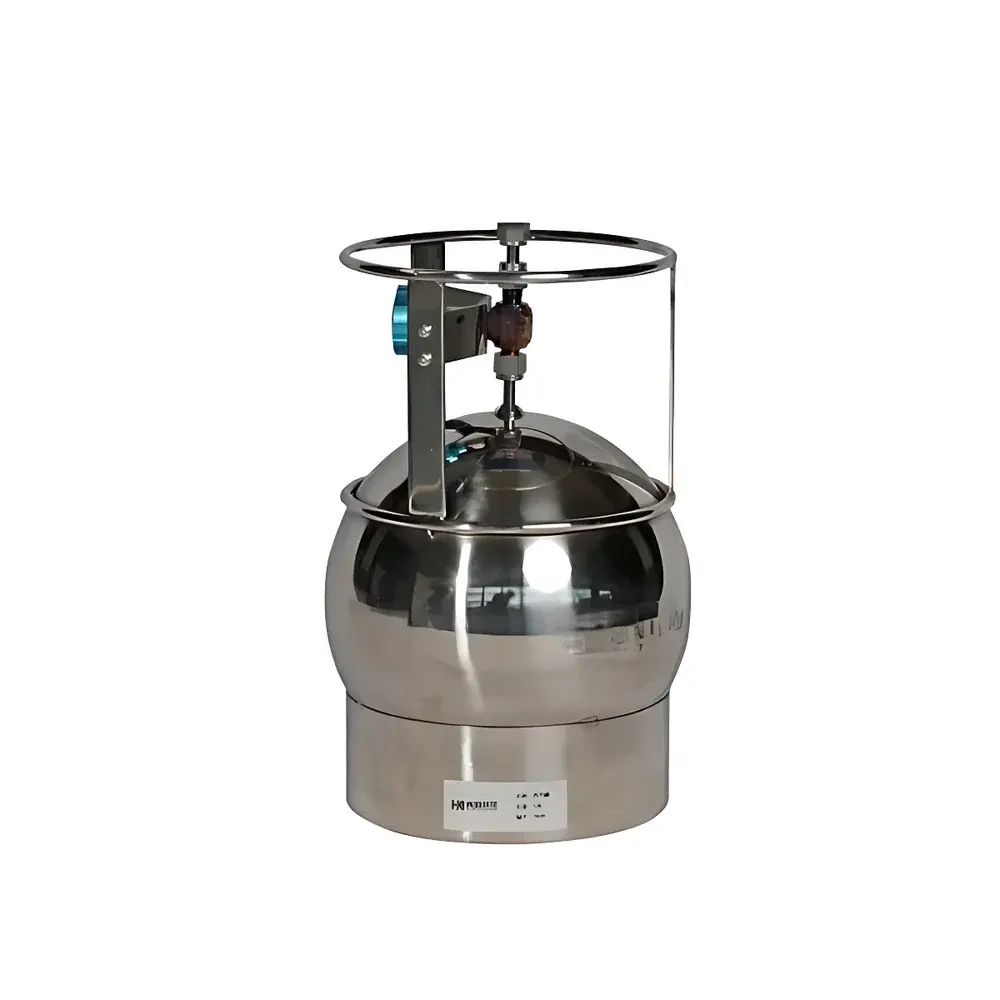
Summa Canister GHD-01 by HUANKONG
| Brand | HUANKONG |
|---|---|
| Origin | Shandong, China |
| Manufacturer Type | Direct Manufacturer |
| Country of Origin | China |
| Model | GHD-01 |
| Capacity Options | 1 L, 3.2 L, 6 L, 15 L |
| Material | Electropolished 316L Stainless Steel |
| Internal Surface Treatment | Dual-stage inert silanization (100% passivated, metal-free contact) |
| Compliance | HJ 759–2023, U.S. EPA TO-15, EPA Method TO-14A, ASTM D6196 |
| Valve Configuration | Integrated high-purity electropolished stainless steel sampling control valve with leak-tight VCR fittings |
| Environmental Rating | IP65-rated housing for field deployment |
Overview
The Summa Canister GHD-01 is a certified, high-fidelity whole-air sampling vessel engineered for the quantitative collection, transport, and storage of volatile organic compounds (VOCs) in ambient and indoor air matrices. Designed in strict accordance with the physical and chemical stability requirements of regulatory atmospheric monitoring protocols, the canister operates on the principle of pressurized, inert-phase sample containment—eliminating adsorptive losses, catalytic degradation, or surface-mediated reactivity during holding periods up to 30 days (per TO-15 guidelines). Its core functionality relies on maintaining a chemically inert internal environment: all wetted surfaces—including interior walls, valve seats, and flow paths—are subjected to a validated two-step silanization process following electropolishing of 316L stainless steel, ensuring zero direct metal–analyte interaction. This architecture delivers trace-level recovery (>95% for C2–C12 hydrocarbons, chlorinated solvents, and oxygenates) under standardized humidities (up to 80% RH) and temperatures (−20 °C to 40 °C), making it suitable for both discrete grab sampling and integration into automated pre-concentration workflows.
Key Features
- Electropolished 316L stainless steel construction with certified surface roughness ≤ 0.4 µm Ra, minimizing boundary-layer retention and facilitating complete thermal desorption.
- Dual-stage inert silanization applied under controlled nitrogen atmosphere—verified via X-ray photoelectron spectroscopy (XPS) for uniform Si–O–Si monolayer coverage and absence of residual silanol groups.
- Integrated high-integrity sampling valve with VCR face-seal connections, rated for 100,000+ actuation cycles and helium leak rate <1×10⁻⁹ atm·cm3/s per ISO 15848-1.
- Multiple volumetric configurations (1 L, 3.2 L, 6 L, 15 L) calibrated to NIST-traceable standards; pressure-rated to 30 psig with burst safety factor ≥4.
- Field-deployable mechanical design: non-collapsible geometry, reinforced end caps, and IP65-rated external housing for resistance to rain, dust, vibration, and thermal cycling in unsheltered environments.
- Pre-conditioned and certified clean: each unit undergoes multi-stage vacuum bake-out (24 h at 150 °C under <1×10⁻⁶ Torr), followed by inert gas purge and blank verification against EPA TO-15 target list (detection limits ≤50 pptv).
Sample Compatibility & Compliance
The GHD-01 Summa Canister is validated for use with gaseous matrices containing VOCs across environmental, occupational, and indoor air quality applications. It supports analytes including but not limited to aliphatic/aromatic hydrocarbons, halogenated compounds (e.g., PCE, TCE), carbonyls (e.g., formaldehyde, acetaldehyde), and polar species (e.g., methanol, acetone) when used with appropriate stabilization protocols (e.g., addition of acidified copper sulfate for sulfur-containing compounds). Regulatory alignment includes full conformance with Chinese standard HJ 759–2023 (Determination of Volatile Organic Compounds in Ambient Air—Canister Sampling/Gas Chromatography–Mass Spectrometry), U.S. EPA Compendium Method TO-15 (Determination of Volatile Organic Compounds (VOCs) in Ambient Air Using Active Sampling Onto Sorbent Tubes Followed by Thermal Desorption and GC/MS Analysis), and TO-14A (Determination of Volatile Organic Compounds (VOCs) in Ambient Air Using Summa Canisters and Gas Chromatography/Mass Spectrometry). All units are supplied with individual Certificate of Conformance documenting batch-specific blank data, leak test results, and surface passivation validation reports.
Software & Data Management
While the GHD-01 is a passive sampling device and requires no embedded firmware or onboard software, its operational integrity is fully integrated into laboratory information management systems (LIMS) and electronic lab notebooks (ELN) via standardized metadata tagging. Each canister is laser-engraved with a unique serial number linked to a digital compliance dossier—including calibration history, cleaning logs, blank chromatograms, and third-party certification documents. When deployed in automated atmospheric pre-concentrator systems (e.g., Markes UNITY-xr, Entech 7100 series), the GHD-01 interfaces seamlessly with instrument control software supporting 21 CFR Part 11-compliant audit trails, user access controls, and electronic signature capture. Raw analytical data generated from canister-derived samples may be processed using EPA-approved quantification algorithms (e.g., ISTD-normalized response factors, matrix-matched calibration curves) within compliant GC/MS data systems (e.g., Thermo Fisher Chromeleon, Agilent MassHunter).
Applications
- Ambient air monitoring networks (regulatory compliance, trend analysis, source apportionment)
- Indoor air quality assessments in commercial, residential, and healthcare facilities
- Workplace exposure evaluation per OSHA and NIOSH methodologies
- Method validation and reference standard preparation for VOC calibration gases
- Mobile monitoring platforms (e.g., vehicle-mounted air samplers, drone-deployed sensor arrays)
- Integration into continuous emission monitoring systems (CEMS) as offline calibration reservoirs or QA/QC check standards
FAQ
What cleaning and passivation protocols are performed prior to shipment?
Each GHD-01 canister undergoes vacuum bake-out at 150 °C for 24 hours under ≤1×10⁻⁶ Torr, followed by high-purity nitrogen purge and dual-stage silanization. Blank testing is conducted per TO-15 criteria using thermal desorption–GC/MS; certificates include chromatograms and compound-specific detection limits.
Can the canister be reused, and what is the recommended maximum reuse cycle?
Yes—under documented cleaning protocols (EPA TO-15 Section 8.3), the GHD-01 supports ≥50 reuses. Reconditioning must include leak testing, blank analysis, and re-validation of silanized surface integrity via surrogate recovery tests (e.g., deuterated benzene, fluorobenzene).
Is the GHD-01 compatible with automated thermal desorption systems?
Yes. The VCR-threaded inlet/outlet interface meets industry-standard mechanical and dimensional specifications (per ASTM F2516) for direct coupling to autosamplers from Markes, PerkinElmer, Thermo Fisher, and Gerstel.
Does the canister require field conditioning before first use?
No—units are shipped pre-cleaned, certified, and ready for immediate deployment. Field conditioning is only required if exposed to extreme contamination or after extended storage (>6 months) without protective end caps.
How is traceability maintained across the supply chain and laboratory workflow?
Each canister carries a permanent laser-etched ID linked to a secure cloud-accessible compliance dossier. Dossier contents include manufacturing lot data, surface characterization reports, blank test results, and third-party certification documentation—all aligned with ISO/IEC 17025 and GLP audit requirements.



