
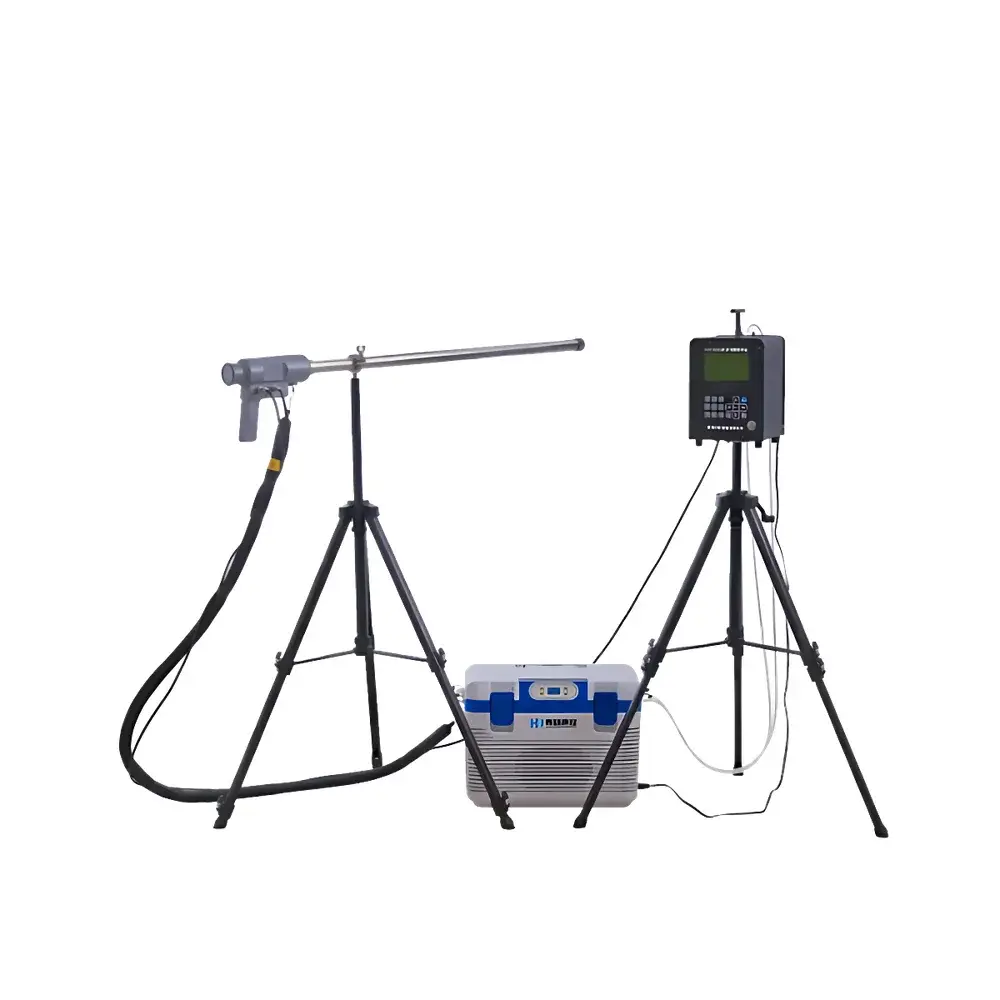
HUANKONG GHK-2000Q Aldehyde and Ketone Emission Sampler
| Brand | HUANKONG |
|---|---|
| Origin | Shandong, China |
| Manufacturer Type | OEM Manufacturer |
| Country of Origin | China |
| Model | GHK-2000Q |
| Instrument Category | Flue Gas Sampling System |
| Target Analytes | Aldehydes and Ketones (e.g., formaldehyde, acetaldehyde, acetone, propionaldehyde) |
| Operating Temperature Range | −30 °C to +50 °C |
| Sampling Gun Heating Range | 0–200 °C |
| Dual-Channel Flow Control | Independent constant-flow sampling (±10% tolerance |
| Data Storage | 200 entries with time-stamped flow, temperature, pressure, and volume data |
| Power Supply | Integrated high-capacity lithium battery powering host, heated box, trace-heated line, and sampling probe |
| Compliance | GB/T 16157–1996, HJ 1153–2020 |
| Key Features | Light-shielded isothermal sample preservation, anti-backflow desiccant bottle, real-time standard-volume correction (STP), ambient temperature & barometric pressure sensing, brushless diaphragm pump, IP-rated weather-resistant enclosure |
Overview
The HUANKONG GHK-2000Q Aldehyde and Ketone Emission Sampler is a field-deployable, dual-channel flue gas sampling system engineered specifically for the quantitative collection of carbonyl compounds—including formaldehyde, acetaldehyde, acetone, and C3–C6 aliphatic ketones—from stationary emission sources. It operates on the principle of impinger-based solution absorption, where gaseous aldehydes and ketones are trapped in derivatizing reagents (e.g., 2,4-dinitrophenylhydrazine, DNPH) within chilled, light-protected absorption bottles. The system integrates active sampling with precise thermal management: the sampling probe, heated transfer line, and insulated sample chamber maintain isothermal conditions throughout the entire gas path to prevent condensation, adsorption loss, or thermal degradation of thermally labile carbonyls. Designed for compliance with Chinese environmental monitoring standards—particularly HJ 1153–2020 (Determination of Aldehydes and Ketones in Stationary Source Exhaust Gas by Solution Absorption–HPLC) and GB/T 16157–1996 (Methods for Determination of Particulates and Gaseous Pollutants in Exhaust Gas from Stationary Sources)—the GHK-2000Q delivers metrologically traceable, reproducible sample acquisition under variable stack conditions.
Key Features
- Dual independent sampling channels with programmable, constant-flow control (each channel configurable for distinct duration, flow rate, and temperature setpoint)
- Full-path heating architecture: sampling probe (0–200 °C adjustable), trace-heated transfer line, and thermostatically stabilized sample chamber (maintained at 4 °C ±1 °C with light shielding)
- Integrated anti-backflow desiccant bottle with silica gel and anhydrous calcium chloride to eliminate moisture ingress and protect the brushless diaphragm pump and internal flow sensors
- Real-time environmental parameter acquisition: ambient temperature, atmospheric pressure, differential pressure across the sampling train, and volumetric flow rate—with automatic conversion to standard temperature and pressure (STP: 273.15 K, 101.325 kPa)
- Intelligent power management: onboard high-energy-density lithium battery powers all subsystems—including probe heater, heated line, cooling module, and controller—for uninterrupted operation in off-grid or mobile deployments
- Ruggedized enclosure rated for extended outdoor use: operational range −30 °C to +50 °C; IP54-rated against rain, snow, and dust ingress
- Auto-recovery functionality: retains configuration and cumulative sampling data during power interruption; resumes sampling upon restoration without manual reinitialization
- On-device data logging: stores up to 200 complete sampling records with timestamps, flow profiles, temperature logs, pressure readings, and calculated standard volumes
Sample Compatibility & Compliance
The GHK-2000Q is validated for use with standard DNPH-cartridge or impinger-based collection media per HJ 1153–2020. Its design ensures compatibility with both glass impingers (e.g., 2-bottle train with DNPH solution) and solid-phase cartridges (e.g., silica gel coated with DNPH). All wetted surfaces contacting sampled gas are chemically inert (borosilicate glass, PTFE, and electropolished stainless steel), minimizing analyte adsorption or catalytic decomposition. The system meets structural and procedural requirements for GLP-aligned field sampling workflows and supports audit-ready documentation for regulatory submissions under China’s Ministry of Ecology and Environment (MEE) frameworks. While not certified to ISO/IEC 17025 for calibration, its flow control accuracy (±2% of setpoint under calibrated conditions) and thermal stability align with QA/QC expectations for Method 8 and EPA TO-11A–compatible protocols.
Software & Data Management
Data retrieval is performed via USB interface using proprietary PC software compliant with Windows 10/11. The software enables viewing, sorting, and exporting of sampling logs in CSV format for integration into LIMS or statistical analysis platforms. Each record includes raw sensor outputs (e.g., analog voltage from pressure transducers), compensated flow values, STP-corrected total volume, and user-defined metadata fields (sampling point ID, operator name, method reference). Audit trail functionality records all parameter changes with timestamp and user identifier. Firmware updates are delivered via signed binary packages to ensure integrity; no cloud connectivity or remote telemetry is implemented—consistent with air-gapped operational security requirements common in industrial emission monitoring.
Applications
- Regulatory compliance monitoring at coal-fired power plants, waste incinerators, chemical manufacturing units, and biomass combustion facilities
- Source testing for formaldehyde and acetaldehyde emissions from resin production, plywood lamination, and paint drying ovens
- Method validation and inter-laboratory comparison studies requiring high-fidelity carbonyl capture under high-humidity or low-temperature stack conditions
- Stack testing campaigns involving simultaneous multi-point sampling across duct cross-sections using synchronized GHK-2000Q units
- Research applications in atmospheric chemistry where artifact-free speciation of reactive carbonyls is critical prior to HPLC-UV or LC-MS/MS analysis
FAQ
What derivatization reagents are compatible with the GHK-2000Q?
DNPH in acetonitrile/water (1:1 v/v) is the primary reagent specified in HJ 1153–2020; the system accommodates standard 25-mL or 50-mL impingers and commercially available DNPH-coated silica cartridges.
Does the unit support automated flow calibration?
No built-in calibrator is included; however, the system provides analog and digital interfaces for connection to external primary flow standards (e.g., dry gas meters or critical orifices) during pre- and post-sampling verification.
Can sampling be initiated remotely?
Remote start/stop is not supported; all operations require local interaction via the front-panel keypad and LCD display.
Is the lithium battery replaceable in the field?
Yes—the battery pack is user-serviceable with standard Torx tools and conforms to UN 38.3 transport safety specifications for lithium-ion cells.
How is condensate managed in high-moisture flue gases?
The combination of probe heating (up to 200 °C), heated line (maintained ≥5 °C above dew point), and the integrated desiccant bottle prevents liquid water ingress while preserving carbonyl integrity in saturated streams.
Related Products







