
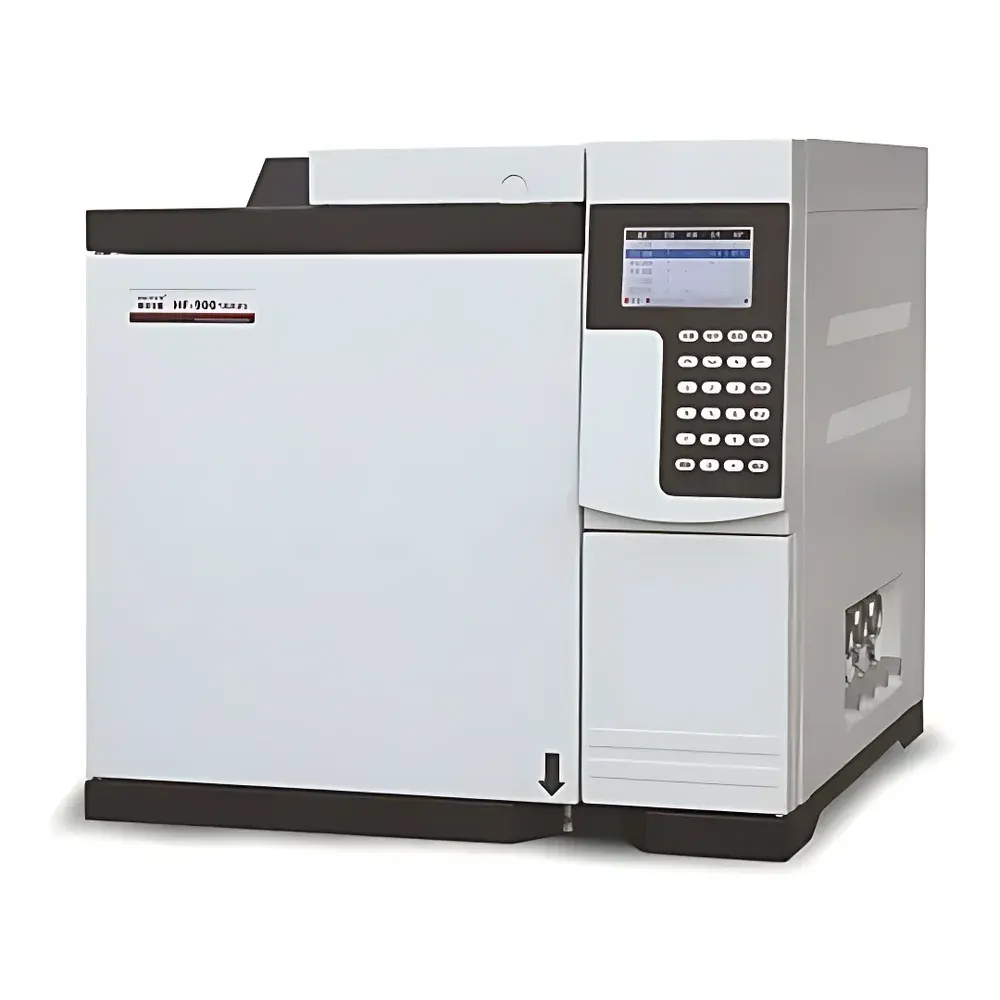
Huifen HF-900 Laboratory Gas Chromatograph
| Brand | Huifen Instrument |
|---|---|
| Origin | Shandong, China |
| Model | HF-900 |
| Instrument Type | Laboratory Gas Chromatograph |
| Application Scope | General-purpose |
| Oven Temperature Range | Ambient + 5 °C to 450 °C |
| Maximum Ramp Rate | 60 °C/min |
| Cooling Rate | 350 °C to 50 °C in <5 min |
| Injector Temperature Max | 450 °C |
| Carrier Gas Flow Range | 0–1200 mL/min |
| Carrier Gas Pressure Range | 0–970 kPa |
| Number of Independent Temperature Zones | 7 |
| Temperature Setpoint Accuracy | ±0.1 °C |
| Maximum Run Time | 999.99 min |
| Programmed Temperature Steps | 20 |
| Detector Options | FID, TCD, FPD |
| FID Detection Limit | ≤3.0×10⁻¹² g/s (n-hexadecane / isooctane) |
| FID Linear Dynamic Range | ≥10⁷ |
| TCD Sensitivity | ≥10,000 mV·mL/mg (benzene / toluene) |
| TCD Linear Dynamic Range | ≥10⁵ |
Overview
The Huifen HF-900 is a modular, general-purpose laboratory gas chromatograph engineered for precision, reliability, and operational flexibility in routine and method-development environments. Based on classical capillary and packed-column separation principles, the HF-900 employs temperature-programmed elution with high-stability oven control and independently regulated thermal zones to ensure reproducible retention times and peak shape integrity. Its architecture supports both qualitative and quantitative analysis across diverse sample matrices—including volatile organic compounds (VOCs), residual solvents, petrochemical fractions, environmental pollutants, and pharmaceutical impurities—under standardized protocols aligned with ASTM D3612, ISO 11843, USP , and EPA Method 8260. The system’s column oven features intelligent rear-door airflow modulation, enabling rapid thermal equilibration and consistent baseline stability during multi-step temperature programs.
Key Features
- Seven independently controlled temperature zones—including oven, up to four injector ports, and up to three detector modules—each maintained within ±0.1 °C setpoint accuracy under dynamic load conditions.
- High-resolution oven temperature control: ambient +5 °C to 450 °C, with programmable ramp rates from 0.1 to 60 °C/min and cooling from 350 °C to 50 °C in under 5 minutes.
- Modular injector design supporting simultaneous configuration of up to four inlets: split/splitless capillary injectors (with septum purge), packed-column injectors, six-port gas sampling valves, and optional methanizer or catalytic conversion furnaces.
- Dual-detector capability as standard; expandable to three detectors (FID, TCD, FPD) with independent power supplies, signal conditioning, and real-time status monitoring.
- FID with auto-ignition logic, flame-out detection, and wide-range logarithmic amplification (10⁷ linear dynamic range); TCD featuring low-dead-volume cell geometry and carrier-gas interruption protection.
- Embedded LCD interface with bilingual (English/Chinese) menu navigation, self-diagnostic routines, power-failure recovery, and non-volatile method storage.
Sample Compatibility & Compliance
The HF-900 accommodates liquid, gaseous, and thermally stable semi-volatile samples via compatible injection techniques: syringe-based manual or autosampler-driven introduction, gas-tight loop injection, headspace analysis (with optional HS unit), and purge-and-trap preconcentration interfaces. It complies with fundamental requirements for GLP and GMP-regulated laboratories, including audit-trail-capable method versioning, user-access-level controls (admin/operator/guest), and electronic signature support per FDA 21 CFR Part 11 when integrated with validated chromatography data systems (CDS). All thermal and flow parameters are traceable to NIST-calibrated references, and detector performance meets or exceeds specifications defined in ISO 6425 (TCD) and ASTM D2887 (FID sensitivity verification).
Software & Data Management
The HF-900 operates natively with Huifen GC Navigator™ software—a Windows-based platform supporting instrument control, sequence definition, real-time chromatogram visualization, peak integration using ISO 14155-compliant algorithms, calibration curve generation (linear, quadratic, weighted), and report export in PDF, CSV, and XML formats. Raw data files adhere to ANDI/NetCDF format for cross-platform compatibility with third-party CDS solutions (e.g., OpenLab CDS, Chromeleon). Audit trail logs record all parameter modifications, run executions, and user logins with timestamps and IP metadata. Software validation packages—including IQ/OQ documentation templates and installation qualification checklists—are available upon request for regulated environments.
Applications
- Residual solvent analysis in APIs and excipients per ICH Q3C guidelines.
- VOC profiling in indoor air, soil extracts, and drinking water (EPA 502.2, 624).
- Fatty acid methyl ester (FAME) quantification in biodiesel feedstocks (ASTM D6584).
- Hydrocarbon group-type analysis (PIONA) in gasoline and naphtha streams.
- Pesticide residue screening in food commodities using multi-residue methods (EN 15662).
- Quality control of industrial monomers, polymer additives, and synthetic intermediates.
FAQ
What detector configurations are supported on the HF-900?
The system supports up to three detectors simultaneously—commonly FID + TCD, or FID + FPD + TCD—with independent temperature, gas flow, and voltage control for each module.
Can the HF-900 be integrated into a networked laboratory environment?
Yes—it features Ethernet (RJ-45) and RS-232 connectivity, enabling remote operation, centralized data archiving, and integration with LIMS via HL7 or ASTM E1384 message protocols.
Is method transfer possible between the HF-900 and other GC platforms?
Method portability is facilitated by adherence to GC universal parameter conventions (e.g., retention index referencing, normalized flow calculations) and exportable method files compatible with major CDS vendors.
Does the system meet regulatory requirements for pharmaceutical QC labs?
When deployed with validated software, calibrated hardware, and documented SOPs, the HF-900 satisfies core instrumentation requirements outlined in USP , EU Annex 11, and WHO TRS 992 for analytical instrument qualification.
What maintenance intervals are recommended for optimal performance?
Injector liner replacement every 100–200 injections; column trimming every 2–4 weeks depending on sample cleanliness; FID jet cleaning quarterly; full system leak check and flow calibration semiannually.




