
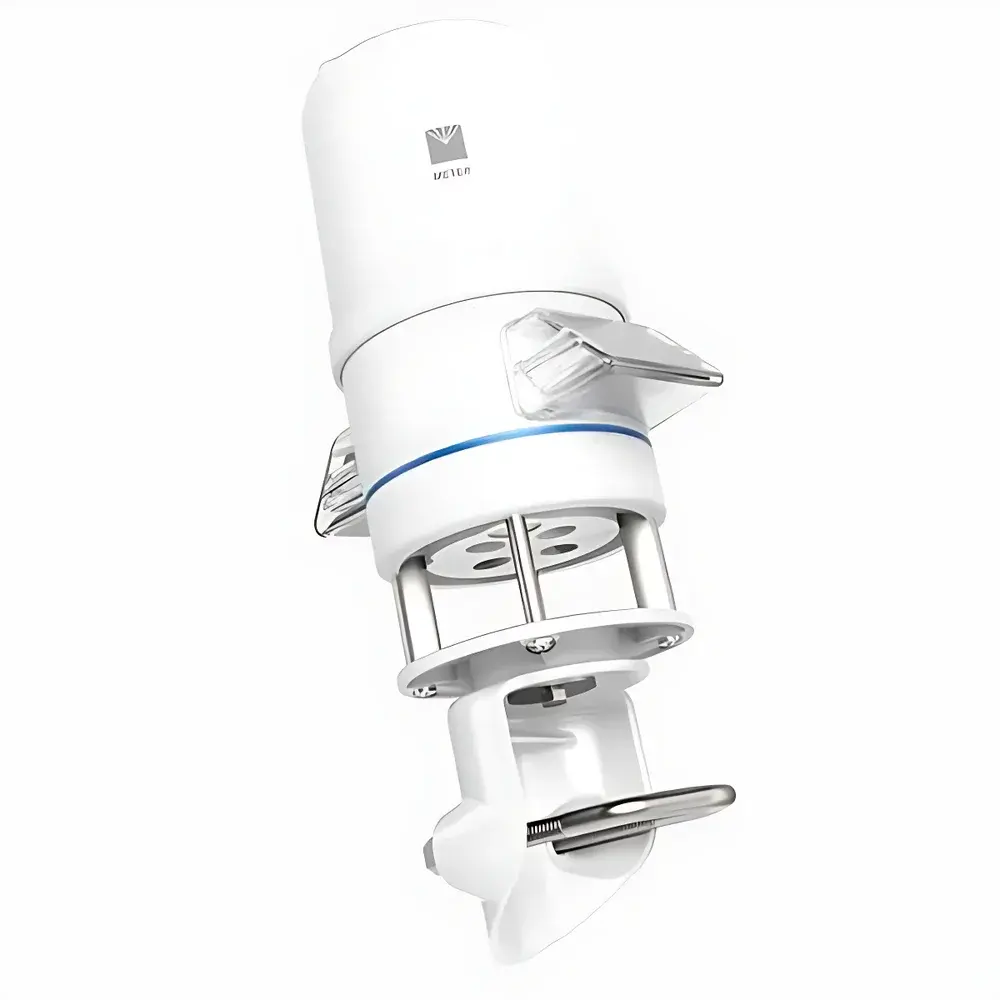
METER ATMOS 41W All-in-One Wireless Weather Station
| Brand | METER |
|---|---|
| Origin | USA |
| Model | ATMOS 41W |
| Instrument Type | Portable All-in-One Weather Station |
| Certifications | ISO 9001:2015, CE (EMC per ISO/IEC 17050:2010) |
| Power | 6× AA Alkaline or NiMH batteries (solar-rechargeable option available) |
| Communication | LTE-M/NB-IoT & 3G cellular (global carrier support), Bluetooth 5.2 BLE, integrated 56-channel GPS/QZSS |
| Data Storage | 8 MB non-volatile flash memory (≥100,000 records) |
| Operating Temperature | –40 °C to +60 °C (RH & barometric sensors functional at –40 °C |
| extended air temperature range | –63 °C to +60 °C) |
| Dimensions | 16.5 cm (W) × 31.8 cm (H) |
Overview
The METER ATMOS 41W is an all-in-one, self-contained wireless weather station engineered for autonomous, long-term environmental monitoring in remote and resource-constrained field deployments. Unlike modular systems requiring external data loggers, power supplies, or communication gateways, the ATMOS 41W integrates high-accuracy meteorological sensing, microcontroller-based data acquisition, cellular telemetry, GNSS time synchronization, and energy management into a single compact enclosure. Its measurement architecture is grounded in physically validated sensor principles: thermistor-based air temperature and vapor pressure determination, silicon photodiode-based pyranometry with 0.1 W/m² resolution, ultrasonic wind speed and direction transduction, dual-mode precipitation detection (optical drop counting + tipping-bucket accumulation), and conductometric rainwater EC analysis. Designed for unattended operation across extreme climatic gradients—from arctic tundra to semi-arid rangelands—the ATMOS 41W delivers traceable, audit-ready environmental time series compliant with international observational standards.
Key Features
- True all-in-one design: No external cabling, external power, or auxiliary hardware required—deployable in under 90 seconds via pole-mounting and mechanical fastening.
- Dual-mode precipitation measurement: Simultaneous optical droplet detection (for real-time intensity and drop-size inference) and precision tipping-bucket accumulation (0.017 mm resolution), enabling cross-validated rainfall totals and improved low-intensity event detection.
- Rainwater electrical conductivity (EC) sensing: Integrated 4-electrode conductivity cell (0–3 mS/cm, ±15% accuracy) supports discrimination between natural rainfall, irrigation water, and biological contamination (e.g., avian excreta), enhancing data integrity for hydrological and ecological applications.
- Enhanced thermal performance: Calibrated thermistors deliver ±0.2 °C accuracy at 25 °C and maintain ±0.6 °C measurement uncertainty across –20 °C to +50 °C; extended operational range of –63 °C to +60 °C enables polar and high-altitude deployment.
- High-temporal-resolution sampling: 3-second default interval for solar radiation, vapor pressure, air temperature, and wind parameters—with on-device calculation of instantaneous min/max values per interval (Tmin, Tmax).
- Integrated tilt compensation and auto-leveling: Onboard inclinometer (±1° accuracy, 0–180° range) enables automatic correction of solar irradiance and wind vector measurements under minor mounting misalignment.
- Robust communications stack: Dual-band LTE-M/NB-IoT and fallback 3G UMTS (5-band) with global carrier compatibility; embedded 56-channel GPS/QZSS for sub-4 m positional accuracy and automatic UTC time synchronization.
Sample Compatibility & Compliance
The ATMOS 41W is designed for direct exposure to ambient atmospheric conditions without protective enclosures or aspirated shields—its sensor geometry and thermal mass have been validated against WMO Guide to Meteorological Instruments and Methods of Observation (CIMO Guide) recommendations for unshielded temperature and humidity measurement. Rain gauge filtration complies with ASTM D1193 Class IV water quality requirements for particulate retention. All electronics conform to IEC 61000-6-3 (EMC emissions) and IEC 61000-6-2 (immunity), certified under CE marking per ISO/IEC 17050:2010. Manufacturing adheres to ISO 9001:2015 quality management protocols. While not GLP/GMP-certified per se, its firmware supports audit-trail-capable data logging (with timestamp, battery voltage, signal strength, and sensor diagnostics embedded per record), satisfying baseline requirements for environmental data governance frameworks including EPA QA/G-5 and ISO 17025 Annex A.2.
Software & Data Management
Data from the ATMOS 41W is transmitted securely via TLS 1.2–encrypted HTTP(S) to ZENTRA Cloud—a FISMA-compliant, SOC 2 Type II–audited platform hosted on AWS infrastructure. Users access time-series visualizations, export CSV/NetCDF files, configure custom alert thresholds (e.g., wind gust >15 m/s, EC >1.2 mS/cm), and share read-only dashboards with collaborators. The ZENTRA Utility desktop application enables local firmware updates, manual time sync, and offline configuration. All data records include embedded metadata: GPS coordinates, UTC timestamps (GPS-synchronized), battery voltage, cellular RSSI, and sensor-specific diagnostic flags (e.g., “rain gauge clog warning”, “tilt out-of-range”). Raw sensor outputs are preserved without interpolation; statistical aggregation (e.g., hourly means, daily totals) occurs server-side with full provenance tracking.
Applications
- Remote ecological observatories: Long-term microclimate characterization in alpine, desert, or boreal ecosystems where grid power and maintenance access are unavailable.
- Agricultural decision support: High-frequency canopy-level weather inputs for evapotranspiration modeling (FAO-56), frost risk forecasting, and irrigation scheduling.
- Wildfire danger assessment: Real-time integration of wind vectors, relative humidity minima, and fine-fuel moisture proxies derived from vapor pressure deficit trends.
- Urban heat island studies: Dense spatial networks of ATMOS 41W units enable kilometer-scale thermal and moisture gradient mapping.
- Hydrological calibration: Dual-mode rainfall data improves radar-gauge adjustment algorithms and informs stormwater model parameterization, particularly in complex terrain.
- Climate resilience infrastructure monitoring: Embedded tilt and vibration diagnostics support structural health assessment of meteorological towers, bridges, and slope stability arrays.
FAQ
What cellular networks does the ATMOS 41W support?
The device ships with global 3G UMTS (5-band) and region-specific LTE-M/NB-IoT variants. North American models operate on Verizon, AT&T®, and T-Mobile LTE-M bands; international configurations leverage partnerships with over 550 carriers worldwide. SIM cards are embedded and provisioned by METER.
How is time synchronization maintained?
Primary synchronization uses the integrated GPS/QZSS receiver (accuracy ±4 m in open-sky conditions). Fallback methods include NTP over cellular and manual sync via ZENTRA Utility software.
Can the ATMOS 41W operate below –40 °C?
Yes—air temperature and relative humidity sensors remain functional down to –40 °C. For sustained operation below this threshold, alkaline batteries are recommended (NiMH may exhibit reduced capacity); the extended-range thermistor continues accurate measurement to –63 °C.
Is raw sensor data accessible without cloud dependency?
Yes—Bluetooth 5.2 BLE enables local retrieval of the full 8 MB dataset (≥100,000 records) using the ZENTRA Utility app. Firmware v3.2+ also supports scheduled local CSV export via USB-C (adapter required).
How is data quality ensured during heavy rainfall or icing events?
The upgraded rain gauge funnel incorporates hydrophobic nano-coating and optimized mesh filtration to reduce clogging. Optical rain detection remains functional during freezing conditions (no moving parts), while EC measurement identifies conductivity anomalies indicative of debris or biological contamination—both flagged in metadata for downstream QA/QC filtering.
Related Products







