
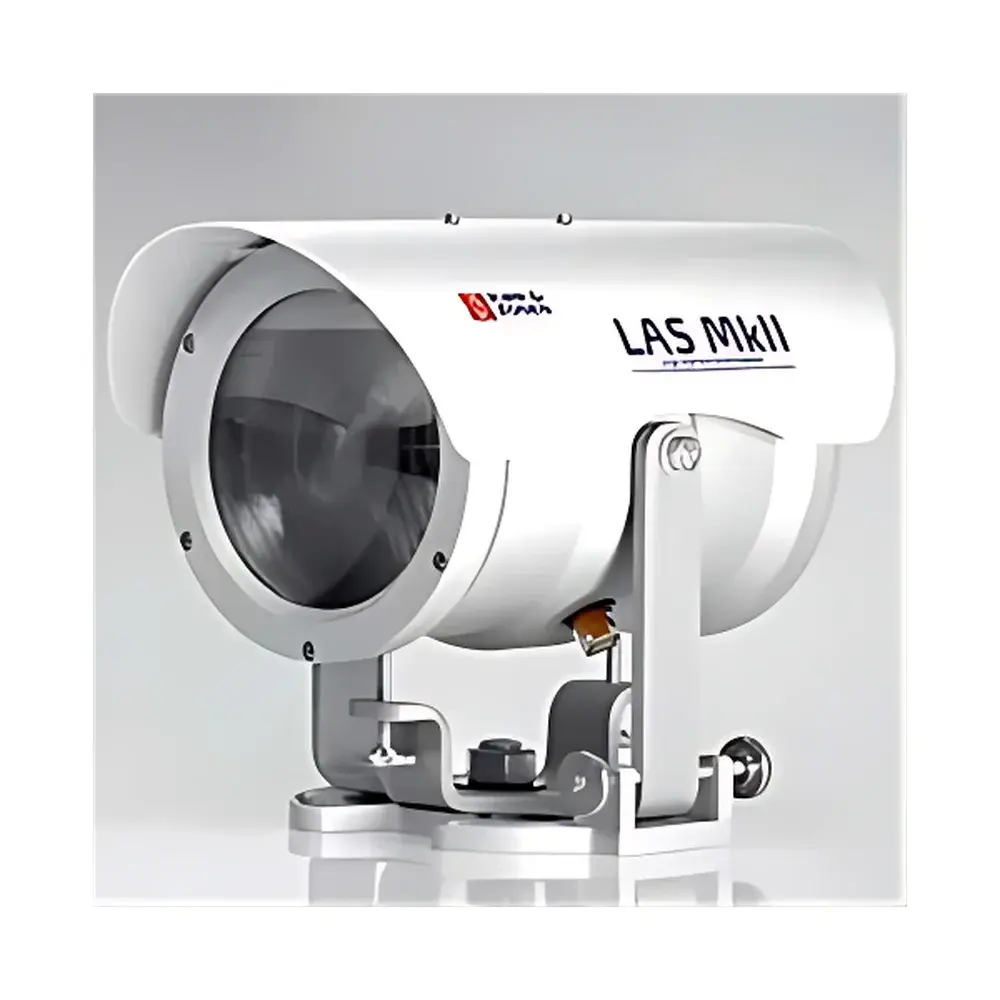
Kipp & Zonen LAS MkII Large-Aperture Scintillometer
| Brand | Kipp & Zonen |
|---|---|
| Origin | Netherlands |
| Model | LAS MkII |
| Aperture | 10 cm (100–1,000 m path) / 15 cm (250–4,500 m path) |
| Wavelength | 850 nm |
| Scintillation Bandwidth | 10⁻¹⁷–10⁻¹² m⁻²/³ |
| Power Supply | 12 VDC, 6 W (up to 54 W with heater enabled) |
| Dimensions | 400 × 300 × 240 mm (L×H×D) |
| Weight | 8.5 kg |
| Internal Processing | Cn², sensible heat flux (H), and derived turbulence parameters |
| Data Logging | Onboard non-volatile memory for multi-month storage |
| Interface | RS-232/422 digital, 0–2 V analog output |
| Software | EVATION® (real-time monitoring, post-processing, calibration support) |
Overview
The Kipp & Zonen LAS MkII Large-Aperture Scintillometer is a field-deployable, physics-based instrument engineered for continuous, non-intrusive measurement of atmospheric surface-layer turbulence and sensible heat flux (H) over horizontal paths ranging from 100 m to 4.5 km. It operates on the principle of optical scintillation—quantifying intensity fluctuations of a collimated near-infrared (850 nm) beam induced by refractive index variations (Cn²) in turbulent air. These variations arise primarily from gradients in temperature and humidity, governed by the Monin–Obukhov similarity theory. Unlike eddy covariance systems requiring high-frequency 3D wind and scalar measurements, the LAS MkII delivers path-averaged H directly via the structure parameter of the refractive index of air (Cn²), linked to H through well-established micrometeorological relationships. Its design prioritizes operational robustness in remote or off-grid environments, with low power consumption enabling solar-powered deployment without external computing infrastructure.
Key Features
- Two aperture options: 10 cm (optimal for 100–1,000 m paths) and 15 cm (optimized for extended ranges up to 4,500 m), each calibrated for precise Cn² retrieval across its specified path length.
- Integrated digital signal processor within the receiver unit performs real-time computation of Cn², sensible heat flux (H), and auxiliary turbulence metrics—including the Obukhov length (L) when paired with ancillary meteorological sensors.
- Self-contained human–machine interface: built-in LCD display and membrane keyboard allow full local configuration, diagnostics, and real-time data review—no laptop, cables, or driver software required for basic operation.
- Onboard non-volatile data logger stores time-stamped Cn², H, internal diagnostics, and sensor metadata at user-selectable intervals (e.g., 1–60 min), supporting >6 months of continuous logging at 5-min resolution.
- Low-power architecture: nominal 6 W consumption (12 VDC); optional integrated heater (max 54 W) maintains optical alignment and window clarity under dew/frost conditions—critical for year-round unattended operation.
- Dual-output connectivity: RS-232/422 serial interface enables remote command-and-control and high-resolution data streaming; 0–2 V analog output permits direct integration with legacy SCADA or third-party dataloggers without protocol translation.
Sample Compatibility & Compliance
The LAS MkII measures path-integrated atmospheric turbulence—not discrete samples—and therefore has no consumables, sample chambers, or fluidic interfaces. Its optical path is fully open-air and requires unobstructed line-of-sight between transmitter and receiver units. The system complies with ISO 7726 (Ergonomics of the thermal environment — Instruments for measuring physical quantities) for radiometric stability and thermal drift specifications. When deployed in regulatory or research-grade networks (e.g., FLUXNET, ICOS, or national hydrological observatories), it supports traceable calibration via manufacturer-provided Cn² transfer standards and adheres to Good Laboratory Practice (GLP) documentation requirements for field instrumentation. Optional meteorological sensor kits (anemometer, Pt100 temperature probe, barometric pressure transducer) are CE-marked and meet IEC 61260-1:2014 Class 2 tolerances for environmental sensing.
Software & Data Management
EVATION® is the dedicated, Windows-based software suite supplied standard with every LAS MkII. It provides bidirectional communication for instrument setup (e.g., averaging period, heater activation thresholds, logging interval), live telemetry visualization (Cn² time series, H trends, signal-to-noise ratio diagnostics), and post-mission analysis. EVATION® implements the Hill–Thiermann algorithm for Cn²-to-H conversion and supports user-defined corrections for humidity contribution (via input of relative humidity or vapor pressure). Export formats include CSV, NetCDF, and ASCII-compatible time-series files compatible with MATLAB, Python (xarray/pandas), and R workflows. Audit trails, configuration snapshots, and firmware version logs are embedded in all exported datasets—supporting compliance with FDA 21 CFR Part 11 where electronic records are subject to validation requirements.
Applications
- Surface energy balance closure studies in micrometeorology and land–atmosphere interaction modeling.
- Validation of satellite-derived evapotranspiration (ET) products (e.g., MOD16, SEBS) across heterogeneous agricultural or natural landscapes.
- Long-term monitoring of sensible heat flux in climate observatories, including Arctic tundra, semi-arid grasslands, and forest canopies.
- Calibration and intercomparison campaigns for eddy covariance towers, particularly where footprint mismatch or sensor height limitations introduce uncertainty.
- Operational irrigation scheduling support—when integrated into agro-hydrological decision-support systems using real-time H as proxy for crop water stress.
- Boundary-layer research in urban meteorology, where path-averaged fluxes mitigate representativeness errors inherent in point measurements.
FAQ
What meteorological inputs are required to compute sensible heat flux?
The LAS MkII computes Cn² autonomously. To derive sensible heat flux (H), ambient air temperature, pressure, and humidity (or dew point) are required. These may be provided externally via EVATION® or measured in situ using the optional integrated meteorological sensor kit.
Can the LAS MkII operate unattended for more than one year?
Yes—field deployments exceeding 18 months have been documented using dual solar panels (≥40 W peak), deep-cycle AGM batteries, and the heater disabled during frost-free seasons. Firmware v3.2+ includes battery voltage hysteresis control to prevent deep discharge.
Is path-averaged H directly comparable to eddy covariance H?
Path-averaged H represents the spatial integral over the optical path, while EC H is point-based and footprint-weighted. Direct comparison requires careful spatial matching and application of flux footprint models (e.g., Kljun et al. 2015); differences <15% are typical under homogeneous terrain.
Does the LAS MkII require periodic factory recalibration?
No routine recalibration is needed. Kipp & Zonen recommends verification every 24 months using the supplied alignment jig and reference Cn² test source. Field-level zero-checks (dark-current measurement) are automated during startup.
How is data security handled during remote transmission?
RS-232/422 is a physical-layer interface without native encryption. For secure telemetry, users deploy external industrial routers with TLS/SSL tunneling or integrate the LAS MkII into encrypted cellular/Iridium mesh networks at the gateway level.
Related Products







