
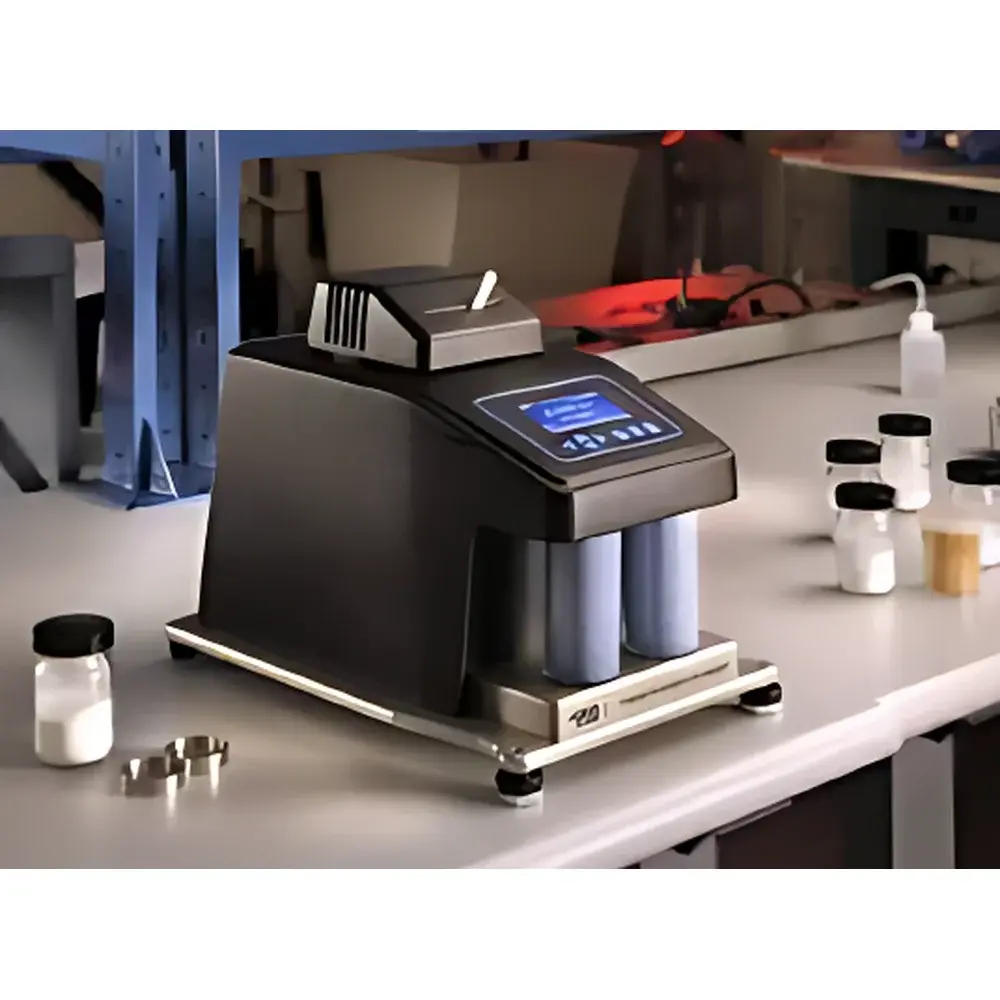
METER AQUALAB VSA Soil Water Characteristic Curve Analyzer
| Brand | METER |
|---|---|
| Origin | USA |
| Model | VSA |
| Instrument Type | Water Activity / Matric Potential Analyzer |
| Measurement Principle | Dynamic Dew Point Isotherm (DDI) |
| Temperature Range | 15–50 °C |
| Water Activity Range | 0.03–0.950 aw |
| Matric Potential Range | −10 to −475 MPa |
| Resolution | 0.0001 aw (0.01% RH), ±0.1 °C |
| Accuracy | ±0.005 aw, ±1 MPa or ±1%, ±0.01 °C |
| Repeatability | ±0.003 aw |
| Sample Capacity | 14 mL |
| Dimensions | 38.1 × 26.7 × 30.5 cm |
| Weight | 14.9 kg |
| Power | 110–220 V AC, 50/60 Hz |
| Interface | USB |
Overview
The METER AQUALAB VSA Soil Water Characteristic Curve Analyzer is a precision laboratory instrument engineered for the automated generation of soil water retention curves (SWRCs) and moisture sorption isotherms using Dynamic Dew Point Isotherm (DDI) technology. Unlike conventional static vapor sorption (DVS) or pressure plate methods, the VSA employs a closed-loop, temperature-controlled cold-mirror dew point sensor system to directly measure equilibrium water activity (aw) of soil samples across a defined relative humidity (RH) gradient. This physical measurement is then converted to matric potential (ψm, in MPa) using the Kelvin equation and validated thermodynamic relationships—enabling high-fidelity characterization of soil’s hydric behavior under controlled isothermal conditions. Designed specifically for unsaturated zone hydrology and soil physics research, the VSA delivers full desorption and adsorption isotherms within 24–48 hours, supporting reproducible quantification of hysteresis, pore-size distribution inference, and validation of hydraulic property models (e.g., van Genuchten or Brooks-Corey parameters).
Key Features
- Dynamic Dew Point Isotherm (DDI) methodology—the only commercially available fully automated platform implementing this ISO/ASTM-aligned approach for soil water characteristic analysis
- Simultaneous dual-path isotherm acquisition: independent control of adsorption (wetting) and desorption (drying) cycles with user-defined step resolution and dwell time
- Integrated Peltier-based temperature regulation (15–50 °C, ±0.1 °C stability) enabling isothermal SWRC generation at environmentally relevant conditions
- High-resolution microbalance (0.5 mg sensitivity) synchronized with real-time dew point detection for mass–activity correlation
- Automated sequence execution: load sample, define protocol, initiate—no manual intervention required during run
- Configurable repetition: up to 3 independent replicate runs per sample, with automatic data alignment and statistical summary (mean, SD, CV%)
- Robust industrial enclosure constructed from flame-retardant POLYLAC PA-765 (UL94 V-0 certified ABS), suitable for shared lab environments
Sample Compatibility & Compliance
The VSA accommodates a broad range of mineral and organic soils—including sandy loams, clays, biochars, and amended substrates—with minimal sample preparation (air-dried, sieved ≤2 mm, 3–10 g typical). It complies with ASTM D6988-22 (Standard Test Method for Determination of Water Activity (aw) of Soil and Rock) and supports GLP-compliant workflows through audit-trail-enabled software logging (user ID, timestamp, method version, calibration history). Data output meets requirements for submission to USDA-ARS databases and peer-reviewed hydrological modeling repositories. The system operates within ambient humidity limits (0–90% RH, non-condensing), and its gas-handling design (max. 7 PSI external purge compatibility) permits integration with inert-atmosphere glove boxes for anaerobic or oxidation-sensitive samples.
Software & Data Management
Instrument control and data reduction are managed via the proprietary AQUALAB Connect software (Windows-compatible, USB-connected), which provides role-based access control, electronic signature support, and 21 CFR Part 11–ready configuration options—including secure user authentication, immutable raw-data archiving, and change-tracking logs for all method edits. Raw outputs include time-stamped aw, mass, temperature, and calculated ψm (MPa) per data point; processed deliverables include SWRC plots (θ vs. ψm), hysteresis loops, derivative dθ/dψm distributions, and exportable CSV/Excel files compatible with HYDRUS, STANMOD, or R-based pedotransfer function libraries. All calibrations (dew point sensor, temperature probe, balance) are traceable to NIST standards and documented in machine-readable calibration certificates.
Applications
- Determination of soil water retention parameters for vadose zone modeling and irrigation scheduling algorithms
- Evaluation of amendment efficacy (e.g., hydrogels, biochar, clay stabilizers) on soil moisture buffering capacity
- Seed storage physiology studies: correlating seed aw with germination viability and metabolic dormancy thresholds
- Food and pharmaceutical stability testing: parallel isotherm generation for excipients, powders, and lyophilized formulations
- Validation of neutron probe, TDR, and capacitance sensor calibrations against primary-reference SWRCs
- Teaching laboratories: hands-on demonstration of soil–water interaction thermodynamics and hysteresis phenomena
FAQ
What distinguishes DDI from traditional pressure plate or centrifuge methods?
DDI eliminates mechanical stress artifacts and equilibration delays inherent in filtration-based techniques. It measures thermodynamic equilibrium directly at the sample surface, yielding higher point density (>100 points per curve), sub-hour equilibration per step, and intrinsic compatibility with low-water-content (<0.05 g H2O/g dry soil) samples.
Can the VSA measure frozen or saline soils?
No. The DDI method assumes liquid-phase water activity dominance; samples must be above freezing and contain negligible dissolved solutes that alter vapor pressure beyond the instrument’s correction algorithms. Saline soils require pre-leaching or osmotic potential subtraction in post-processing.
Is external humidity control required?
No. The VSA maintains internal RH control autonomously via closed-loop dew point modulation. Ambient lab humidity only affects startup stabilization time—not measurement integrity—provided condensation is avoided.
How often does the dew point sensor require recalibration?
Annual verification against saturated salt standards (e.g., LiCl, MgCl2, NaCl) is recommended. Factory calibration remains valid for 12 months under normal use; drift exceeds ±0.003 aw only after >5,000 operational hours.







