
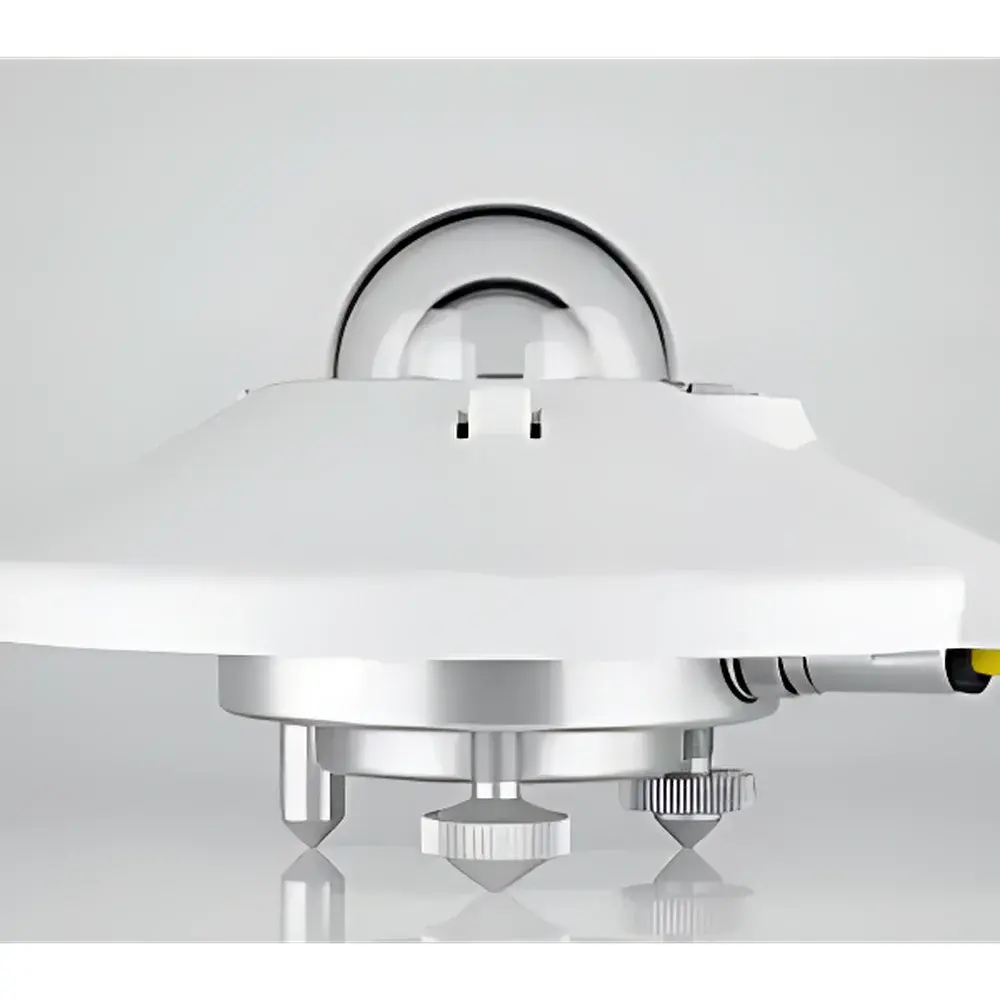
Kipp & Zonen SMP10 Secondary Standard Pyranometer
| Brand | Kipp & Zonen |
|---|---|
| Origin | Netherlands |
| Model | SMP10 |
| Spectral Range | 285–2800 nm |
| Response Time (63%) | < 0.7 s |
| Response Time (95%) | < 2 s |
| Zero Offset A | < 7 W/m² |
| Zero Offset B | < 2 W/m² |
| Directional Error (up to 80°, 1000 W/m² beam) | < 10 W/m² |
| Temperature Dependence of Sensitivity (−40 °C to +70 °C) | < 0.3 %/°C |
| Analog Output (-V version) | 0–1 V |
| Analog Output (-A version) | 4–20 mA |
| Digital Output | 2-wire RS-485 Modbus® |
| Operating Voltage | 5–30 VDC |
| Integrated Desiccant Cartridge Lifetime | ≥10 years (sealed operation) |
Overview
The Kipp & Zonen SMP10 is a secondary standard pyranometer engineered for high-accuracy, long-term solar irradiance measurement under demanding outdoor conditions. It operates on the thermopile principle: incident broadband solar radiation heats a blackened thermopile sensor, generating a voltage proportional to the irradiance (W/m²) across its spectral response range of 285–2800 nm—encompassing the full photosynthetically active radiation (PAR) band and the majority of the solar spectrum reaching Earth’s surface. Designed to meet ISO 9060:2018 classification requirements for secondary standard instruments, the SMP10 delivers traceable, stable, and spectrally flat responsivity suitable for reference-grade monitoring in meteorological networks, solar resource assessment, PV performance testing, and climate research stations.
Key Features
- Hermetically sealed desiccant cartridge: Integrated dry box eliminates routine dome drying or internal humidity checks; maintains optical clarity and calibration stability for ≥10 years without opening the instrument housing.
- Modbus® RTU over 2-wire RS-485: Enables digital communication with SCADA systems, data loggers, and IoT-enabled weather stations; supports multi-drop configurations and remote diagnostics.
- Temperature-compensated analog outputs: Both 0–1 V (-V) and 4–20 mA (-A) variants include real-time temperature correction algorithms embedded in the signal conditioning circuitry, minimizing thermal drift across −40 °C to +70 °C ambient operating range.
- Wide DC supply tolerance (5–30 VDC): Simplifies integration into existing solar monitoring infrastructure, battery-backed systems, and low-power telemetry platforms without external regulators.
- Robust electrical protection: Built-in safeguards against reverse polarity, transient overvoltage (per IEC 61000-4-5), and output short-circuit ensure operational resilience in unattended field deployments.
- CVF4 ventilation compatibility: Optional active ventilation unit reduces dew, frost, and dust accumulation on the quartz dome, extending cleaning intervals and improving measurement continuity—particularly critical in high-humidity, arid-dust, or cold-climate environments.
Sample Compatibility & Compliance
The SMP10 is designed for continuous, unattended measurement of global horizontal irradiance (GHI) on a leveled, fixed mounting platform. Its directional error (< 10 W/m² at 80° zenith angle and 1000 W/m² beam intensity) and low zero-offset characteristics (A < 7 W/m², B < 2 W/m²) ensure compliance with WMO Guide to Meteorological Instruments and Methods of Observation (CIMO Guide) Chapter 7 and ISO 9060:2018 secondary standard specifications. The instrument’s mechanical design conforms to IEC 61724-1:2021 for photovoltaic system performance monitoring and supports traceability to World Radiometric Reference (WRR) via accredited calibration laboratories. No sample preparation or consumables are required—only periodic visual inspection and optional dome cleaning per site-specific soiling conditions.
Software & Data Management
Digital output follows the open Modbus® RTU protocol, enabling seamless integration with industry-standard data acquisition software (e.g., Campbell Scientific LoggerNet, HOBOware Pro, Meteologger, or custom Python/Node-RED implementations). Firmware supports configurable sampling intervals, linear scaling factors, and diagnostic registers (e.g., internal temperature, supply voltage, desiccant status flag). All analog and digital outputs are synchronized and temperature-corrected in hardware—eliminating post-processing corrections. Audit-ready data logs comply with GLP-aligned metadata tagging when paired with time-synchronized dataloggers supporting NTP or GPS timestamping. While the SMP10 itself does not store data, its deterministic response and consistent sensitivity allow direct substitution during recalibration without reconfiguration—reducing downtime in networked observatories.
Applications
- Solar energy resource assessment for utility-scale PV plant feasibility studies and yield modeling
- Reference irradiance measurement in IEC 61215 / UL 61215-compliant PV module testing laboratories
- Long-term climate monitoring networks requiring WMO-compliant GHI records
- Calibration transfer between primary standards (e.g., PMO-6, CHP1) and field-deployed instruments
- Albedo and net radiation studies when deployed in upward/downward pairs
- Smart agriculture microclimate stations requiring high-stability solar input data
FAQ
What calibration standard is the SMP10 traceable to?
The SMP10 is calibrated traceable to the World Radiometric Reference (WRR) maintained by the Physikalisch-Meteorologisches Observatorium Davos (PMOD/WRC), Switzerland.
Can the SMP10 be used indoors or under artificial light sources?
It is optimized for natural broadband solar radiation; spectral mismatch may occur under non-solar spectra (e.g., LED, halogen, or fluorescent lighting), limiting accuracy outside its specified 285–2800 nm range.
Is the desiccant cartridge user-replaceable?
No—the desiccant is factory-sealed and not intended for end-user replacement; the ≥10-year service life assumes nominal environmental exposure per IEC 60721-3-4 Class 4K4.
Does the SMP10 require leveling for accurate measurements?
Yes—precise horizontal alignment using an integrated bubble level is mandatory to minimize cosine response errors; tilt >1° introduces measurable deviation in GHI quantification.
How does the CVF4 ventilation unit affect power consumption?
The CVF4 draws ≤1.2 W at 12 VDC and operates independently of the SMP10’s internal electronics; its control logic can be synchronized via external TTL trigger or scheduled via compatible datalogger firmware.
Related Products







