
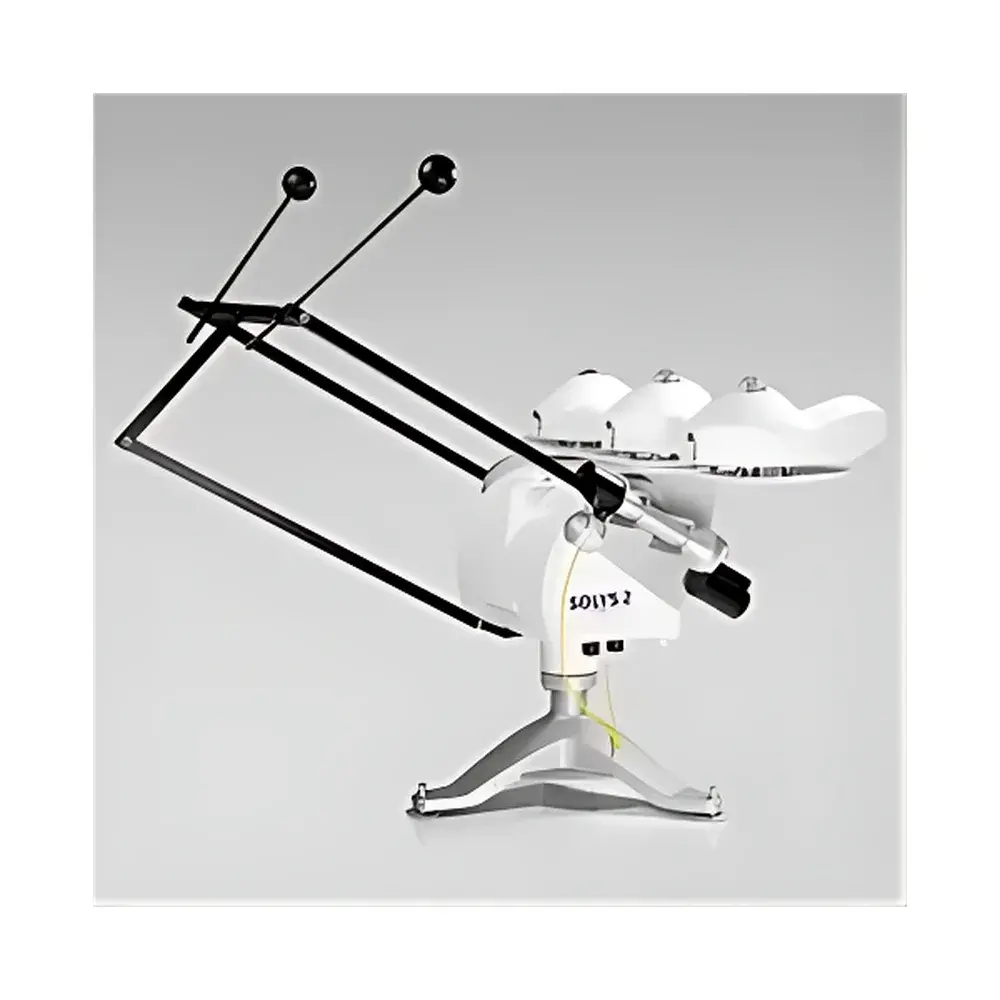
Kipp & Zonen SOLYS2 Solar Tracker
| Brand | Kipp & Zonen |
|---|---|
| Origin | Netherlands |
| Model | SOLYS2 |
| Tracking Accuracy | < 0.1° (passive) / < 0.02° (active with optional sun sensor) |
| Payload Capacity | 20 kg |
| Power Supply | 18–30 VDC or 90–264 VAC (50/60 Hz) |
| Operating Temperature | −20 to +50 °C (DC) / −40 to +50 °C (AC) |
| Enclosure Material | Cast aluminum with textured finish |
| Mounting | Integrated tripod base with leveling feet, azimuth adjustment, and bubble level |
| Communication Interface | Ethernet/Web interface |
| Drive Mechanism | Inverted-tooth belt drive |
| Power Consumption | 21 W (normal), 13 W (night), 100 W (with heater enabled, AC only) |
| Dimensions (tracker) | 50 × 34 × 38 cm |
| Weight (tracker) | 23 kg |
| Weight (tripod) | 5 kg |
| GPS Integration | Yes, auto-configures latitude, longitude, and UTC time |
| Software | Open-source firmware |
| Compliance | BSRN-compliant, designed for ISO 9072-1, ASTM G167, and IEC 61724-1 solar monitoring applications |
Overview
The Kipp & Zonen SOLYS2 Solar Tracker is a precision-engineered, field-deployable instrument designed for continuous, high-accuracy solar pointing in radiometric and meteorological applications. It operates on the principle of astronomical ephemeris-based tracking—calculating real-time solar position using embedded GPS-derived geolocation and UTC time—and delivers passive tracking accuracy better than ±0.1° across its full operational envelope. When paired with the optional active sun sensor, the system achieves closed-loop correction with sub-arcminute precision (< ±0.02°), compensating for mechanical drift, thermal expansion, or minor structural settling in long-term installations. Engineered to meet the stringent requirements of the Baseline Surface Radiation Network (BSRN), the SOLYS2 serves as the mechanical backbone for direct normal irradiance (DNI) measurements using pyrheliometers such as the CHP1, and supports co-located broadband and spectral radiometers. Its open-source firmware architecture enables transparent validation, third-party integration, and audit-ready configuration control—critical for GLP-compliant solar resource assessment and climate monitoring programs.
Key Features
- Integrated GPS receiver for automatic geolocation and time synchronization—eliminates manual coordinate entry and prevents clock drift
- Built-in bubble level and azimuth-adjustable tripod base for rapid, tool-free leveling and orientation alignment
- Robust cast-aluminum housing with textured surface finish for enhanced UV resistance and thermal stability
- Dual-power capability: compatible with both 18–30 VDC and 90–264 VAC inputs, enabling flexible deployment in grid-connected or off-grid sites
- Low-power nighttime operation (13 W) and intelligent heater control (100 W, AC-only) for frost mitigation in cold climates
- Inverted-tooth belt drive mechanism ensures smooth, backlash-free motion and long-term repeatability without lubrication
- Web-enabled Ethernet interface supporting remote diagnostics, firmware updates, and real-time status telemetry (solar zenith/azimuth, GPS lock status, internal temperature)
Sample Compatibility & Compliance
The SOLYS2 is optimized for mounting up to three ventilated Kipp & Zonen radiometers—including CHP1 pyrheliometers, CMP series pyranometers, and CHM 15k cloud height meters—via standardized top-mounting plates and shading assemblies. All mechanical interfaces comply with ISO 9072-1 (solar tracking systems) and support traceable installation per IEC 61724-1 (photovoltaic system performance monitoring). The tracker’s passive pointing accuracy satisfies BSRN Tier-1 requirements for DNI uncertainty budgets, while its active mode meets the tighter tolerances recommended for high-resolution solar spectral studies. Electromagnetic compatibility (EMC) is certified to IEC 61000-6-2/6-3 standards, and surge immunity conforms to IEC 61000-4-5 Level 3. No proprietary software dependencies exist—configuration and logging are accessible via standard HTTP/HTTPS and Modbus TCP protocols.
Software & Data Management
The SOLYS2 runs on open-source firmware developed and maintained by Kipp & Zonen, with full source code available under a permissive license for academic and regulatory review. Configuration is performed exclusively through an embedded web server—no host PC or vendor-specific software is required. Users can access live telemetry, adjust tracking parameters (e.g., sun avoidance angles, start/stop times), download binary log files (CSV-compatible), and upload signed firmware updates via HTTPS. Audit trails—including timestamped configuration changes, GPS fix history, and heater activation logs—are retained onboard and exportable for 21 CFR Part 11–aligned quality systems. Optional integration with third-party SCADA platforms is supported via Modbus TCP over Ethernet.
Applications
- Direct Normal Irradiance (DNI) measurement in solar resource assessment for CSP and PV power plant feasibility studies
- Long-term climate monitoring within BSRN, GCOS, and national meteorological networks
- Calibration reference stations for secondary standard radiometers and field sensor intercomparisons
- Atmospheric science campaigns requiring synchronized multi-instrument solar tracking (e.g., aerosol optical depth, water vapor column retrieval)
- Research-grade solar spectral irradiance measurements using spectroradiometers and filter radiometers
- Automated sky imaging and cloud classification systems requiring precise solar vector input
FAQ
Does the SOLYS2 require a computer for initial setup?
No—geolocation, time, and tracking parameters are auto-configured via integrated GPS; all further configuration is performed through its built-in web interface.
Can the SOLYS2 operate unattended in extreme cold?
Yes—when powered by AC, its internal heater extends operational capability to −40 °C; for sustained sub-zero deployment, use with a certified cold-weather enclosure (optional accessory).
What is the maximum payload capacity?
The SOLYS2 supports up to 20 kg distributed load, including instruments, ventilation units, and shading assemblies.
Is firmware update functionality accessible remotely?
Yes—signed firmware binaries can be uploaded via HTTPS; version history and integrity checks are enforced at boot time.
How is tracking accuracy verified in the field?
A built-in diagnostic mode outputs raw encoder positions and calculated solar vectors; comparison against NREL’s SOLPOS algorithm or NOAA’s SPA provides traceable validation.







