
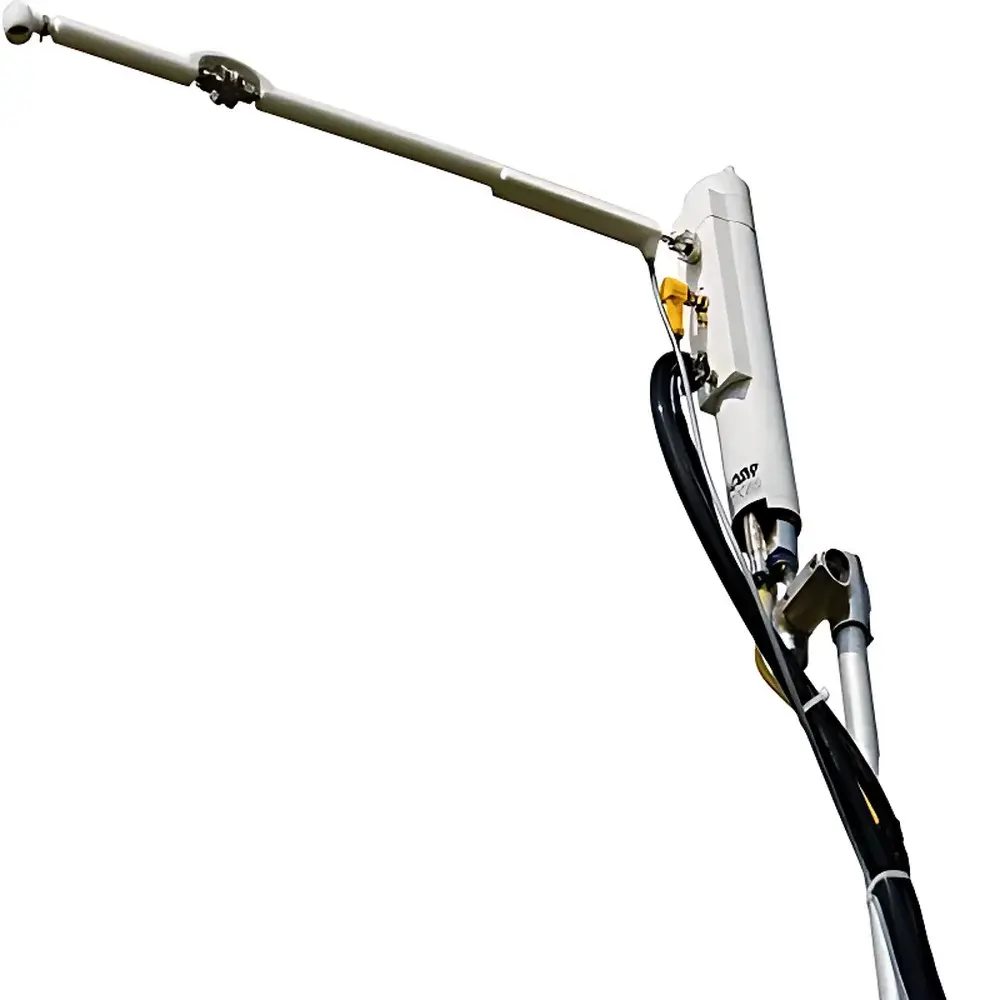
LI-COR LI-7200RS Closed-Path CO₂/H₂O Smart Analyzer System
| Brand | LI-COR |
|---|---|
| Origin | USA |
| Model | LI-7200RS |
| Measurement Principle | Non-Dispersive Infrared (NDIR) Spectroscopy with Thermopile-Cooled PbSe Detectors |
| CO₂ Range | 0–3000 µmol/mol |
| H₂O Range | 0–60 mmol/mol |
| Accuracy | <1% for CO₂, <2% for H₂O |
| Zero Drift (CO₂) | ±0.1 µmol/mol/°C (typ.), ±0.3 µmol/mol/°C (max.) |
| Zero Drift (H₂O) | ±0.03 mmol/mol/°C (typ.), ±0.05 mmol/mol/°C (max.) |
| RMS Noise @5 Hz | 0.08 µmol/mol (CO₂), 0.0034 mmol/mol (H₂O) |
| Bandwidth Options | 5, 10, or 20 Hz |
| Operating Temperature | −25 to +50 °C (extended: −40 to +50 °C) |
| Power | 10.5–30 VDC |
| Data Storage | 16 GB industrial-grade USB flash drive |
| Communication | Ethernet, SDM (>50 Hz), RS-232 (115.2 kbps, ≤20 Hz), 6 DACs (0–5 V, 300 Hz) |
| Analog Inputs | 4 differential, bipolar ±5 V, 300 Hz |
| Detector | Thermoelectrically cooled PbSe photodetector |
| Probe Dimensions | Ø7.5 cm × 31 cm |
| Weight | 1.8 kg |
| Interface Unit (LI-7550) | 35 × 30 × 15 cm |
| Flow Module (7200-101) | 15 LPM, 35 × 30 × 15 cm, 6.15 kg, <16 W |
| Heated/Anti-Condensation Inlet Tube | 71.1 cm length, ID 5.33 mm, OD 6.35 mm, −40 to +50 °C, 0.1–6 W |
| Insulated Inlet Tube | up to 1 m, same ID/OD |
| Auxiliary Sensor (7550-101) | 11.5 × 6.5 × 4.2 cm, 0.39 kg |
| Compliance | Designed for GLP/GMP-aligned eddy covariance deployments |
Overview
The LI-COR LI-7200RS Closed-Path CO₂/H₂O Smart Analyzer System is an engineered solution for high-frequency, long-term eddy covariance flux measurements in atmospheric science and ecosystem research. Unlike conventional open-path analyzers, the LI-7200RS employs a closed-path configuration based on dual-beam, non-dispersive infrared (NDIR) spectroscopy—utilizing thermoelectrically cooled PbSe detectors and precisely temperature-stabilized optical filters—to deliver absolute, drift-free quantification of carbon dioxide and water vapor concentrations at rates up to 20 Hz. Its design bridges the operational robustness of closed-path systems with the spatial representativeness advantages traditionally associated with open-path configurations. By integrating the analyzer probe directly with an ultrasonic anemometer via a short, heated or insulated inlet tube, the system minimizes flow-induced turbulence and instrument-induced flow distortion—critical for maintaining spectral integrity in turbulent flux calculations. The LI-7200RS is purpose-built for deployment across climatically diverse sites, including boreal forests, alpine tundra, agricultural fields, and coastal wetlands, where precipitation, fog, snow, and sub-zero temperatures routinely challenge measurement continuity.
Key Features
- Weather-resilient closed-path architecture: Eliminates optical window fouling and condensation artifacts common in open-path systems—enabling uninterrupted operation during rain, snow, fog, and high-humidity conditions.
- Thermally regulated optical subsystem: Detector and interference filter temperatures are actively controlled to suppress thermal drift, ensuring zero and gain stability over diurnal and seasonal temperature gradients.
- Modular inlet configuration: Supports both insulated and electrically heated inlet tubes (71.1 cm standard; custom lengths available), with precise thermal management to prevent water vapor condensation and maintain laminar flow dynamics.
- Integrated SMARTFlux® processing engine: Embedded real-time eddy covariance computation replicates EddyPro® software output—including coordinate rotation, Webb-Pearman-Leuning (WPL) corrections, and flux partitioning—directly at the field site without requiring post-processing.
- Industrial-grade data handling: 16 GB removable USB storage with timestamped binary logging; dual communication pathways (Ethernet + SDM) enable synchronized acquisition with ultrasonic anemometers (e.g., Gill WindSonic, Campbell CSAT3) and auxiliary meteorological sensors.
- Low-power, wide-voltage operation: Compatible with solar-battery power systems (10.5–30 VDC); nominal 12 W consumption allows multi-day autonomy in remote installations.
Sample Compatibility & Compliance
The LI-7200RS accepts sampled air from ambient or canopy-level intakes via stainless-steel or fluoropolymer tubing (ID 5.33 mm). Its closed-path design ensures compatibility with trace gas standards certified per ISO 6141 and NIST-traceable calibration gases. All analog inputs support differential, bipolar signal conditioning per IEC 61000-4-5, enabling direct interfacing with soil moisture, net radiation, and PAR sensors compliant with ASTM E892 and ISO 9060. The system meets environmental operating specifications outlined in IEC 60529 (IP54 enclosure rating for LI-7550 interface unit) and supports audit-ready data workflows aligned with GLP and GMP principles. When deployed with FluxSuite® cloud platform and EddyPro® v8+, raw data streams include embedded metadata tags, digital signatures, and full change logs—facilitating compliance with FDA 21 CFR Part 11 requirements for electronic records and signatures in regulated environmental monitoring.
Software & Data Management
Data acquisition, real-time processing, and remote diagnostics are managed through LI-COR’s FluxSuite® web-based platform, which provides secure TLS 1.2–encrypted access to live sensor status, diagnostic logs, and SMARTFlux®-computed flux time series. Raw high-speed data (up to 20 Hz) are stored in LI-COR’s proprietary .7200 binary format—fully compatible with EddyPro® for offline quality control, gap-filling, and uncertainty propagation analysis. The LI-7550 interface unit includes six programmable DAC outputs for actuating external devices (e.g., valve manifolds, pump controllers) and four analog input channels calibrated to ±0.1% FS accuracy. Firmware updates are delivered over-the-air via Ethernet, with version-controlled rollback capability. All data exports adhere to CF Metadata Conventions v1.8 and comply with ICOS (Integrated Carbon Observation System) and AmeriFlux Level 1–4 data submission standards.
Applications
- Ecosystem-scale carbon and water flux quantification across FLUXNET, ICOS, and NEON observatory networks.
- Long-term validation of satellite-derived evapotranspiration and gross primary production (GPP) products (e.g., MODIS, Sentinel-3).
- Soil-atmosphere exchange studies involving chamber-based and gradient methods—enabled by optional flow module (7200-101) and auxiliary sensor integration.
- Urban micrometeorology and green infrastructure performance assessment under variable precipitation regimes.
- Climate change impact modeling requiring multi-decadal, gap-free CO₂/H₂O time series with documented uncertainty budgets.
- Regulatory air quality monitoring where continuous, NDIR-validated speciation of greenhouse gases supports Tier 3 IPCC reporting protocols.
FAQ
How does the LI-7200RS differ from the LI-7500RS open-path analyzer?
The LI-7200RS uses a closed-path configuration with pumped sampling, eliminating sensitivity to precipitation, dust, and window contamination—making it suitable for high-humidity or winter deployments where the LI-7500RS may experience data loss.
Can the LI-7200RS be used for soil gas flux measurements?
Yes—when paired with the 7200-101 flow module and appropriate soil chambers or gradient probes, it supports automated soil CO₂ and H₂O efflux quantification with temperature-compensated flow control.
Is SMARTFlux® processing validated against EddyPro®?
Yes—LI-COR provides documented intercomparison reports demonstrating <0.5% mean absolute difference in latent and sensible heat fluxes between SMARTFlux® real-time outputs and identical EddyPro® offline processing of the same raw dataset.
What maintenance intervals are recommended for unattended operation?
Under typical field conditions, optical alignment and detector calibration are stable for ≥12 months; annual verification using certified span gases and zero air is recommended per ISO 17025-compliant QA/QC protocols.
Does the system support synchronization with third-party ultrasonic anemometers?
Yes—via SDM protocol (≥50 Hz) or TTL pulse triggering; timing jitter is <10 µs, meeting AmeriFlux synchronization requirements for spectral coherence analysis.







