
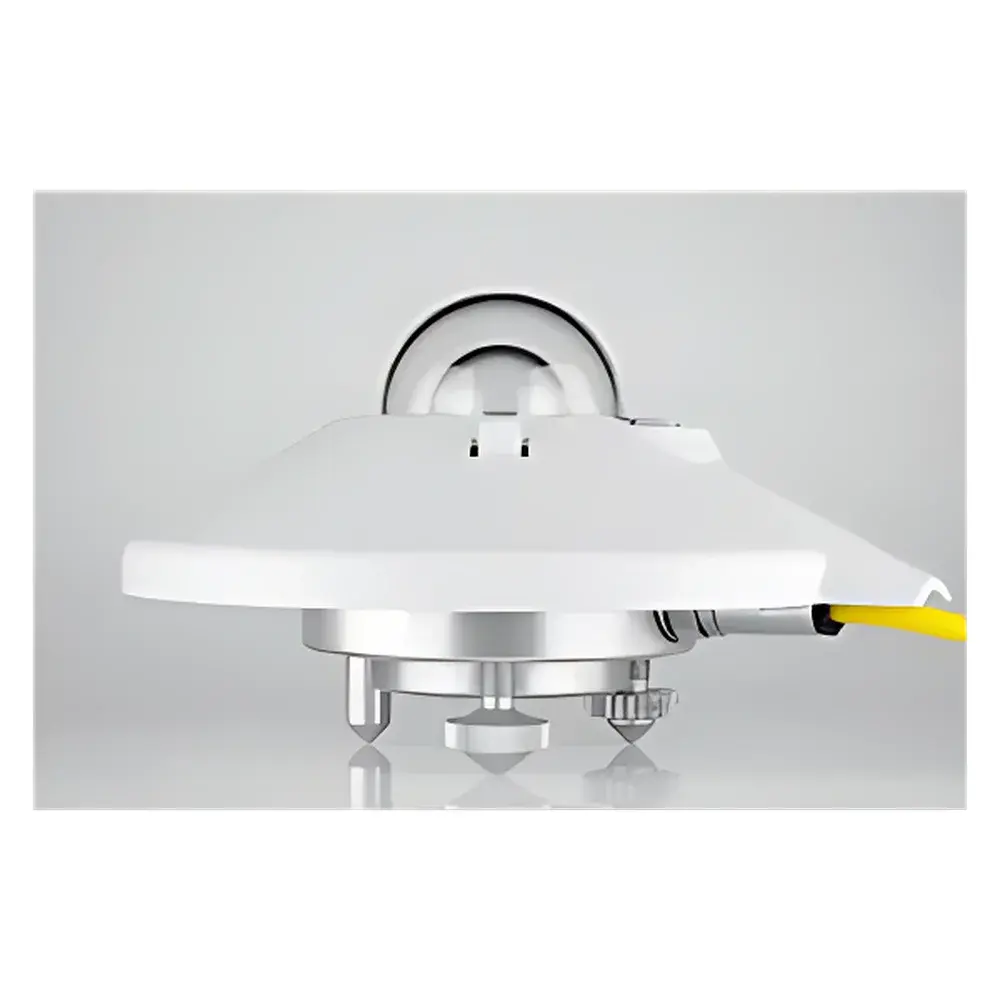
Kipp & Zonen CUV5 Broadband UV Radiometer
| Brand | Kipp & Zonen |
|---|---|
| Origin | Netherlands |
| Model | CUV5 |
| Spectral Range | 280–400 nm |
| Sensitivity | 300–500 µV/(W/m²) |
| Temperature Response | < −0.3 °C |
| Response Time | < 1 s |
| Non-linearity Error | < 1 % |
| Max Solar Irradiance | 400 W/m² |
| Operating Temperature | −40 to +80 °C |
| Directional Error (up to 80°, 1000 W/m² beam) | < 5 W/m² |
| Field of View | 180° |
Overview
The Kipp & Zonen CUV5 Broadband UV Radiometer is a precision-calibrated, thermally compensated instrument engineered for continuous, high-reliability measurement of total solar ultraviolet (UV) irradiance across the biologically relevant 280–400 nm spectral band. Based on the physical principle of photodiode-based radiometry with cosine-corrected optical input, the CUV5 employs a high-transmission quartz dome and optimized diffuser to achieve near-ideal angular response—critical for accurate hemispherical UV flux quantification under variable solar zenith angles. Unlike narrowband or spectral instruments, the CUV5 delivers integrated UVA + UVB irradiance (W/m²), making it suitable for applications where broadband UV exposure assessment—not spectrally resolved characterization—is required. Its design adheres to fundamental radiometric traceability principles aligned with ISO/IEC 17025-accredited calibration practices and supports long-term stability monitoring per WMO Guide to Instruments and Methods of Observation (CIMO Guide, Chapter 9).
Key Features
- Optimized cosine response via precision-ground quartz dome and scattering element, minimizing directional error to < 5 W/m² at 80° incidence under 1000 W/m² beam irradiance
- Thermally compensated photodiode detector with temperature coefficient < −0.3 °C, ensuring minimal drift across operational extremes (−40 to +80 °C)
- Fast electrical response time (< 1 s to 95% of final value) and low non-linearity (< 1 %) over full dynamic range
- IP67-rated waterproof connector system with snap-fit sun shield, integrating a built-in bubble level for precise horizontal alignment
- Threaded desiccant chamber with replaceable silica gel cartridge, enabling routine moisture control without disassembly of optical housing
- Calibration traceable to the World Radiometric Reference (WRR) via Kipp & Zonen’s ISO/IEC 17025-accredited laboratory
Sample Compatibility & Compliance
The CUV5 is compatible with standard meteorological mounting hardware (e.g., solar tracker arms, fixed tilt plates) and integrates seamlessly into automated weather stations, solar resource assessment arrays, and accelerated aging test chambers. It complies with key international standards governing UV measurement practice, including ISO 9060:2018 (spectral classification of solar radiometers), IEC 61724-1:2021 (photovoltaic system performance monitoring), and ASTM G177-22 (standard tables for spectral distribution of terrestrial sunlight). While not certified for medical or regulatory UV index reporting (a function reserved for UVE-specific instruments like the SUV-E), the CUV5 meets the technical requirements for environmental UV exposure monitoring in accordance with GLP-aligned field data collection protocols.
Software & Data Management
The CUV5 outputs a linear analog voltage signal proportional to incident UV irradiance (µV per W/m²), requiring external signal conditioning and digitization. For system integration, it is commonly paired with Kipp & Zonen’s SmartExplorer™ Windows software (supplied separately) when used alongside compatible data loggers supporting voltage input scaling and temperature compensation. Although the CUV5 itself lacks digital communication interfaces (unlike the Modbus®-enabled SUV series), its analog output is compatible with industry-standard SCADA systems, PLCs, and Campbell Scientific CR-series loggers—enabling timestamped, temperature-corrected UV time-series storage compliant with 21 CFR Part 11 audit trail requirements when deployed with validated acquisition firmware.
Applications
- Meteorological networks measuring long-term UV climatology and ozone-related irradiance trends
- Material science laboratories evaluating UV degradation kinetics of polymers, coatings, and textiles in solar simulation chambers
- Photobiology studies assessing cumulative UV dose in controlled environment growth facilities
- Solar thermal and PV testing labs monitoring UV contribution to panel encapsulant aging and backsheet yellowing
- Environmental health monitoring for occupational UV exposure assessment near industrial UV sources (e.g., curing lamps, disinfection arrays)
- Educational instrumentation for atmospheric physics and renewable energy curricula
FAQ
Is the CUV5 suitable for calculating the UV Index (UVI)?
No. The CUV5 measures total broadband UV (280–400 nm) irradiance but does not apply the CIE-defined erythemal action spectrum. For UVI calculation, use the SUV-E model calibrated per ISO 17166:1999 and CIE S 007/E-1999.
Can the CUV5 distinguish between UVA and UVB components?
No. It provides a single integrated output for the entire 280–400 nm range. For spectrally resolved UVA (315–400 nm) or UVB (280–315 nm) measurements, select the SUV-A or SUV-B models.
Does the CUV5 require periodic recalibration?
Yes. Kipp & Zonen recommends recalibration every two years under normal field use, or annually in high-irradiance or corrosive environments, to maintain traceable accuracy within stated specifications.
What mounting accessories are recommended?
A leveled mounting plate with adjustable tilt angle and a passive sun tracker (e.g., SOLYS 2) are strongly advised to minimize cosine error; optional ventilation units may be added in high-temperature desert deployments.
Is the CUV5 compatible with third-party data loggers?
Yes—provided the logger supports high-impedance voltage input (≥ 1 MΩ), programmable scaling, and optional temperature compensation using an external Pt100 sensor.







