
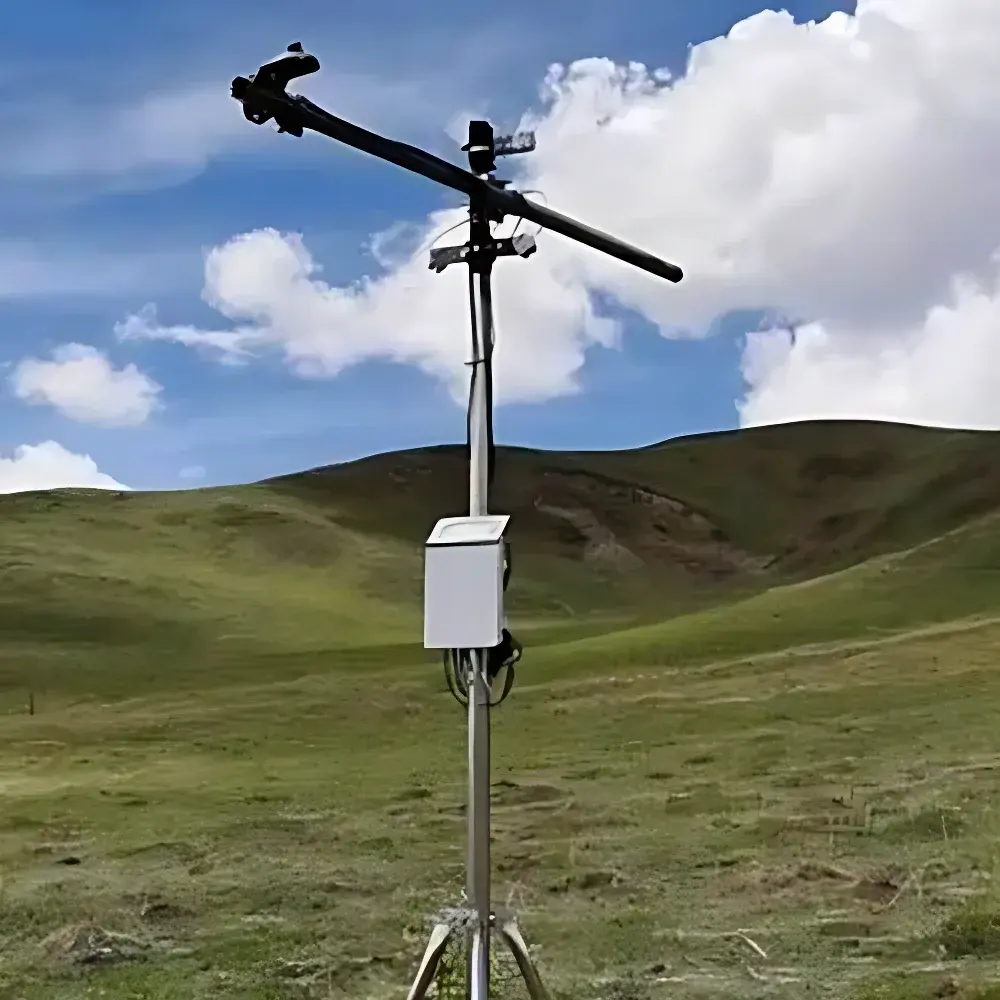
METER ZL6 Micro-Meteorological Monitoring System
| Brand | METER |
|---|---|
| Origin | USA |
| Manufacturer Type | Authorized Distributor |
| Product Category | Imported Instrument |
| Model | ZL6 Micro-Meteorological Monitoring System |
| Instrument Type | Portable Weather Station |
| Power | Integrated Solar Panel + NiMH Rechargeable Battery (3+ years life) or AA Alkaline Batteries (3–12 months) |
| Sensor Interfaces | 6 universal analog/digital ports |
| Expandable Sensors | 29 compatible sensor models |
| Data Storage Capacity | 40,000–80,000+ records (configurable) |
| Connectivity | Embedded GSM module (2G/3G fallback), ZENTRA Cloud integration |
| Enclosure | IP68-rated, UV-stabilized, radiation-shielded housing |
| Deployment | Plug-and-play sensor interface, no programming required |
| Compliance | Designed for GLP-aligned environmental field studies |
Overview
The METER ZL6 Micro-Meteorological Monitoring System is a compact, solar-powered, edge-deployed environmental observation platform engineered for high-fidelity microclimate characterization across heterogeneous terrestrial ecosystems. Unlike conventional synoptic weather stations, the ZL6 is purpose-built to resolve spatially localized atmospheric and surface–atmosphere exchange processes—such as sensible heat flux, latent heat exchange, canopy turbulence, and soil–atmosphere water vapor gradients—at scales ranging from centimeters to tens of meters. Its core architecture centers on the ZL6 Cloud Data Logger, a low-power, embedded IoT device compliant with IEC 61000-6-2/4 electromagnetic immunity standards and rated for continuous operation in ambient temperatures from –25 °C to +50 °C. The system operates on the principle of distributed sensing: calibrated analog and digital sensors—each traceable to NIST-maintained reference standards—feed time-synchronized measurements into the logger’s 16-bit ADC, where raw values are converted using factory-applied polynomial coefficients and stored with UTC timestamps. This enables rigorous inter-site comparability and long-term trend analysis essential for ecological modeling, agronomic decision support, and climate adaptation research.
Key Features
- Modular sensor architecture with six universal input channels supporting analog voltage (0–5 V, ±100 mV), SDI-12, I²C, and pulse-count interfaces—enabling simultaneous acquisition from up to six independent sensor families without external multiplexers.
- Integrated dual-power system: monocrystalline solar panel (2.5 W) paired with a sealed NiMH battery pack (7.2 V, 4.5 Ah), certified for >3 years of maintenance-free field deployment under typical mid-latitude insolation; optional AA alkaline backup for short-term deployments or shaded environments.
- GSM-based telemetry with embedded SIM slot (pre-provisioned with global roaming carrier profile), transmitting encrypted CSV payloads to ZENTRA Cloud at user-defined intervals (1 min to 24 h), with automatic retransmission of missed packets upon network recovery.
- IP68-rated polycarbonate enclosure with passive radiation shielding and thermal mass stabilization—validated per ISO 7726 for consistent air temperature measurement accuracy within ±0.2 °C under full sun exposure.
- Zero-configuration plug-and-play sensor recognition: firmware auto-detects connected METER sensors (e.g., ATMOS 41, TEROS 12, ECRN-100) and loads appropriate calibration metadata, eliminating manual scaling or offset entry.
- Onboard storage capacity scalable from 40,000 to >80,000 timestamped records depending on configured sampling frequency and parameter count—retaining full-resolution data even during extended network outages.
Sample Compatibility & Compliance
The ZL6 system is validated for deployment across agricultural fields, rangelands, forest understories, alpine tundra, greenhouse interiors, and urban green infrastructure. All METER-certified sensors—including TEROS-series soil hydrometric probes, ATMOS-series atmospheric modules, and PYR/SQ-521 radiometric instruments—undergo individual factory calibration against primary standards traceable to NIST and PTB. Sensor mounting configurations adhere to WMO Guide to Meteorological Instruments and Methods of Observation (CIMO Guide, Chapter 7) for representative microscale placement. Data integrity protocols comply with FAO’s Good Practice Guidance for Land Use, Land-Use Change and Forestry (GPG-LULUCF) and support ISO 14064-2 verification workflows. ZENTRA Cloud implements role-based access control (RBAC), immutable audit logs, and 21 CFR Part 11–compliant electronic signatures for GxP-aligned studies.
Software & Data Management
ZENTRA Cloud serves as the secure, browser-accessible SaaS platform for remote configuration, visualization, and export of ZL6-derived datasets. Users log in via TLS 1.3–secured HTTPS to access real-time dashboards featuring interactive time-series plots, multi-parameter correlation matrices, and georeferenced site maps powered by integrated GPS metadata. Raw data exports are available in CSV, NetCDF4, and JSON formats—with optional inclusion of sensor-specific QA/QC flags (e.g., “battery_low”, “sensor_unplugged”, “radiation_shield_error”). Automated alerting triggers email/SMS notifications for threshold breaches (e.g., rainfall >25 mm/h, soil water potential <−1500 kPa). Version-controlled firmware updates are pushed OTA to deployed loggers. All data reside in AWS-hosted, SOC 2–certified infrastructure with daily backups and point-in-time recovery capability.
Applications
- Agricultural water use efficiency studies: coupling TEROS 12 (soil θ, T, σb) and ATMOS 41 (Ta, RH, wind, rain, PAR) to compute crop evapotranspiration (ETc) via FAO-56 Penman–Monteith.
- Forest eddy-covariance gap-filling: supplementing tower-based flux data with ZL6-derived stability metrics (Obukhov length, Richardson number) and sub-canopy radiation partitioning.
- Urban heat island mitigation trials: deploying multi-node ZL6 arrays to quantify surface cooling efficacy of green roofs, permeable pavements, and street trees.
- Soil biogeochemical monitoring: synchronizing HYDROS 21 (water level, EC, T) and SO-411 (O2) in wetland mesocosms to track redox dynamics and denitrification thresholds.
- Phenocam-integrated phenology networks: correlating PHYTOS 31 leaf wetness duration with NDVI/PRI sensor outputs to model infection risk windows for foliar pathogens.
FAQ
What communication protocols does the ZL6 support?
The ZL6 natively supports GSM (2G/3G) cellular transmission to ZENTRA Cloud. Optional LoRaWAN and Wi-Fi gateways are available for private network deployments.
Can the ZL6 operate without cloud connectivity?
Yes—the logger autonomously records and stores all sensor data locally. Cloud connectivity is required only for remote access, alerts, and automated data sync.
Is sensor calibration data stored onboard?
Yes. Each METER sensor carries an embedded EEPROM storing its unique calibration coefficients, serial number, and NIST-traceability certificate ID—automatically loaded during plug-in.
How is time synchronization maintained?
The ZL6 uses an internal temperature-compensated crystal oscillator (TCXO) with ±2 ppm accuracy and performs periodic NTP synchronization when connected to ZENTRA Cloud.
Does the system meet regulatory requirements for environmental reporting?
While not pre-certified for specific regulatory submissions, the ZL6’s traceable calibration, immutable audit trail in ZENTRA Cloud, and ISO/IEC 17025–aligned documentation package support compliance with EPA Method 100.1, ASTM D5092, and EU Regulation (EU) No 1143/2014 reporting frameworks.
Related Products







