
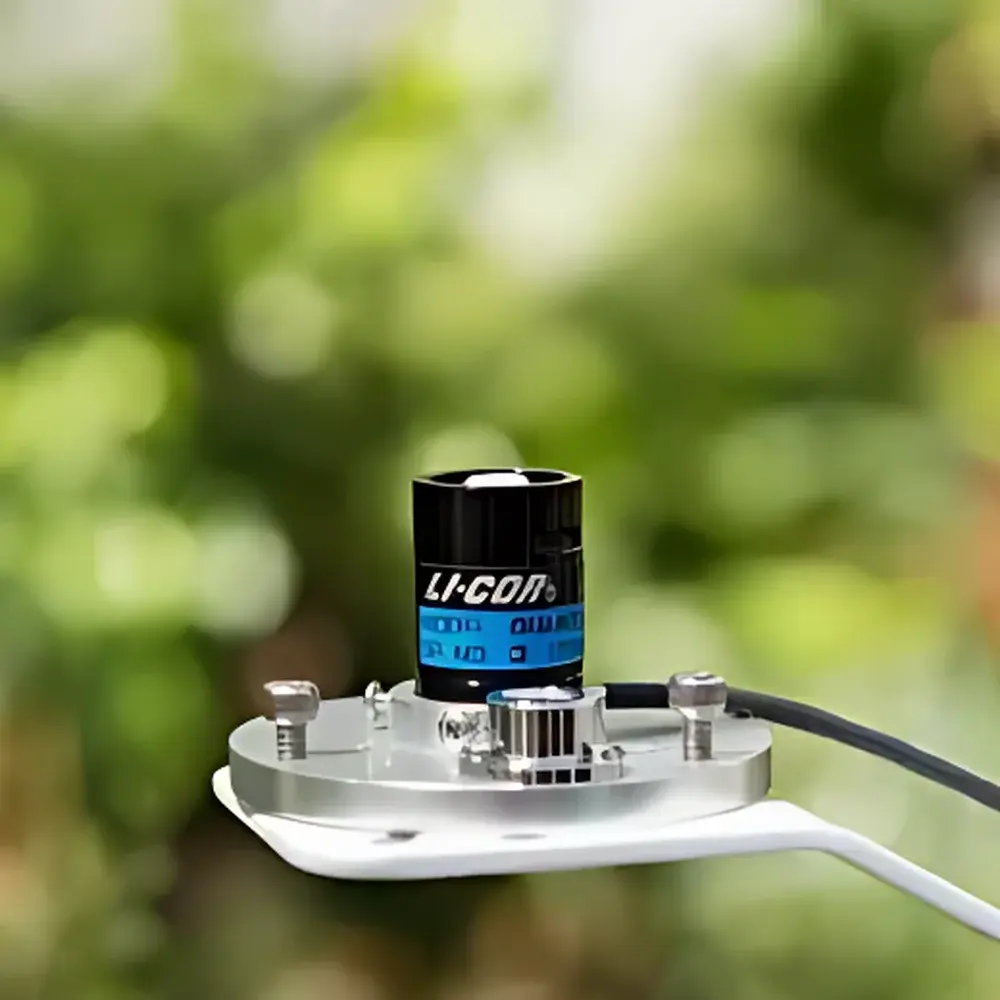
LI-COR LI-190R Quantum Sensor for Photosynthetically Active Radiation (PAR)
| Brand | LI-COR |
|---|---|
| Origin | USA |
| Model | LI-190R |
| Measurement Range | 0 to >10,000 μmol·m⁻²·s⁻¹ |
| Spectral Range | 400–700 nm |
| Calibration Uncertainty | ±5% |
| Sensitivity | 5–10 μA per 1000 μmol·m⁻²·s⁻¹ |
| Linearity Error | ≤1% up to 10,000 μmol·m⁻²·s⁻¹ |
| Response Time | <1 μs |
| Temperature Dependence | <0.15%/°C |
| Cosine Response Error | <±1% at 82° zenith angle |
| Operating Environment | −40 to +65°C, 0–100% RH (non-condensing) |
| Detector | Blue-enhanced silicon photovoltaic cell |
| Housing | Anodized aluminum with acrylic diffuser and stainless-steel mounting hardware |
| Dimensions | 2.36 cm Ø × 3.63 cm H |
| Weight | Sensor head: 24 g |
| 2 m cable with base | 60 g |
| Cable Options | 2 m, 5 m, 15 m, 50 m |
Overview
The LI-COR LI-190R Quantum Sensor is a precision-calibrated, spectrally selective instrument engineered for the accurate measurement of photosynthetically active radiation (PAR) in scientific and agricultural applications. It quantifies photon flux density within the 400–700 nm wavelength band—the spectral region most relevant to plant photosynthesis—expressed in micromoles of photons per square meter per second (μmol·m⁻²·s⁻¹). Unlike broadband radiometers or unfiltered photodiodes, the LI-190R employs a high-stability, blue-enhanced silicon photovoltaic detector coupled with a rigorously characterized glass optical filter. This filter delivers near-ideal quantum response across the PAR band while effectively suppressing infrared radiation beyond 700 nm—a critical feature for canopy-level or understory measurements where near-infrared (NIR) contribution can otherwise dominate signal output. Its thermally stable optical design ensures minimal drift under variable ambient humidity and temperature conditions, supporting long-term deployment in uncontrolled environments including open-field sites, greenhouse compartments, growth chambers, and forest understories.
Key Features
- Optimized spectral response: High-fidelity 400–700 nm quantum efficiency closely matching the CIE-defined photosynthetic action spectrum, validated against NIST-traceable standards.
- Superior cosine correction: Precision-machined acrylic diffuser and optical geometry yield <±1% deviation in irradiance response up to 82° incident angle—essential for diffuse-light conditions and low solar elevation angles.
- Thermal and environmental resilience: Operates reliably from −40°C to +65°C and 0–100% relative humidity (non-condensing); no recalibration required across seasonal or diurnal climatic shifts.
- Low-light fidelity: Maintains high signal-to-noise ratio and resolution below 10 μmol·m⁻²·s⁻¹, enabling robust determination of photosynthetic compensation points and dark respiration rates.
- Modular mechanical design: Removable sensor head facilitates field calibration verification, cleaning, and replacement without system downtime; compatible with standard mounting accessories including leveling bases and protective shrouds.
- Electrical compatibility: Outputs a linear current signal (typically 5–10 μA per 1000 μmol·m⁻²·s⁻¹), readily interfaced with LI-COR data loggers (e.g., LI-1500, LI-250A), third-party analog input modules, or custom DAQ systems via optional signal conditioners.
Sample Compatibility & Compliance
The LI-190R is validated for use under diverse light sources—including natural daylight, LED horticultural arrays, fluorescent, metal halide, and high-pressure sodium lamps—without spectral reweighting or correction factors. Its uniform quantum response eliminates the need for source-specific calibration, a requirement common to many legacy quantum sensors. The device complies with ISO 17166:2022 (E:2022) guidelines for photobiological measurement instrumentation and meets the spectral validation criteria outlined in ASTM E2912–21 for photosynthetic photon flux density (PPFD) sensors. While not intrinsically compliant with FDA 21 CFR Part 11, its traceable calibration certificate (NIST-traceable, ±5% uncertainty) and documented metrological chain support GLP/GMP-aligned environmental monitoring workflows when integrated into validated data acquisition platforms.
Software & Data Management
The LI-190R functions as an analog transducer and does not include embedded firmware or onboard storage. Data acquisition relies on external logging systems such as the LI-1500 Light Meter or LI-250A Quantum Meter, both of which provide real-time display, timestamped logging, unit conversion (e.g., μmol·m⁻²·s⁻¹ ↔ W·m⁻²), and export in CSV or XML formats. When paired with LI-COR’s PC-based Logger Pro software or third-party platforms (e.g., LabVIEW, Python-based PySerial/DAQmx), users can implement automated QA/QC routines, apply temperature compensation algorithms (using built-in thermistor outputs on select configurations), and generate audit-ready reports compliant with institutional data integrity policies. Raw current output enables integration into SCADA or IoT-enabled microclimate networks using industrial-grade signal isolators and 4–20 mA converters.
Applications
- Agricultural light-use efficiency studies: Quantifying PPFD gradients across crop canopies to inform irrigation, fertilization, and pruning strategies.
- Horticultural lighting optimization: Validating spectral output and spatial uniformity of LED grow lights in controlled-environment agriculture (CEA) facilities.
- Ecosystem flux modeling: Serving as a primary input for eddy covariance systems estimating gross primary productivity (GPP) in micrometeorological towers.
- Plant physiology research: Measuring light saturation curves, quantum yield, and non-photochemical quenching (NPQ) thresholds under controlled irradiance ramps.
- Greenhouse climate control: Feeding real-time PAR data into automated shading and supplemental lighting control logic to maintain target DLI (Daily Light Integral).
- Ecological monitoring networks: Deployed in long-term NEON, LTER, or Fluxnet observatories where sensor stability, low maintenance, and inter-site comparability are essential.
FAQ
Is the LI-190R calibrated traceable to NIST?
Yes—each sensor ships with a calibration certificate referencing NIST-traceable irradiance standards, specifying absolute uncertainty of ±5% at 25°C.
Can it be used underwater or in submerged hydroponic systems?
No—the LI-190R is rated for outdoor exposure but is not submersible; its O-ring seal prevents moisture ingress only under atmospheric conditions.
Does it require periodic recalibration?
LI-COR recommends annual recalibration for research-grade accuracy; however, field stability data indicate <±2% drift over 24 months under typical outdoor deployment conditions.
How does it differ from the older LI-190SA model?
The LI-190R features an updated optical filter with improved IR rejection (>99.9% at 750 nm), enhanced thermal stability (<0.15%/°C vs. 0.2%/°C), and tighter cosine response tolerance, particularly at oblique incidence angles.
Is there a digital-output version available?
No—LI-190R is strictly analog (current output); for digital interface, pair with LI-250A or use external ADC modules compatible with 0–25 mV or 4–20 mA signal conditioning options.
Related Products





