
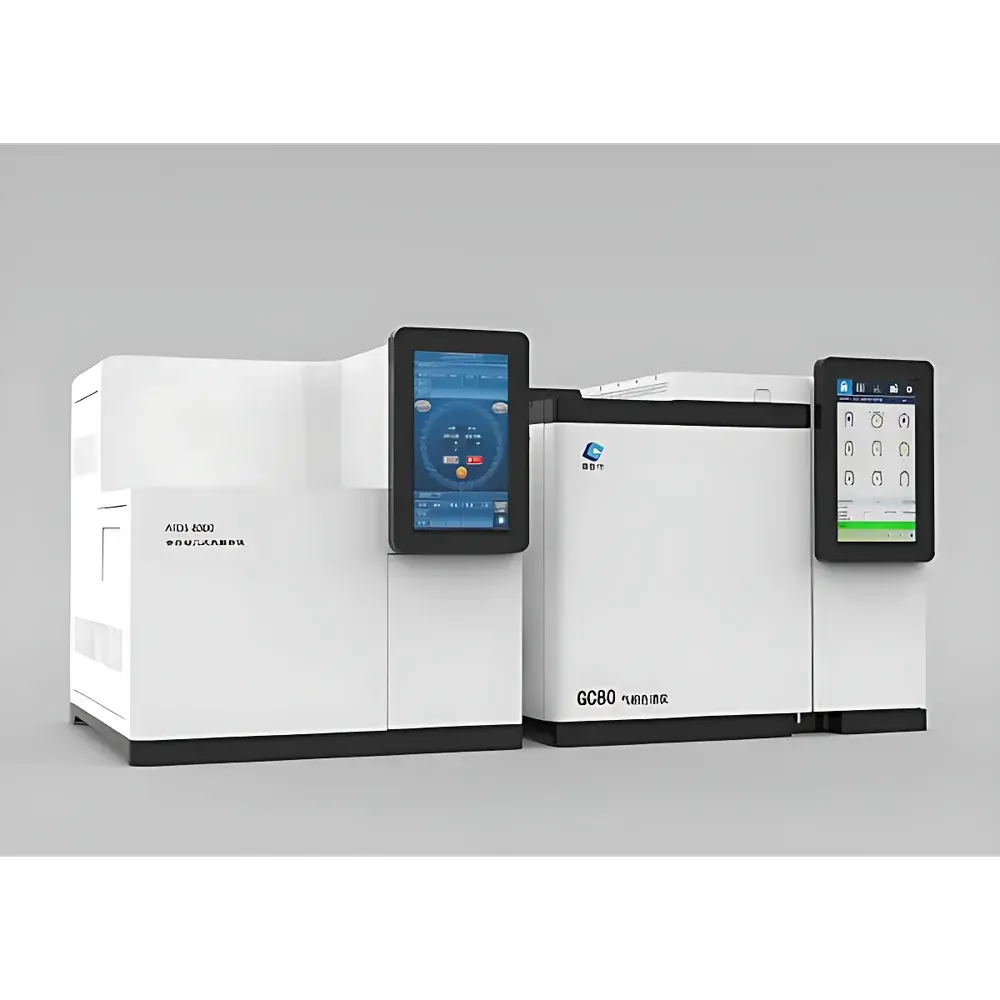
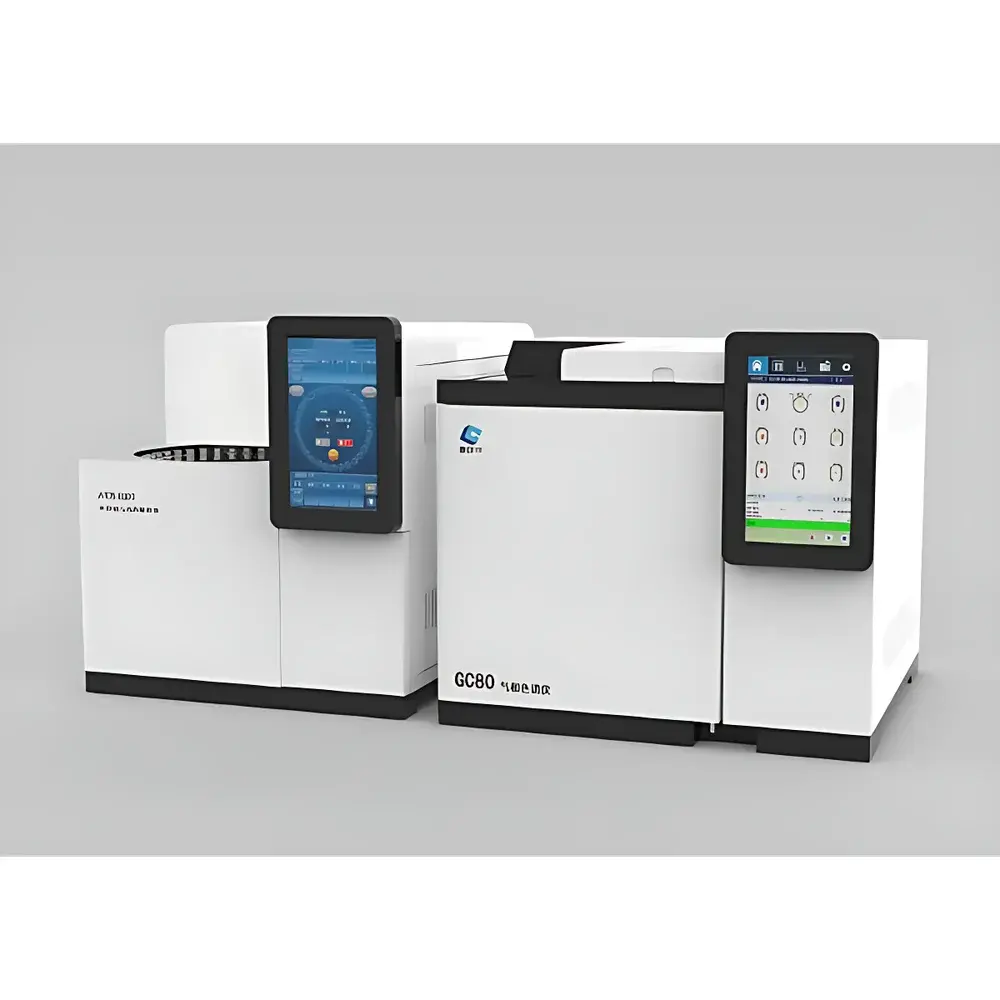
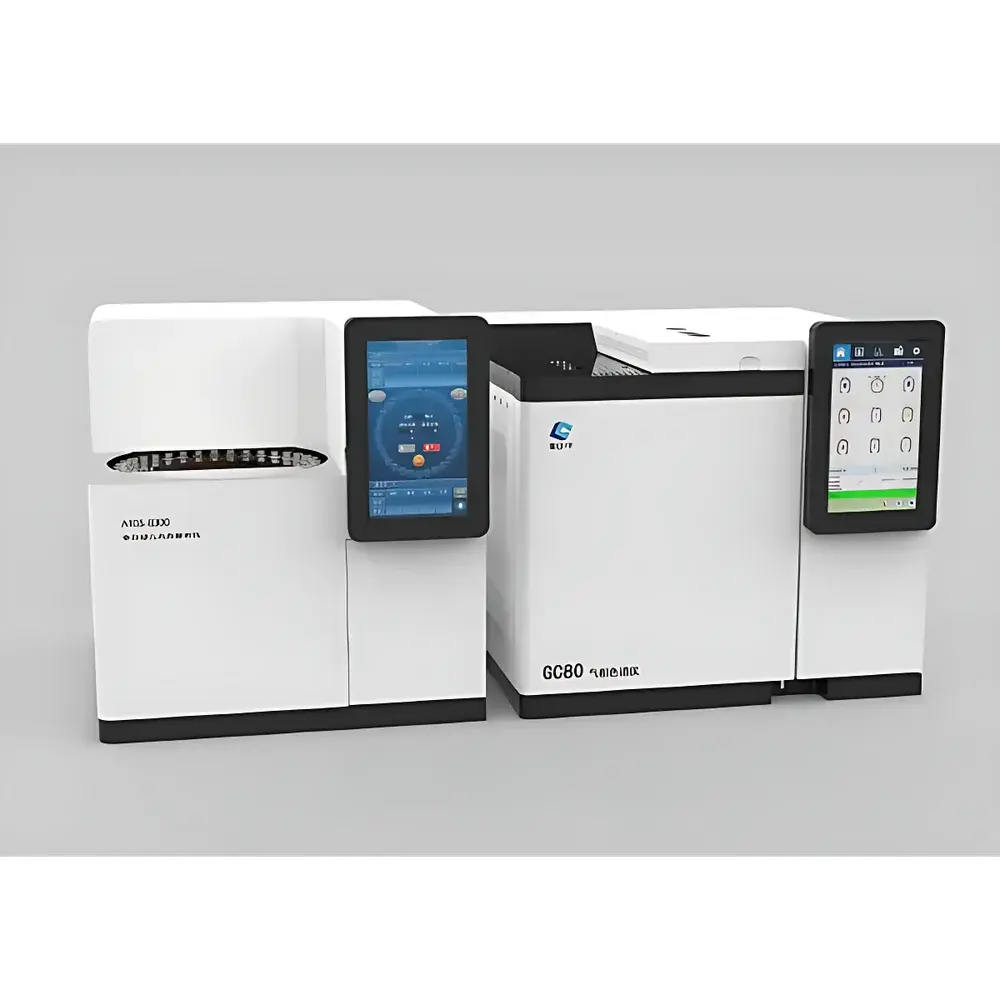
Luchuang GC-9870T Advanced Laboratory Gas Chromatograph
| Brand | Luchuang |
|---|---|
| Origin | Shandong, China |
| Manufacturer Type | OEM Manufacturer |
| Instrument Type | Laboratory Gas Chromatograph |
| Model | GC-9870T |
| Temperature Control Range | Ambient + 6°C to 399°C |
| Ramp Rate | 0.1–40°C/min |
| Cooling Time | ~6 min (300°C to 50°C) |
| Carrier Gas Flow Range | 0–600 mL/min |
| Carrier Gas Pressure Range | 0–0.4 MPa |
| Injector Maximum Temperature | 400°C |
| Injector Pressure Setting Range | 0–0.4 MPa |
| Injector Total Flow Setting Range | 0–600 mL/min |
| Column Oven Dimensions | 260 × 250 × 150 mm (L×H×D) |
| Weight | 50 kg |
| Power Consumption | 2500 W |
| Voltage | 220 V ±10% |
| FID Detection Limit | ≤2×10⁻¹² g/s (n-hexadecane) |
| TCD Sensitivity | ≥10,000 mV·mL/mg (n-hexadecane) |
| ECD Detection Limit | ≤1×10⁻¹⁴ g/mL (⁶³Ni source) |
| Max Operating Temperature (FID) | ≤450°C |
| Programmed Temperature Ramping | 8-step linear |
| Temperature Stability | ±0.1°C |
| Temperature Gradient Uniformity | ±1% (100–350°C) |
| Data Storage Capacity | 20 chromatographic methods |
| Display | 10-inch LCD with bilingual (Chinese/English) interface |
Overview
The Luchuang GC-9870T Advanced Laboratory Gas Chromatograph is a high-performance, microprocessor-controlled analytical instrument engineered for precision separation and quantitative analysis of volatile and semi-volatile organic compounds. Based on robust capillary and packed column gas chromatography principles, the system employs temperature-programmed elution under precisely regulated carrier gas flow and pressure conditions to achieve reproducible retention time alignment and peak resolution. Its modular detector architecture supports concurrent operation of up to three independent detection systems—enabling simultaneous multi-analyte detection without hardware reconfiguration. Designed for compliance with international laboratory practice standards—including ASTM D3606, ISO 11843, and USP —the GC-9870T delivers consistent performance across environmental monitoring, pharmaceutical impurity profiling, petrochemical hydrocarbon speciation, food safety screening, and forensic toxicology applications.
Key Features
- Eight-stage linear temperature programming with ramp rate control from 0.1 to 40°C/min and thermal stability of ±0.1°C across the full operating range (ambient +6°C to 399°C).
- Dual independent oven door design with intelligent post-column cooling, enabling rapid thermal equilibration and near-ambient temperature control for extended low-temperature analyses.
- Integrated carrier gas control system featuring digital mass flow controllers (MFCs) and pressure regulators for precise, stable delivery across 0–600 mL/min and 0–0.4 MPa ranges—ensuring retention time reproducibility and method transferability.
- Bilingual (Chinese/English) 10-inch LCD interface with 20 customizable display screens and non-volatile FLASH memory for secure storage of up to 20 complete chromatographic methods—including method parameters, calibration curves, and sequence files.
- Modular detector configuration supporting simultaneous installation and operation of up to four detectors—including dual FID, dual TCD, dual ECD, or hybrid combinations (e.g., FID + TCD + ECD)—with independent gas routing and electrical isolation.
- Advanced safety architecture including automatic carrier gas cutoff upon flow interruption, platinum resistance thermometer (PRT) fault detection (open/short circuit alerts), and overtemperature thermal shutdown with audible and visual diagnostics.
- Full support for auxiliary modules: thermal desorption units, headspace samplers, pyrolyzers, and auto-samplers—enabling unattended operation and integration into automated QA/QC workflows.
Sample Compatibility & Compliance
The GC-9870T accommodates standard 1/4-inch and 1/8-inch packed columns (3–5 mm OD) as well as fused-silica capillary columns (up to 0.53 mm ID) via universal 6-inch column mounting spacing. Its high-temperature injector (up to 400°C) and programmable split/splitless operation ensure compatibility with thermally labile and high-boiling-point analytes. The instrument meets fundamental requirements for GLP-compliant laboratories, including audit-trail-capable event logging, method versioning, and user-access-level controls. While not pre-certified for FDA 21 CFR Part 11, its firmware architecture supports integration with validated LIMS environments through RS-232 and USB data export protocols compliant with ASTM E1382 and ISO/IEC 17025 documentation frameworks.
Software & Data Management
Data acquisition and processing are performed using embedded firmware with real-time peak detection, baseline correction, and integration algorithms compliant with ICH Q2(R2) guidelines for analytical procedure validation. Chromatograms and associated metadata—including injection time, oven temperature profile, detector voltage, and gas flow logs—are stored in proprietary binary format with timestamped checksums. Export options include CSV, TXT, and AIA/ANDI formats for interoperability with third-party chemometric tools (e.g., OpenChrom, Chromeleon, or Empower). All method parameters are password-protected and subject to change logging, satisfying traceability requirements for ISO/IEC 17025 Clause 7.7 and EU GMP Annex 11 risk-based validation strategies.
Applications
The GC-9870T serves as a primary analytical platform in regulated and research-intensive settings: residual solvent quantification per ICH Q3C in pharmaceutical manufacturing; benzene/toluene/xylene (BTX) and polycyclic aromatic hydrocarbon (PAH) analysis in soil and water per EPA Method 8260C; fatty acid methyl ester (FAME) profiling in biodiesel per EN 14103; pesticide residue screening in agricultural commodities per AOAC 2007.01; and volatile organic compound (VOC) emission testing in indoor air per ISO 16000-6. Its dual-TCD capability enables simultaneous hydrogen and oxygen analysis in high-purity industrial gases, while the FID/ECD combination supports organochlorine pesticide quantification at sub-ppt levels in drinking water matrices.
FAQ
Does the GC-9870T support remote instrument control via Ethernet or Wi-Fi?
No—the current firmware supports only RS-232 serial communication and USB host connectivity for data transfer and method upload. Network-enabled control requires external PC-based acquisition software.
Can the instrument be configured for EPA Method 8021B (halogenated hydrocarbons)?
Yes—when equipped with an ECD and appropriate capillary column (e.g., DB-5 or equivalent), the GC-9870T meets all instrumental performance criteria specified in Method 8021B, including detection limit verification and retention time window compliance.
Is the FLASH memory used for method storage battery-backed?
No—FLASH memory is inherently non-volatile and retains data indefinitely without power or backup batteries, eliminating data loss risks associated with CMOS memory degradation.
What is the maximum column length supported in splitless mode?
Up to 60 m for 0.25 mm ID fused-silica columns, provided inlet pressure and flow settings remain within the specified 0–0.4 MPa and 0–600 mL/min operational envelopes.
Does the GC-9870T include built-in validation protocols for IQ/OQ/PQ documentation?
The system provides raw performance test data (e.g., temperature accuracy, retention time repeatability, detector linearity) but does not ship with pre-written validation templates. Users must generate protocol documents aligned with their internal SOPs and regulatory jurisdiction requirements.




