
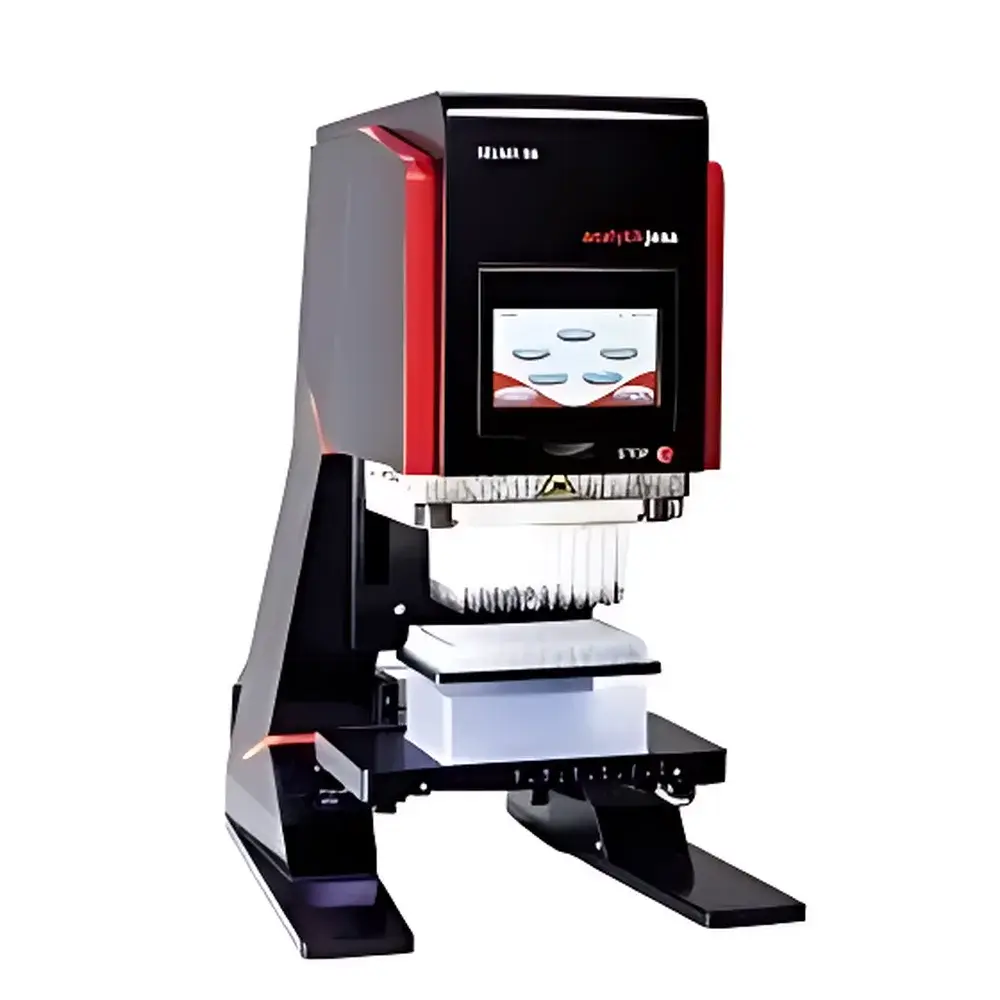
Analytik Jena SELMA Portable Liquid Handling Workstation
| Brand | Analytik Jena |
|---|---|
| Origin | Germany |
| Model | SELMA |
| Plate Formats | 96-well and 384-well microplates |
| Pipetting Range | 0.5 µL – 1000 µL |
| Precision (96-channel, 25 µL tip) | ≤3% at 0.5–2.0 µL, ≤2% at 2.0–5.0 µL, ≤1% at 5.0–25.0 µL |
| Dimensions (W×H×D) | 307 mm × 480–520 mm × 325 mm |
| Weight | 15–20 kg |
| Display | 3.5-inch color touchscreen with full Chinese UI |
| Tip Tray Technology | Integrated, sealed, rapid tip loading/unloading |
| Onboard Protocol Storage | Dozens of user-defined methods |
Overview
The Analytik Jena SELMA Portable Liquid Handling Workstation is an engineered solution for precision liquid transfer in regulated and space-constrained laboratory environments. Based on positive displacement and air-cushion pipetting principles, SELMA delivers high reproducibility across low-volume ranges (0.5–1000 µL) while maintaining compliance with fundamental metrological requirements for volumetric accuracy in life science workflows. Designed and manufactured in Jena, Germany, the system integrates core fluidic control architecture with intuitive human-machine interaction—enabling reliable operation inside biosafety cabinets (BSCs), laminar flow hoods, or shared benchtop spaces without requiring dedicated infrastructure. Its compact footprint (307 × 480–520 × 325 mm) and lightweight construction (15–20 kg) allow seamless integration into GLP-compliant labs, QC facilities, and academic core facilities where flexibility, sterility assurance, and traceable execution are essential.
Key Features
- Minimal manual intervention: Only plate and tip tray handling requires operator input—no pipette calibration, tip ejection priming, or multi-step initialization.
- Dual-format compatibility: Native support for both 96-well and 384-well microplates, with optional single-channel, 8-channel, and full-array dispensing modes.
- Modular tip technology: Proprietary TipTray system ensures leak-free sealing, consistent tip fitment, and rapid exchange—critical for cross-contamination prevention in high-risk biosamples.
- On-device method management: Stores dozens of user-defined protocols with full parameter logging; recall via one-touch interface without external PC dependency.
- Multi-function pipetting engine: Supports serial dilution, plate reformatting (96 ↔ 384), wall-contact dispensing, bead-based nucleic acid extraction, and aspiration/mixing cycles with programmable blow-out and wash steps.
- Full-volume range coverage: Four interchangeable 96-channel tips (25 µL, 60 µL, 250 µL, 1000 µL) and two 384-channel tips (25 µL, 60 µL), each validated per ISO 8655-6 for gravimetric accuracy and repeatability.
Sample Compatibility & Compliance
SELMA accommodates aqueous buffers, viscous lysates, ethanol-based eluates, glycerol-containing reagents, and low-surface-tension solvents commonly used in molecular biology, toxicology, and analytical sample preparation. Its sealed fluid path design minimizes aerosol generation during aspiration—making it suitable for handling BSL-2/BSL-3 agents under BSC containment. The system adheres to ISO/IEC 17025 foundational requirements for measurement traceability and supports audit-ready documentation through timestamped protocol logs and onboard version control. While not inherently 21 CFR Part 11 compliant out-of-the-box, SELMA’s deterministic execution model and immutable method storage provide a robust foundation for laboratories implementing supplementary electronic signature and audit trail policies.
Software & Data Management
Operation is fully managed via a built-in 3.5-inch capacitive touchscreen with localized Chinese interface—eliminating language barriers during method setup or troubleshooting. All protocols—including volume, source/destination mapping, mixing cycles, and tip wash parameters—are defined and saved directly on the device. No proprietary software installation or driver dependencies are required. Export of run logs (CSV format) is supported via USB port for integration into LIMS or ELN systems. Firmware updates are delivered as signed binary packages, ensuring integrity and version consistency across instrument fleets.
Applications
SELMA serves as a validated tool across diverse assay workflows requiring volumetric fidelity and operational simplicity: qPCR and RT-PCR master mix assembly; ELISA plate coating and substrate addition; cytotoxicity screening using 384-well viability assays; small-molecule compound dilution series for IC50 determination; magnetic bead-based DNA/RNA isolation from blood, tissue, or environmental samples; pesticide residue extraction prior to LC-MS analysis; antimicrobial resistance profiling via broth microdilution; and crystallization trial setup for protein structural studies. Its reliability in sub-5 µL transfers makes it especially valuable for precious sample conservation in biobanking and single-cell applications.
FAQ
Does SELMA require connection to a computer for routine operation?
No—full standalone functionality is provided via the integrated touchscreen interface.
Can SELMA perform gradient dilutions across a 96-well plate?
Yes, using built-in serial dilution logic with customizable step volumes and mixing iterations.
Is calibration traceable to national standards?
Yes—gravimetric verification follows ISO 8655-6 procedures; calibration certificates are issued per customer request.
What maintenance is required beyond regular tip tray replacement?
Annual inspection of pipetting motors and seal integrity is recommended; no daily servicing or fluidic recalibration is needed.
How does SELMA prevent carryover between samples?
Through configurable tip washing cycles, air-gap aspiration, and disposable tip architecture with positive displacement options for high-viscosity fluids.



