
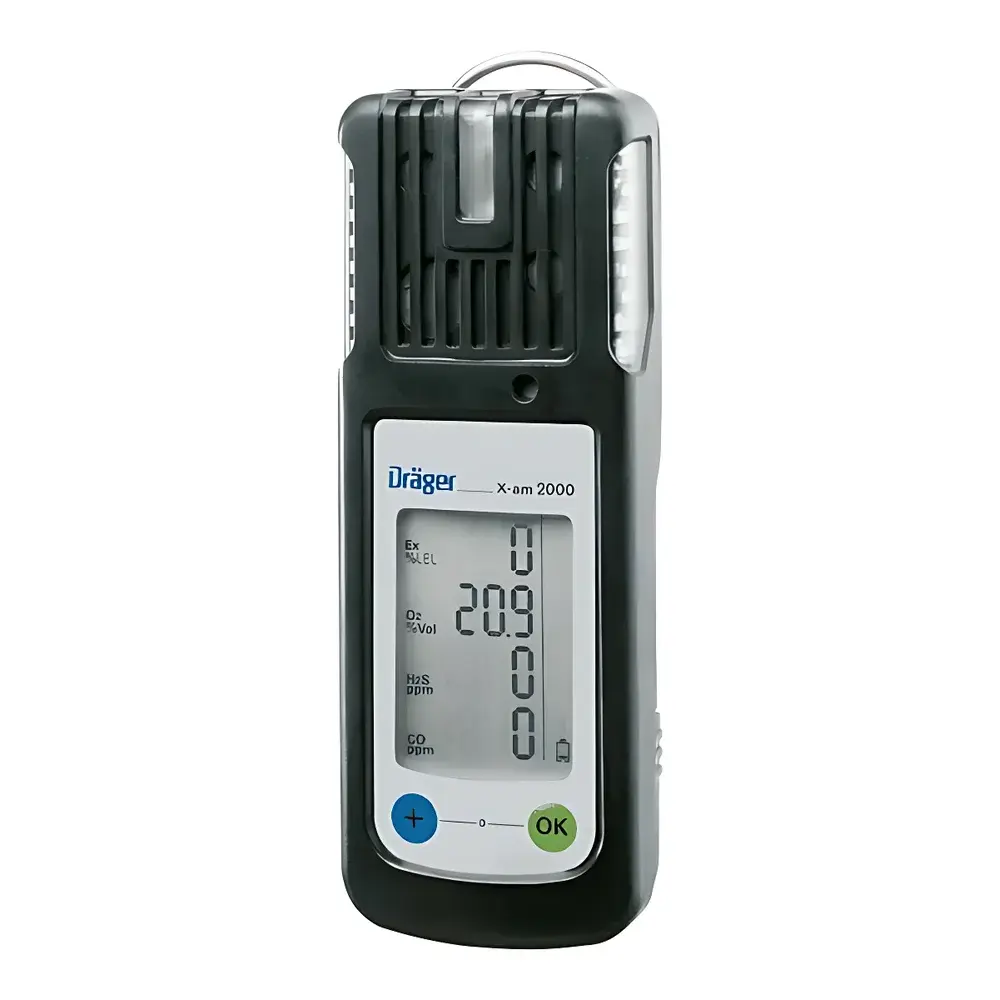
Cole-Parmer X-am 2000 Multi-Gas Monitor Model 86515-20
| Brand | Cole-Parmer |
|---|---|
| Origin | USA |
| Manufacturer Type | Authorized Distributor |
| Origin Category | Imported |
| Model | 86515-20 |
| Measurement Principle | Electrochemical (O₂, CO, H₂S) & Catalytic Bead (Combustible Gas) |
| Measured Gases | O₂, CO, H₂S, LEL (Methane/Propane Equivalent) |
| Detection Ranges | O₂ (0–25% vol), CO (0–2000 ppm), H₂S (0–200 ppm), LEL (0–100% LEL) |
| Resolution | O₂ (0.1% vol), CO/H₂S (1 ppm), LEL (1% LEL) |
| Alarm Setpoints | O₂ (Low: 19.5%, High: 23.5%), CO (Low: 35 ppm, High: 50 ppm), H₂S (Low: 10 ppm, High: 20 ppm), LEL (Low: 10% LEL, High: 20% LEL) |
| Alarm Output | Audible (90 dB @ 1 ft), Visual (180° LED array), Vibratory |
| Data Logging | Internal memory with IR interface for PC download |
| Battery | Two AA alkaline cells (12 h typical runtime) |
| Weight | 7.8 oz (0.22 kg) |
| Enclosure Rating | IP67 |
| Certifications | UL/cUL Class I, Div 1, Groups A–G, T4 |
| Sensor Life | 5 years (typical) |
Overview
The Cole-Parmer X-am 2000 Multi-Gas Monitor (Model 86515-20) is a compact, intrinsically safe personal gas detection instrument engineered for continuous real-time monitoring of four critical atmospheric hazards: oxygen (O₂), carbon monoxide (CO), hydrogen sulfide (H₂S), and combustible gases expressed as Lower Explosive Limit (LEL). Its measurement architecture integrates electrochemical sensors for toxic and oxygen gases with a catalytic bead (pellistor) sensor for flammable gas detection—ensuring compliance with fundamental industrial hygiene and confined-space entry safety protocols. Designed to meet the operational demands of field technicians, utility crews, emergency responders, and maintenance personnel, the device delivers high reproducibility in variable environmental conditions while maintaining strict adherence to international intrinsic safety standards.
Key Features
- Compact ergonomic form factor (7.8 oz / 0.22 kg), sized comparably to a modern smartphone—optimized for extended wear on belt, chest strap, or harness without fatigue.
- Dual-button interface with intuitive menu navigation—enabling rapid configuration of alarm thresholds, data logging intervals, and display preferences without requiring external software.
- Multi-modal alarm system: 90 dB audible alert at 1 ft distance, 180° wide-angle visual indicator (high-intensity LED array), and tactile vibration—redundant notification ensuring alert recognition in noisy, low-visibility, or physically demanding environments.
- IP67-rated enclosure with integrated rubber overmold—providing full protection against dust ingress and temporary submersion (up to 1 m for 30 min); shock-absorbing design safeguards internal sensor integrity during drops or mechanical vibration.
- Onboard data logger with non-volatile memory—storing time-stamped concentration readings, alarm events, STEL (Short-Term Exposure Limit), TWA (Time-Weighted Average), and min/max values for retrospective analysis.
- Infrared (IR) communications port—enabling secure, cable-free data transfer to Windows-based PCs using proprietary Cole-Parmer configuration and reporting software (no Bluetooth or Wi-Fi interfaces).
Sample Compatibility & Compliance
The X-am 2000 is validated for use in ambient air sampling across occupational settings including wastewater treatment plants, petrochemical facilities, mining operations, tunnel construction sites, and municipal infrastructure maintenance. Its sensor response characteristics are calibrated per manufacturer-recommended test gases (e.g., 50% LEL methane for combustibles, 100 ppm CO in air for carbon monoxide), with cross-sensitivity profiles documented in the technical manual per ISO 16000-23 and EN 45544-1. The instrument complies with multiple global certification frameworks: UL/cUL 913 (Class I, Division 1, Groups A–G, T4), CSA C22.2 No. 152, ATEX Directive 2014/34/EU (Category 1G, Ex ia IIC T4 Ga), and CE marking under the EU Machinery and EMC Directives. All certifications support deployment in Zone 0/1 hazardous locations where explosive atmospheres may be present.
Software & Data Management
Data retrieval and configuration are managed via Cole-Parmer’s proprietary PC application, compatible with Windows 10/11. The software supports audit-trail-enabled report generation—including user-defined date ranges, event filtering (alarms, calibration logs, battery status), and export to CSV or PDF formats. Calibration records include timestamp, gas concentration, span value, zero offset, and operator ID—supporting GLP/GMP-aligned documentation requirements. While the device itself does not implement FDA 21 CFR Part 11 electronic signature controls, its data structure and immutable logging protocol facilitate integration into validated enterprise EHS management systems when deployed within controlled workflows.
Applications
- Confined space entry pre-screening and continuous atmospheric monitoring (per OSHA 1910.146 and ANSI Z117.1).
- Routine patrol monitoring for sewer systems, manholes, pump stations, and underground vaults where H₂S accumulation and O₂ depletion pose acute risks.
- Leak detection and verification during hydrocarbon pipeline maintenance, valve replacement, or flare stack inspection.
- Emergency response triage—rapid hazard identification prior to structural entry during fire, hazmat, or natural disaster scenarios.
- Industrial hygiene surveys supporting exposure assessment against ACGIH TLVs®, OSHA PELs, and EU OELs.
FAQ
What calibration gases are required for routine bump testing and full calibration?
Bump testing requires certified 50% LEL methane (for LEL sensor), 100 ppm CO in air, 25 ppm H₂S in air, and 18% O₂ in nitrogen. Full calibration uses the same gases at specified flow rates (typically 0.5 L/min) via dedicated calibration cap.
Can the instrument be used in environments below freezing or above 50°C?
Operational range is specified from –20°C to +50°C. Performance outside this range may affect sensor response time and accuracy; extended exposure below –10°C is not recommended without thermal stabilization.
Is the IR interface compatible with Mac or Linux operating systems?
No—the IR communication protocol and configuration software are exclusively supported on Windows platforms. Third-party IR drivers or emulators are not validated or supported by Cole-Parmer.
How is sensor drift compensated over time?
The device performs automatic baseline correction during zero-air exposure and includes manual zero adjustment capability. Periodic span calibration (recommended every 6 months or after exposure to extreme contaminant levels) maintains traceable measurement integrity.
Does the data logger retain information after battery replacement?
Yes—memory is non-volatile and retains all logged data, alarm history, and calibration records even with complete power loss. No data corruption occurs during standard AA battery replacement.
Related Products







