
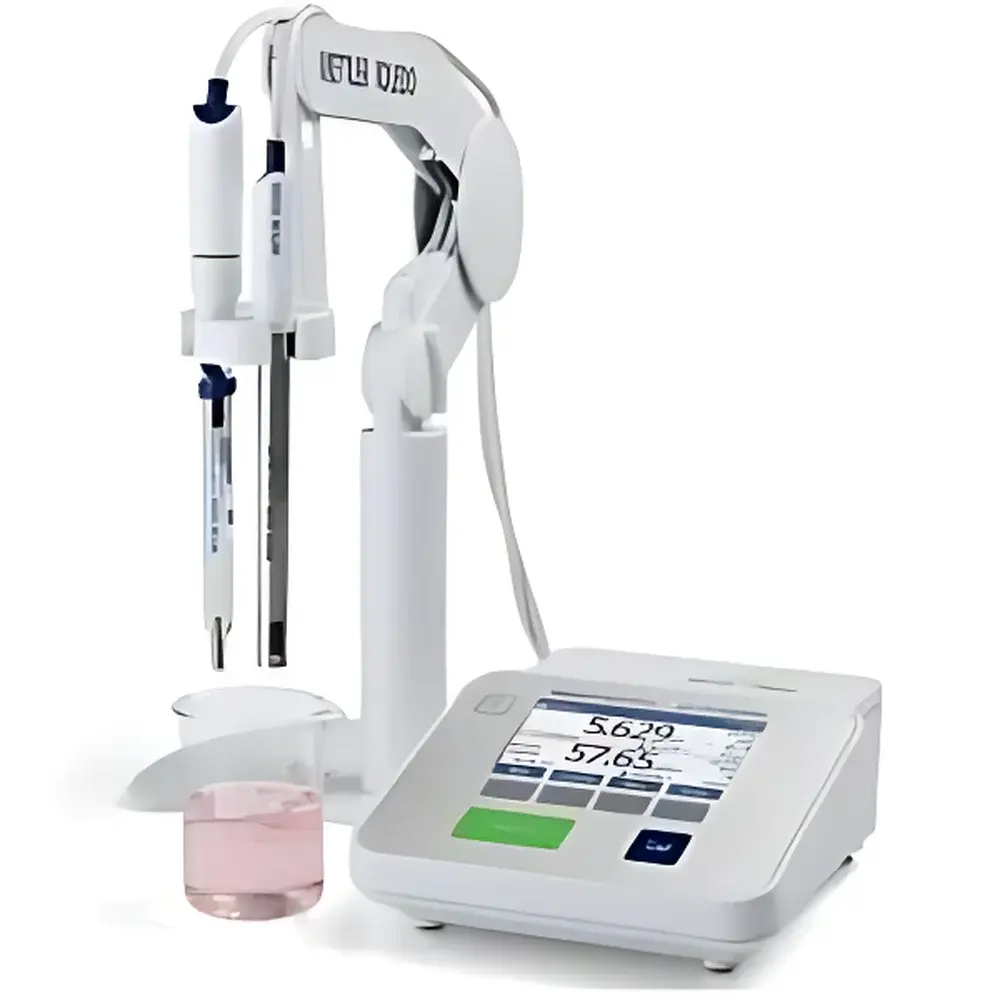
METTLER TOLEDO SevenCompact S210/S220/S230 Benchtop pH Meter
| Brand | METTLER TOLEDO |
|---|---|
| Origin | Switzerland |
| Model | S210 / S220 / S230 |
| Instrument Type | Benchtop |
| Parameter Types | Multi-parameter (pH, mV, rel. mV, °C) |
| Measurement Range | –2.000 to 20.000 pH |
| Resolution | 0.001 / 0.01 / 0.1 pH |
| Accuracy | ±0.002 pH |
| Calibration Solutions | China-specific buffer sets (e.g., pH 4.01, 6.86, 9.18) |
| IP Rating | IP54 |
| Display | High-contrast color TFT touchscreen |
Overview
The METTLER TOLEDO SevenCompact S210, S220, and S230 benchtop pH meters are precision electrochemical instruments engineered for high-reproducibility potentiometric pH measurement in regulated laboratory environments. Based on the Nernst equation, these meters measure the potential difference between a pH-sensitive glass electrode and a stable reference electrode—converted into pH units with temperature compensation via integrated Pt1000 or NTC sensors. Designed for ISO/IEC 17025-compliant quality control labs, pharmaceutical QC units, academic research facilities, and environmental testing centers, the SevenCompact series delivers traceable, audit-ready results without compromising operational simplicity. Each model supports automatic electrode recognition, real-time stability monitoring, and configurable measurement modes—including single-point, two-point, and three-point calibration with slope and offset diagnostics. The S220 adds conductivity and ion concentration (ISE) capability; the S230 extends functionality to dissolved oxygen (DO) and redox potential (ORP), maintaining consistent hardware architecture and firmware logic across the platform.
Key Features
- High-resolution color TFT touchscreen interface with intuitive icon-based navigation and 12-language menu support (English, German, French, Spanish, Chinese, Japanese, Korean, Russian, Portuguese, Italian, Polish, Turkish)
- IP54-rated enclosure ensuring protection against dust ingress and water splashes—validated for continuous operation in demanding lab settings
- Auto-read function with user-definable stability criteria (e.g., ΔpH ≤ 0.002 over 3 s) to minimize operator dependency and ensure measurement consistency
- Integrated electrode diagnostics including asymmetry potential, slope evaluation (% deviation from theoretical 59.16 mV/pH at 25 °C), and lifetime tracking via serial number registration
- USB-A port supporting direct connection to printers, flash drives, keyboards, barcode scanners, and PCs running EasyDirect™ pH software for automated data export and report generation
- uPlace sensor station and uMix magnetic stirrer compatibility for standardized sample handling, reducing inter-operator variability in titration-coupled or kinetic pH monitoring workflows
Sample Compatibility & Compliance
The SevenCompact series is compatible with all METTLER TOLEDO InLab® and LE4xx-series pH electrodes, including refillable, gel-filled, and low-maintenance polymer-junction variants optimized for aqueous, viscous, non-aqueous, and high-ionic-strength samples. Calibration adheres to national metrological standards referenced in JJG 119–2018 (China) and aligns with international best practices defined in ASTM E70, ISO 3696, and USP . All models support GLP/GMP-compliant operation through mandatory entry of operator ID, sample ID, calibration certificate numbers, and timestamped audit trails. Data integrity meets FDA 21 CFR Part 11 requirements when used with EasyDirect™ pH software configured for electronic signatures, role-based access control, and immutable record archiving.
Software & Data Management
EasyDirect™ pH software provides seamless bidirectional communication via USB or RS232, enabling remote instrument configuration, method deployment, and batch-level data review. Raw measurements—including raw mV, temperature, electrode impedance, and calibration history—are stored in .csv and .pdf formats with embedded metadata (instrument ID, firmware version, calibration date, buffer lot numbers). The software enforces structured data capture per SOP templates and generates IQ/OQ documentation packages for initial qualification. Exported datasets retain full traceability for integration into LIMS or ELN systems using standard ASTM E1384 or HL7-compatible schemas.
Applications
- Pharmaceutical manufacturing: Final product pH verification per USP monographs and batch release testing under cGMP conditions
- Food & beverage QA: Monitoring acidity in dairy products, juices, and fermented goods to ensure microbial stability and regulatory compliance (e.g., FDA 21 CFR 114, EU Regulation 1169/2011)
- Environmental analysis: Field-deployable lab validation of wastewater effluent pH prior to discharge reporting under EPA Method 150.1
- Academic research: Kinetic studies of enzymatic reactions requiring sub-millipH resolution and drift-compensated long-term monitoring
- Chemical synthesis: In-process control of hydrolysis, neutralization, and catalyst activation steps where pH thresholds govern reaction selectivity
FAQ
What calibration buffers are supported for China-market instruments?
China-certified SevenCompact units ship pre-configured for use with GB/T 11076–2022–compliant buffer solutions (pH 4.01, 6.86, 9.18 at 25 °C), with optional user-defined buffer tables for non-standard media.
Can the S210 be upgraded to S220 or S230 functionality?
No—hardware differentiation (e.g., conductivity cell interface, DO probe driver circuitry) is fixed at manufacture; only firmware-enabled features within the same model tier are upgradable via authorized service.
Is temperature compensation automatic or manual?
Automatic temperature compensation (ATC) is standard using integrated Pt1000 sensors; manual input is permitted only for non-ATC electrode configurations or legacy probe types.
How is data security ensured during USB transfer?
All USB exports include digital signatures and checksum validation; EasyDirect™ enforces encryption-at-rest for local database files and requires password-authenticated session initiation.
Does the IP54 rating permit use in fume hoods or humidified incubators?
IP54 certifies resistance to vertical dripping and limited dust exposure—it does not guarantee suitability for continuous condensation or corrosive vapor environments; optional protective enclosures are available for such applications.





