
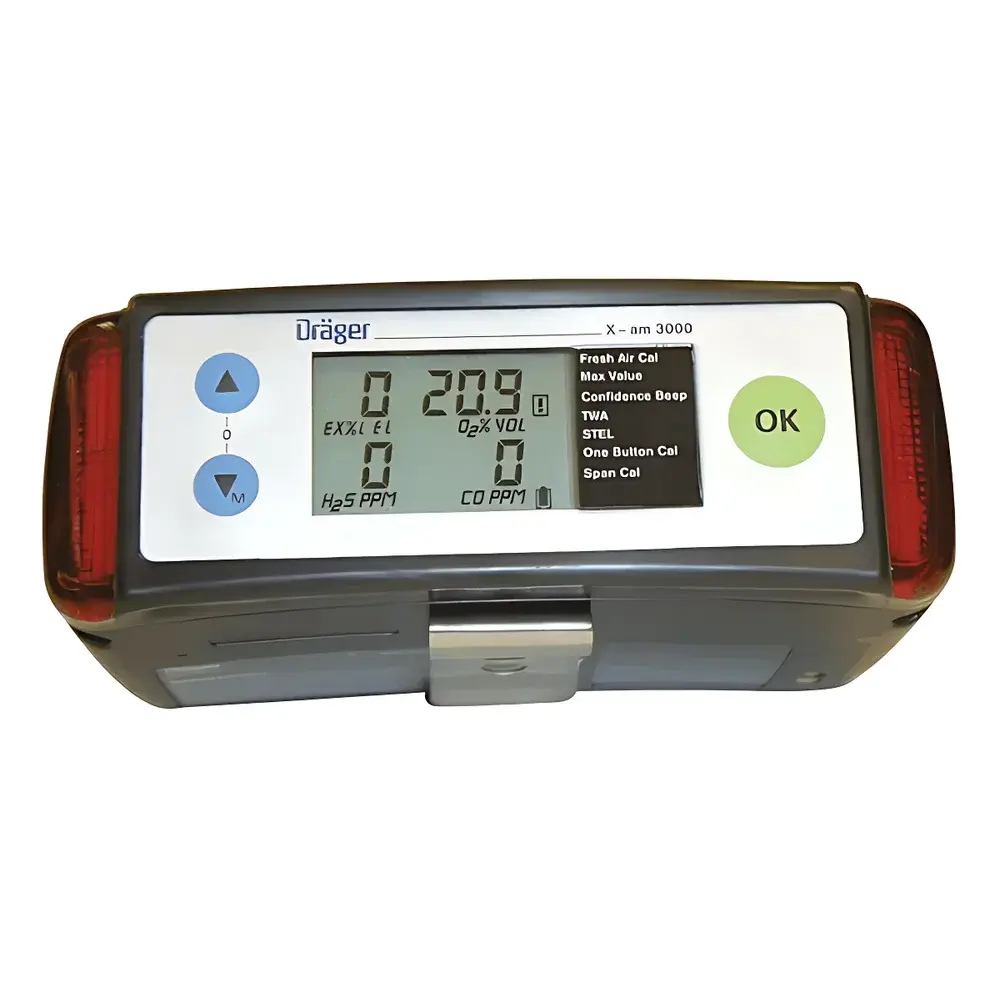
Cole-Parmer X-am 3000 Four-Gas Monitor Model 86515-30
| Brand | Cole-Parmer |
|---|---|
| Origin | USA |
| Manufacturer Type | Authorized Distributor |
| Country of Origin | Imported |
| Model | 86515-30 |
| Measurement Principle | Electrochemical (O₂, CO, H₂S) & Catalytic Bead (LEL) |
| Measured Gases | O₂ (0–25% vol), CO (0–2000 ppm), H₂S (0–200 ppm), Combustible Gas (0–100% LEL) |
| Resolution | O₂: 0.1% vol |
| CO | 1 ppm |
| H₂S | 1 ppm |
| LEL | 1% LEL |
| Alarm Setpoints | O₂: Low 19.5%, High 23.5% |
| CO | Low 35 ppm, High 50 ppm |
| H₂S | Low 10 ppm, High 20 ppm |
| LEL | Low 10%, High 20% |
| Audible Alarm | 90 dB @ 1 ft |
| Visual Alarm | Dual high-intensity LEDs |
| Tactile Alarm | Vibration motor |
| Ingress Protection | IP65 |
| Certifications | UL/cUL Class I, Div. 1, Groups A–G, T4 |
| Sensor Life | 2 years |
| Battery Life | 12 h (pump mode), 24 h (diffusion mode) |
| Power | Two AA alkaline or rechargeable NiMH batteries |
| Weight | 19.4 oz (0.55 kg) |
| Dimensions | 5.5" W × 3.5" H × 2.25" D |
| Display | Backlit LCD |
| Data Logging | None |
| Compliance | Meets requirements for confined space entry per OSHA 1910.146 and ANSI/ASSP Z240.1 |
Overview
The Cole-Parmer X-am 3000 Four-Gas Monitor (Model 86515-30) is a portable, intrinsically safe multigas detection instrument engineered for real-time, simultaneous monitoring of oxygen (O₂), carbon monoxide (CO), hydrogen sulfide (H₂S), and combustible gases (LEL) in industrial, utility, and confined-space environments. Its measurement architecture integrates electrochemical sensors for toxic and oxygen species with a catalytic bead sensor for flammable gas detection—ensuring high selectivity, stability, and repeatability under variable humidity and temperature conditions. Designed to meet stringent occupational safety standards, the X-am 3000 supports compliance-driven workflows in petrochemical plants, wastewater treatment facilities, construction sites, and emergency response operations. The built-in sampling pump enables active draw-through sampling at distances up to 3 meters, making it suitable for remote or hard-to-access locations where diffusion-based detection would be insufficient.
Key Features
- Intrinsically safe design certified to UL/cUL Class I, Div. 1, Groups A–G, T4; ATEX II 1G Ex ia IIC T4 Ga; MSHA; and CE (ATEX, EMC, RoHS) — enabling use in hazardous classified areas without risk of ignition.
- Triple-alert system: 90 dB audible alarm at 1 ft, dual high-intensity red/green LEDs, and tactile vibration—ensuring hazard notification across high-noise, low-visibility, or physically demanding scenarios.
- IP65-rated rugged polymer housing resistant to chemical splashes, impact, and dust ingress—validated for operation in harsh industrial settings and frequent drop events from waist height.
- Intuitive three-button interface with password-protected menu access to prevent unauthorized configuration changes—supporting controlled calibration and alarm threshold management.
- Backlit LCD display with large, high-contrast characters for rapid identification of gas types, real-time concentrations, and alarm status—even in low-light or peripheral viewing conditions.
- Configurable short-term exposure limit (STEL) and time-weighted average (TWA) calculation functions—providing immediate context for occupational exposure assessment per OSHA and ACGIH guidelines.
Sample Compatibility & Compliance
The X-am 3000 is optimized for ambient air sampling in non-corrosive, non-silicon-laden atmospheres. It is not intended for use in inert gas environments, high-H₂S (>200 ppm) or high-LEL (>100%) saturated zones without prior validation. All sensors are factory-calibrated and field-verifiable using traceable NIST-traceable span gases. The instrument meets OSHA 1910.146 requirements for pre-entry and continuous atmospheric monitoring during confined space operations. Its certification portfolio supports global deployment—including compliance with EU Directive 2014/34/EU (ATEX), US 29 CFR 1910 Subpart Z, and Canadian CSA Z240.1-18 for portable gas detection equipment. While the device does not include electronic data logging or FDA 21 CFR Part 11-compliant audit trails, its analog alarm outputs and physical calibration records support GLP-aligned documentation practices when integrated into facility-specific SOPs.
Software & Data Management
The X-am 3000 operates as a standalone, embedded-system detector with no onboard firmware update capability or PC connectivity. Calibration, bump testing, and alarm verification are performed manually using dedicated calibration caps and certified gas cylinders. All operational parameters—including zero offset, span correction factors, and alarm setpoints—are stored in non-volatile memory and retained through battery replacement. No proprietary software is required for routine operation; however, calibration logs and maintenance records must be maintained externally per ISO 45001 and internal quality management systems. For enterprise-level integration, third-party middleware solutions may interface via analog output modules (not included) or external data acquisition systems compliant with Modbus RTU or 4–20 mA protocols.
Applications
- Confined space entry monitoring (tanks, sewers, silos, vaults) per OSHA 1910.146 and ANSI Z117.1.
- Leak detection and area surveillance in refineries, LNG terminals, and chemical processing units.
- Emergency response triage by HAZMAT teams verifying atmospheric hazards before personnel entry.
- Preventive maintenance checks on ventilation systems, combustion appliances, and biogas handling infrastructure.
- Field verification of abatement system performance in remediation projects involving soil vapor extraction or landfill gas control.
FAQ
What gases does the X-am 3000 detect, and what are their respective measurement ranges?
It simultaneously monitors oxygen (0–25% vol), carbon monoxide (0–2000 ppm), hydrogen sulfide (0–200 ppm), and combustible gas (0–100% LEL) using electrochemical and catalytic bead sensing technologies.
Is the instrument suitable for use in explosive atmospheres?
Yes—it holds multiple intrinsic safety certifications including UL/cUL Class I, Div. 1; ATEX II 1G Ex ia IIC T4 Ga; and MSHA approval, permitting operation in Zone 0/1 and Division 1 hazardous locations.
Does the X-am 3000 support data logging or wireless connectivity?
No—the device lacks internal memory, USB ports, Bluetooth, or Wi-Fi functionality. All data must be recorded manually or via external dataloggers interfaced through optional analog outputs.
How often should calibration and bump testing be performed?
Bump testing is recommended before each day’s use; full calibration is required every 180 days or after exposure to sensor-poisoning compounds (e.g., silicones, lead, sulfur compounds), per manufacturer guidelines and site-specific safety programs.
Can the built-in pump be disabled for diffusion-mode operation?
Yes—the pump can be toggled off to extend battery life to 24 hours; in this mode, detection relies on passive gas diffusion, which reduces response time and effective sampling range compared to active pumping.







