
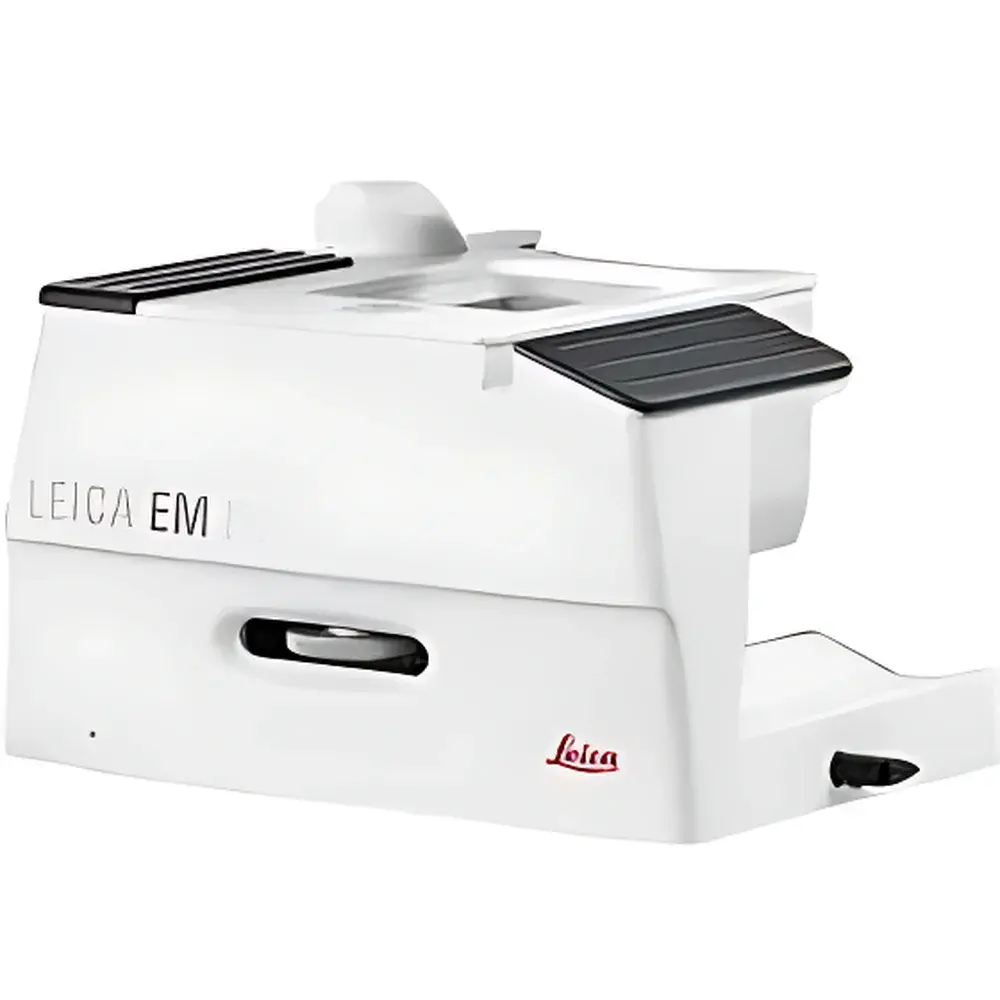
Leica EM FC7 Ultramicrotome
| Brand | Leica |
|---|---|
| Origin | Germany |
| Model | EM FC7 |
| Cutting Principle | Gravity-fed ultrathin sectioning |
| Sample Stage Movement | N-S: 10 mm, W-E: 25 mm |
| Illumination | 4-directional adjustable-brightness LED |
| Stereo Microscope Options | S6E (10–64×), M80 (9.6–77×) |
| Knife Holder | 360° rotatable self-locking, ±30°刻度分隔, clearance angle: −2° to +15°, compatible with 6–12 mm knives (including all major diamond knife brands) |
| Specimen Holder | 360° planar rotation, ±22° tilt around center axis |
| Control Interface | 10.4″ or 7″ capacitive touchscreen |
| Advanced Functions (10.4″ only) | Automated block trimming, E-W distance measurement, diamond knife wear tracking, multi-user authentication, storage for up to 100 user profiles |
Overview
The Leica EM FC7 is a high-precision gravity-driven ultramicrotome engineered for reproducible semi-thin (0.5–2 µm) and ultrathin (30–150 nm) sectioning of biological, polymer, and hard-material specimens. Designed specifically for electron microscopy sample preparation workflows, it enables consistent ribbon formation and minimal compression artifacts—critical for high-resolution TEM, SEM, and AFM imaging. Its gravity-based cutting mechanism eliminates motor-induced vibrations, ensuring stable specimen advancement and clean, distortion-free sections. The instrument integrates seamlessly into cryo-EM and correlative light-electron microscopy (CLEM) pipelines, supporting both room-temperature and cryogenic sectioning when paired with optional cryo accessories. All mechanical motion systems—including specimen advance, knife translation, and stage positioning—are built with hardened steel components and precision-ground linear guides to maintain long-term dimensional stability under daily laboratory use.
Key Features
- Gravity-fed cutting system with zero-motor vibration transmission to the specimen block—essential for preserving ultrastructural integrity in soft biological tissues.
- Motorized knife stage with independent N–S (10 mm) and W–E (25 mm) translational control, enabling precise repositioning without manual realignment.
- Dual stereo microscope compatibility: Leica S6E (10–64× zoom) or M80 (9.6–77× zoom), both equipped with parfocal optics and integrated coaxial illumination for optimal contrast during trimming and sectioning.
- 360° rotating, self-locking knife holder with engraved ±30° angular scale and fine-adjustable clearance angle (−2° to +15°), accommodating standard glass knives and all commercially available diamond knives (6–12 mm width).
- Full 360° planar rotation plus ±22° tilting capability of the specimen chuck—enabling serial section alignment, angled sectioning for tomography, and optimized orientation of anisotropic samples.
- Capacitive touchscreen interface: 10.4″ panel includes automated block trimming algorithms, E–W coordinate measurement tools, diamond knife wear logging, role-based user authentication, and secure storage of up to 100 instrument configurations.
Sample Compatibility & Compliance
The Leica EM FC7 accommodates a broad range of embedded specimens, including epoxy-resin (e.g., Epon, Spurr), acrylic (e.g., LR White, Lowicryl), and cryo-embedded (e.g., HPF/FS, methacrylate) blocks. It supports both room-temperature and low-temperature sectioning when used with Leica’s EM AFS2 or EM VCT500 cryo-workstations. The instrument conforms to ISO 13485 design controls for medical device-related research applications and meets CE marking requirements for laboratory equipment (2014/30/EU EMC Directive and 2014/35/EU LVD). Its firmware architecture supports audit trail generation and electronic signature compliance per FDA 21 CFR Part 11 when deployed in regulated GMP/GLP environments—particularly relevant for preclinical histopathology and biopharmaceutical characterization labs.
Software & Data Management
The EM FC7 operates on Leica’s proprietary EM UC7/FC7 firmware platform, which features deterministic real-time control of all motion axes and sensor feedback loops. The 10.4″ touchscreen runs a Linux-based OS with encrypted local storage; all user profiles, protocol logs, and knife usage records are timestamped and exportable via USB or network share in CSV or XML format. Integrated metadata tagging includes operator ID, date/time, block ID, knife serial number, section thickness setting, and ambient temperature/humidity readings (when connected to optional environmental sensors). Remote diagnostics and firmware updates are supported through Leica’s secure ServiceLink portal—requiring no direct internet exposure of the instrument.
Applications
- Transmission Electron Microscopy (TEM): Routine preparation of ultrathin sections from fixed and resin-embedded mammalian tissues, plant cells, and bacterial biofilms.
- Scanning Electron Microscopy (SEM): Generation of polished cross-sections for backscattered electron (BSE) imaging and energy-dispersive X-ray spectroscopy (EDS) mapping.
- Atomic Force Microscopy (AFM): Production of flat, debris-free surfaces on polymer blends, thin-film devices, and nanocomposites for topographic and mechanical property mapping.
- Cryo-Electron Tomography (Cryo-ET): Serial sectioning of vitrified lamellae prepared by FIB-SEM, with precise alignment enabled by the specimen’s dual-axis rotational capability.
- Correlative Light and Electron Microscopy (CLEM): Co-registration of fluorescence-labeled regions with ultrastructural context via fiducial-assisted section relocation.
- Materials Science: Sectioning of metallographic composites, battery electrode cross-sections, and semiconductor wafers for failure analysis and microstructure evaluation.
FAQ
What types of embedding media are compatible with the EM FC7?
The EM FC7 supports standard epoxy resins (e.g., Epon 812, Araldite), acrylic resins (e.g., LR White, Lowicryl K4M), and cryo-compatible methacrylates (e.g., HM20, K4M). Hardness-matched sectioning parameters must be selected based on polymerization state and temperature.
Can the EM FC7 be used for cryosectioning?
The EM FC7 itself is not a cryomicrotome, but it is fully compatible with Leica’s EM VCT500 cryo-transfer system and EM AFS2 high-pressure freezer for post-fixation cryo-sectioning workflows.
Is remote operation or integration with LIMS possible?
While the EM FC7 does not feature native Ethernet control, its configuration files and log data are exportable for LIMS ingestion. Remote diagnostics and firmware updates require Leica ServiceLink with authenticated technician access.
Does the instrument support GLP/GMP documentation requirements?
Yes—the 10.4″ control panel generates time-stamped, user-authenticated audit trails compliant with FDA 21 CFR Part 11 when configured with password-protected roles and electronic signatures.
What maintenance intervals are recommended?
Leica recommends quarterly calibration verification of specimen advance accuracy and annual full service—including lubrication of linear guides, tension calibration of the gravity arm, and optical alignment of the stereo microscope path.



