
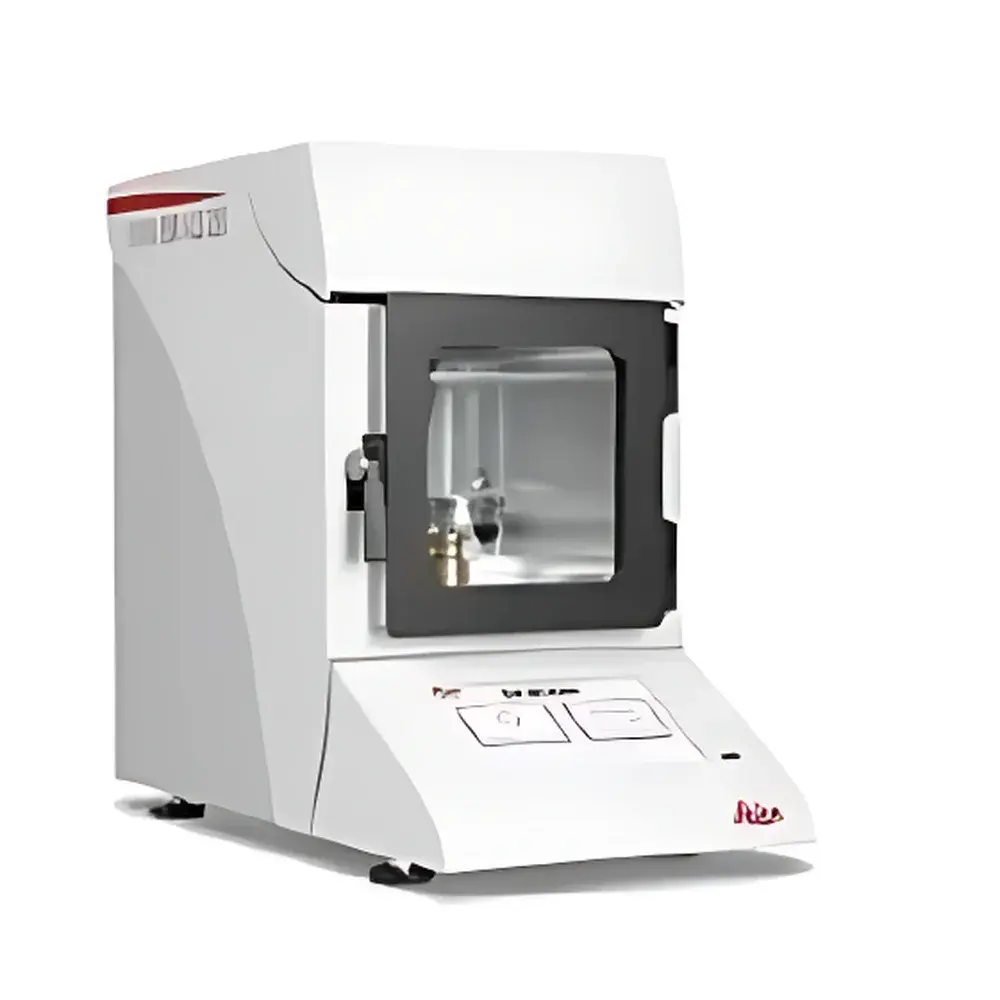
Leica EM ACE200 Vacuum Coater
| Brand | Leica |
|---|---|
| Origin | Germany |
| Model | EM ACE200 |
| Vacuum Level | 7×10⁻³ mbar |
| Sputtering Current Range | 0–150 mA |
| Sample Chamber Dimensions | 140 mm (W) × 145 mm (D) × 150 mm (H) |
| Working Distance Adjustment | 30–100 mm |
| Carbon Evaporation Mode | Pulsed, Quartz Crystal Thickness Monitor Optional (±0.1 nm resolution) |
| Operation Interface | Touchscreen with Fully Automated Cycle Control (Pump-down → Coating → Venting) |
| Dual-Mode Capability | Sputtering + Carbon Evaporation |
Overview
The Leica EM ACE200 is a high-performance, benchtop vacuum coater engineered specifically for reproducible and contamination-controlled sample preparation in electron microscopy workflows. It operates on two complementary physical vapor deposition (PVD) principles: DC magnetron sputtering for conductive metal film deposition (e.g., Au, Pt, Cr, Ir), and resistive carbon filament evaporation for ultra-thin, amorphous carbon support films. Designed for integration into routine SEM, TEM, and microanalysis laboratories, the EM ACE200 delivers stable base vacuum down to 7×10⁻³ mbar—sufficient for both sputtering and carbon evaporation without requiring liquid nitrogen trapping or turbomolecular pumping. Its modular architecture supports single-mode or dual-mode operation, enabling users to switch between metal coating for charge dissipation and high-resolution carbon film deposition for EDS/WDS compatibility or TEM grid reinforcement—all within one instrument platform.
Key Features
- Patented pulsed carbon evaporation technology ensures uniform thermal loading and precise control over carbon film thickness, minimizing cracking and grain formation common in continuous evaporation.
- DC magnetron sputtering source with adjustable current (0–150 mA) enables optimization of film density, grain size, and conductivity across a wide range of target materials including Au/Pd, Pt, Cr, and Ir.
- Rectangular sample chamber (140 × 145 × 150 mm) accommodates standard SEM stubs, multi-well TEM grids, and large-area samples; optimized geometry enhances angular uniformity of deposition.
- Motorized working distance adjustment (30–100 mm) allows fine-tuning of shadowing effects and film conformality—critical for topographic fidelity in high-magnification imaging.
- Optional quartz crystal microbalance (QCM) provides real-time, nanometer-level thickness monitoring (±0.1 nm resolution), traceable to NIST-traceable calibration standards.
- Integrated glow discharge module (optional) applies low-energy plasma treatment to TEM copper or nickel grids, enhancing surface hydrophilicity and improving carbon film adhesion and uniformity.
- Touchscreen HMI with pre-programmed, user-editable coating protocols—including vacuum ramp profiles, current/voltage ramps, and timed venting sequences—ensures method reproducibility across operators and shifts.
Sample Compatibility & Compliance
The EM ACE200 is validated for use with biological, polymeric, ceramic, and metallic specimens requiring non-destructive, low-heat-input metallization or carbon replication. It complies with ISO 14644-1 Class 5 cleanroom handling recommendations when operated in dedicated prep areas. All vacuum components meet EU Pressure Equipment Directive (PED 2014/68/EU) requirements, and electrical safety conforms to IEC 61010-1. The system supports GLP/GMP-aligned documentation practices via optional CSV export of run logs (timestamp, pressure curve, current profile, thickness data), facilitating audit readiness for regulated environments such as pharmaceutical QC labs performing SEM-based particulate analysis per USP .
Software & Data Management
Control firmware features embedded audit trail functionality compliant with FDA 21 CFR Part 11 requirements when paired with networked authentication and electronic signature modules (sold separately). Process parameters are stored in non-volatile memory with versioned protocol libraries. Run data—including vacuum evolution curves, sputtering current vs. time, and QCM thickness accumulation—are exportable in CSV format for integration into LIMS or statistical process control (SPC) platforms. No proprietary drivers or OS-specific software are required; configuration and diagnostics are fully accessible via the onboard touchscreen interface.
Applications
- Routine SEM sample preparation for non-conductive materials (e.g., polymers, ceramics, biological tissues), ensuring stable imaging at accelerating voltages from 1–30 kV.
- EDS and WDS-compatible coating: ultra-thin carbon films (<5 nm) minimize X-ray absorption while preserving elemental quantification accuracy.
- TEM grid preparation: uniform carbon films on Cu/Ni grids for cryo-EM grid support or negative staining protocols.
- Glow discharge pretreatment of holey carbon films to improve hydrophilicity prior to vitrification in cryo-EM workflows.
- Failure analysis in microelectronics: controlled Pt or Cr sputtering for cross-section imaging without interfacial diffusion or redeposition artifacts.
- Materials science research: comparative study of sputter vs. evaporation film morphology using SEM/AFM correlation.
FAQ
What vacuum level is required for stable sputtering and carbon evaporation?
The EM ACE200 achieves a base pressure of ≤7×10⁻³ mbar using its integrated dual-stage rotary vane pump—sufficient for both DC sputtering and carbon evaporation without auxiliary pumping stages.
Can the EM ACE200 deposit chromium or iridium films?
Yes—when equipped with compatible magnetron sputter targets, the system supports Cr, Ir, Pt, Au/Pd, and other conductive metals commonly used for high-resolution SEM imaging.
Is the quartz crystal thickness monitor factory-calibrated?
Each QCM sensor ships with a NIST-traceable calibration certificate; in-situ recalibration is supported via standard reference films and user-defined density inputs.
Does the glow discharge function require additional gas supply?
No—the integrated glow discharge module operates using ambient air or optional argon/nitrogen feed through a standard 6 mm OD stainless steel line; no external gas cabinet is needed.
How is maintenance access designed for long-term reliability?
All critical components—including sputter head, carbon source, and vacuum valves—are front-accessible with tool-free panel removal; consumables (targets, filaments, O-rings) are field-replaceable without service engineer intervention.




