
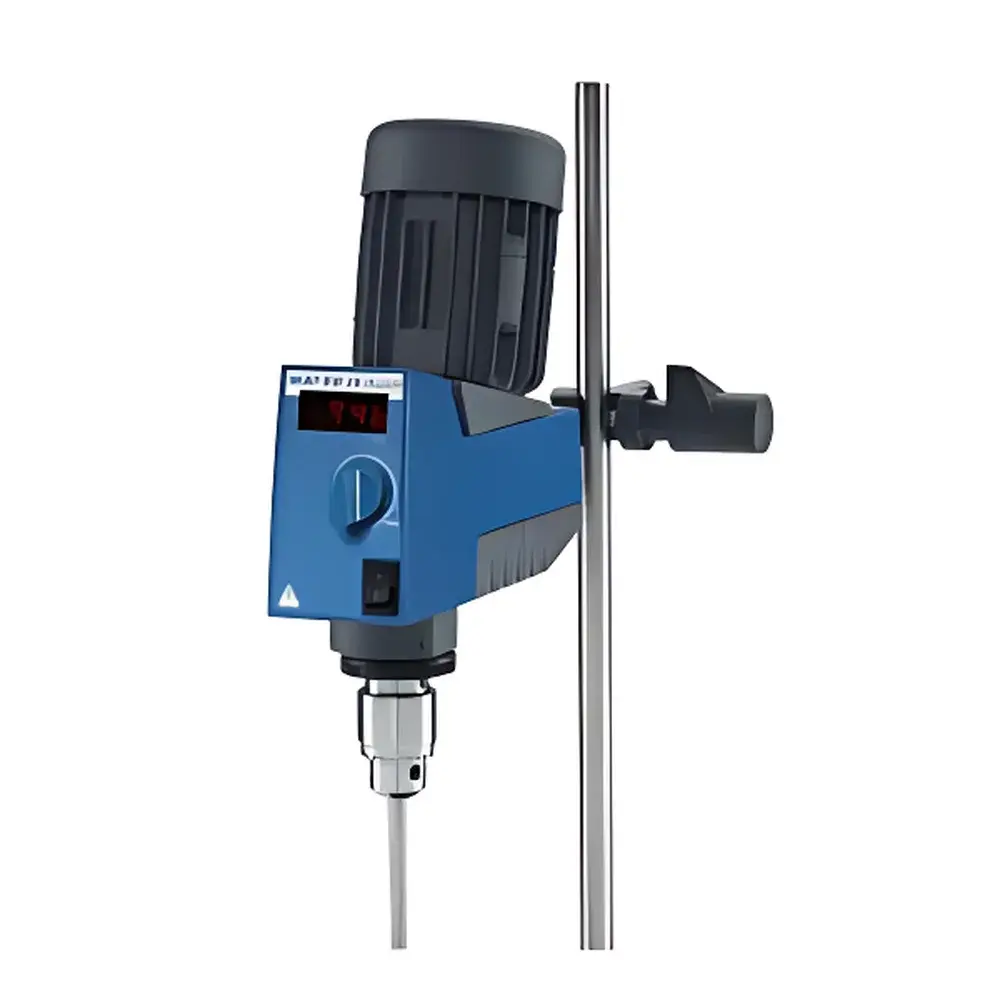
IKA RW 20 digital Overhead Stirrer
| Brand | IKA |
|---|---|
| Origin | Germany |
| Model | RW 20 digital |
| Stirrer Type | Electric Overhead Stirrer |
| Max. Mixing Volume (H₂O) | 20 L |
| Speed Range | 60–2000 rpm |
| Input Power | 72 W |
| Output Power | 35 W |
| Max. Torque | 150 N·cm (at 100 rpm), 300 N·cm (overload at 60 rpm) |
| Display | LED |
| Speed Control | Stepless Mechanical |
| Shaft Clamp Range | 0.5–10 mm |
| Hollow Shaft ID | 10.5 mm |
| IP Rating | IP20 |
| Dimensions (W×H×D) | 88 × 294 × 212 mm |
| Weight | 3.1 kg |
| Ambient Temp. | 5–40 °C |
| Relative Humidity | ≤80 % |
| Voltage | 220–240 V / 100–115 V |
| Frequency | 50/60 Hz |
| Max. Viscosity | 10,000 mPa·s |
| Continuous Duty Cycle | 100 % |
Overview
The IKA RW 20 digital is a robust, German-engineered overhead stirrer designed for reliable, high-torque mixing in routine and demanding laboratory applications. Built upon the proven RW 20 platform, this digitally enhanced variant integrates a precision LED speed display with stepless mechanical speed control—enabling stable, reproducible agitation across a wide operational range (60–2000 rpm). Its core architecture follows Couette flow principles, where rotational shear is transmitted via a vertically mounted drive shaft to immersed impellers, ensuring efficient momentum transfer into viscous or heterogeneous media. The unit delivers up to 150 N·cm nominal torque at low speeds (100 rpm), with transient overload capacity of 300 N·cm at 60 rpm—making it suitable for moderate-viscosity formulations including polymer solutions, suspensions, emulsions, and buffer preparations. Engineered for continuous operation under GLP-compliant conditions, the RW 20 digital maintains thermal stability and mechanical integrity across 8-hour shifts, supporting unattended overnight mixing protocols when paired with appropriate vessel geometry and impeller selection.
Key Features
- Stepless mechanical speed control with dual-range capability: Range I (60–500 rpm at 50 Hz / 72–600 rpm at 60 Hz) for high-torque, low-speed mixing; Range II (240–2000 rpm at 50 Hz / 288–2400 rpm at 60 Hz) for rapid dispersion and homogenization
- Integrated LED speed display with ±1 rpm setting resolution and ±30 rpm measurement tolerance—providing real-time feedback without external tachometry
- Hollow stainless-steel stirring shaft (ID 10.5 mm) enabling insertion of temperature probes, pH electrodes, or sampling needles during operation—critical for in-process monitoring in QC and R&D workflows
- Universal chuck with 0.5–10 mm clamping range and integrated quick-release mechanism—compatible with standard IKA and third-party stir bars, propellers, anchors, and paddle impellers
- IP20-rated enclosure with reinforced aluminum housing and thermally optimized 35 W output motor—designed for long-term reliability in ambient lab environments (5–40 °C, ≤80 % RH)
- Fixed-position mounting via 13 mm diameter extension arm (160 mm length) and universal bracket—ensuring alignment stability even with tall vessels up to 20 L capacity
Sample Compatibility & Compliance
The RW 20 digital accommodates a broad spectrum of sample types—from aqueous buffers and organic solvents to non-Newtonian fluids with viscosities up to 10,000 mPa·s. Its torque profile supports anchor and helical impellers for high-viscosity applications, while turbine and propeller geometries are optimal for low-to-medium viscosity dispersions. The device complies with DIN EN 60529 (IP20) for protection against solid ingress and meets IEC 61000-6-3 EMC emission standards. While not intrinsically rated for explosive atmospheres, its design aligns with general laboratory safety practices per ISO/IEC 17025 and supports audit-ready documentation when integrated into SOP-driven workflows. No internal heating or cooling elements are present; external jacketed vessels or Peltier platforms must be used for temperature-controlled mixing.
Software & Data Management
As a stand-alone electromechanical instrument, the RW 20 digital does not feature embedded firmware, network connectivity, or data logging capabilities. Speed settings and operational status are conveyed solely via the front-panel LED display. However, its mechanical repeatability and stable torque delivery make it compatible with external process recording systems—such as USB-connected tachometers, analog voltage-output torque sensors, or LabVIEW-based acquisition setups—enabling traceable speed validation and torque profiling for method development and regulatory submissions. For laboratories operating under FDA 21 CFR Part 11 or EU Annex 11 requirements, manual logbook entries—including date, operator ID, vessel volume, impeller type, set speed, duration, and observed consistency—constitute the primary record of use.
Applications
- Preparation of culture media, reagents, and calibration standards in microbiology and clinical labs
- Homogenization of nanoparticle suspensions and colloidal dispersions in materials science research
- Batch-wise synthesis of hydrogels, adhesives, and coating formulations requiring controlled shear history
- Stirring of reaction mixtures in glass or stainless-steel reactors (up to 20 L) under inert atmosphere using sealed lids and gas inlet ports
- QC testing of viscosity-dependent product attributes—including pourability, sedimentation resistance, and phase stability—in pharmaceutical and cosmetic manufacturing
- Method transfer support between R&D and pilot-scale production, leveraging consistent torque-speed profiles across IKA’s RW series platform
FAQ
Is the RW 20 digital compatible with variable-frequency drives (VFDs) or external speed controllers?
No—the unit employs an integrated mechanical speed regulator and is not designed for external electronic speed modulation. Altering input voltage or frequency outside specified ranges (100–115 V / 220–240 V, 50/60 Hz) may damage the motor or void warranty.
Can the hollow shaft accommodate PT100 sensors during active stirring?
Yes—its 10.5 mm internal diameter allows insertion of standard 6 mm diameter PT100 probes or combination pH/temperature electrodes, provided the probe sheath is chemically compatible with the medium and mechanically secured against vibration-induced wear.
What maintenance intervals are recommended for continuous operation?
IKA recommends inspecting the chuck mechanism and shaft coupling every 500 operating hours; lubrication is not required. Motor brushes are rated for ≥10,000 hours under nominal load and do not require user replacement.
Does the RW 20 digital meet GMP documentation requirements for pharmaceutical manufacturing?
While the instrument itself lacks electronic audit trails, its mechanical consistency, CE marking, and compliance with EN 61000-6-2 immunity standards support qualification under GMP Annex 15. Full validation requires IQ/OQ documentation, including torque calibration at three speed points (100, 1000, and 2000 rpm) using a certified dynamometer.
Is the unit suitable for corrosive solvents such as chlorinated hydrocarbons or strong acids?
The aluminum housing and standard stainless-steel shaft resist mild corrosion, but prolonged exposure to halogenated solvents or concentrated mineral acids requires optional chemical-resistant coatings or alternative shaft materials (e.g., Hastelloy C-276)—available through IKA’s custom configuration program.



