
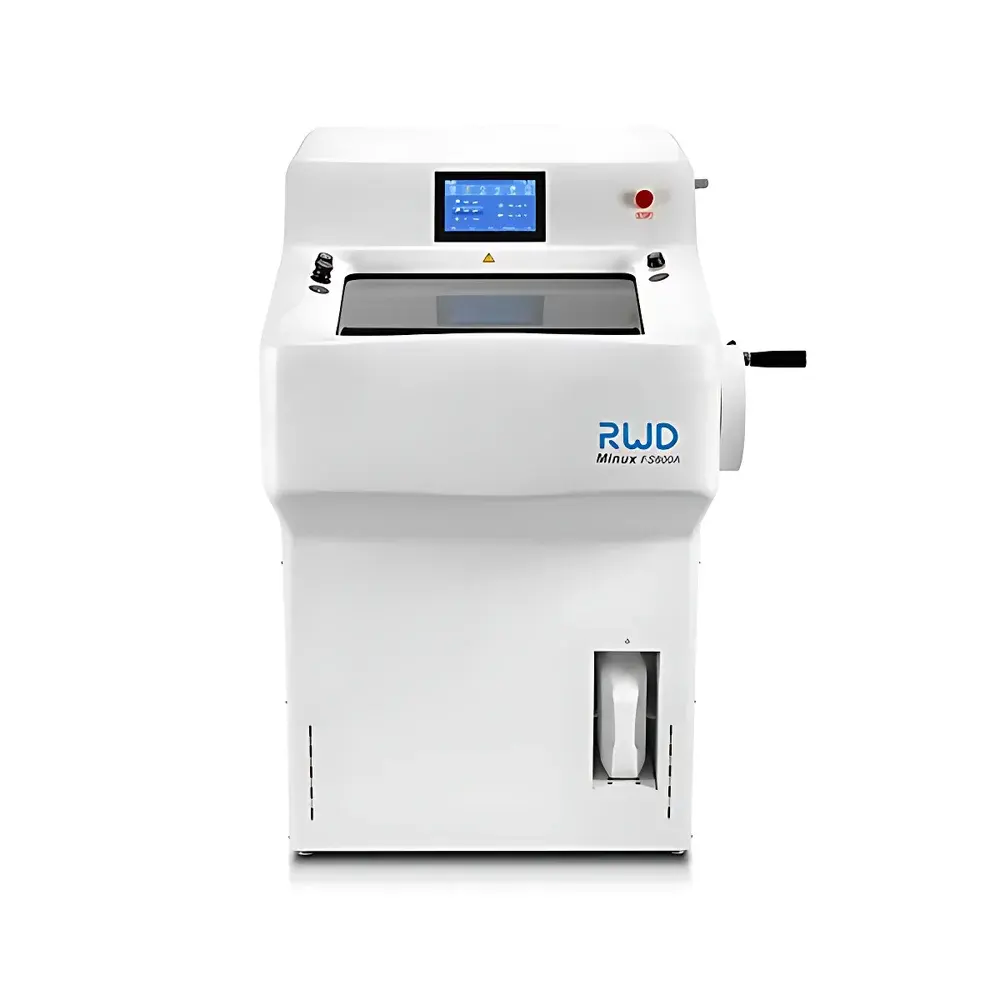
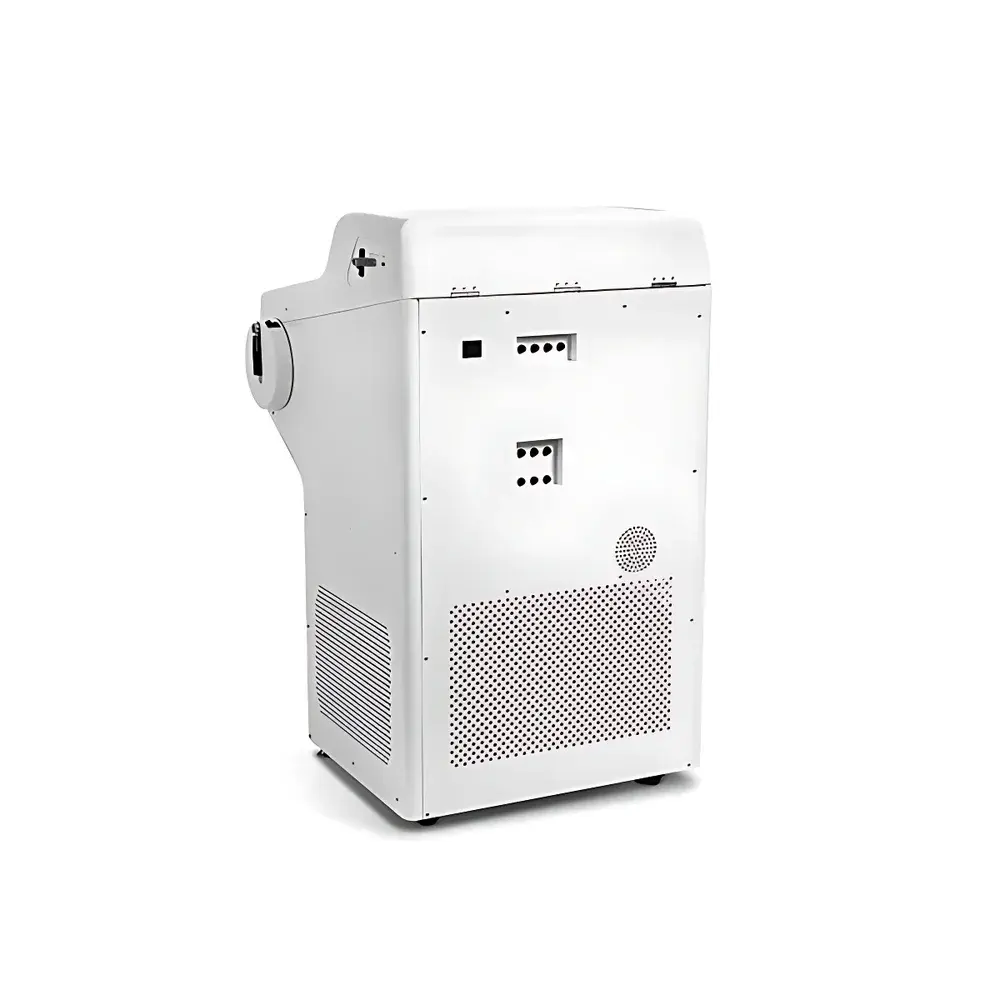
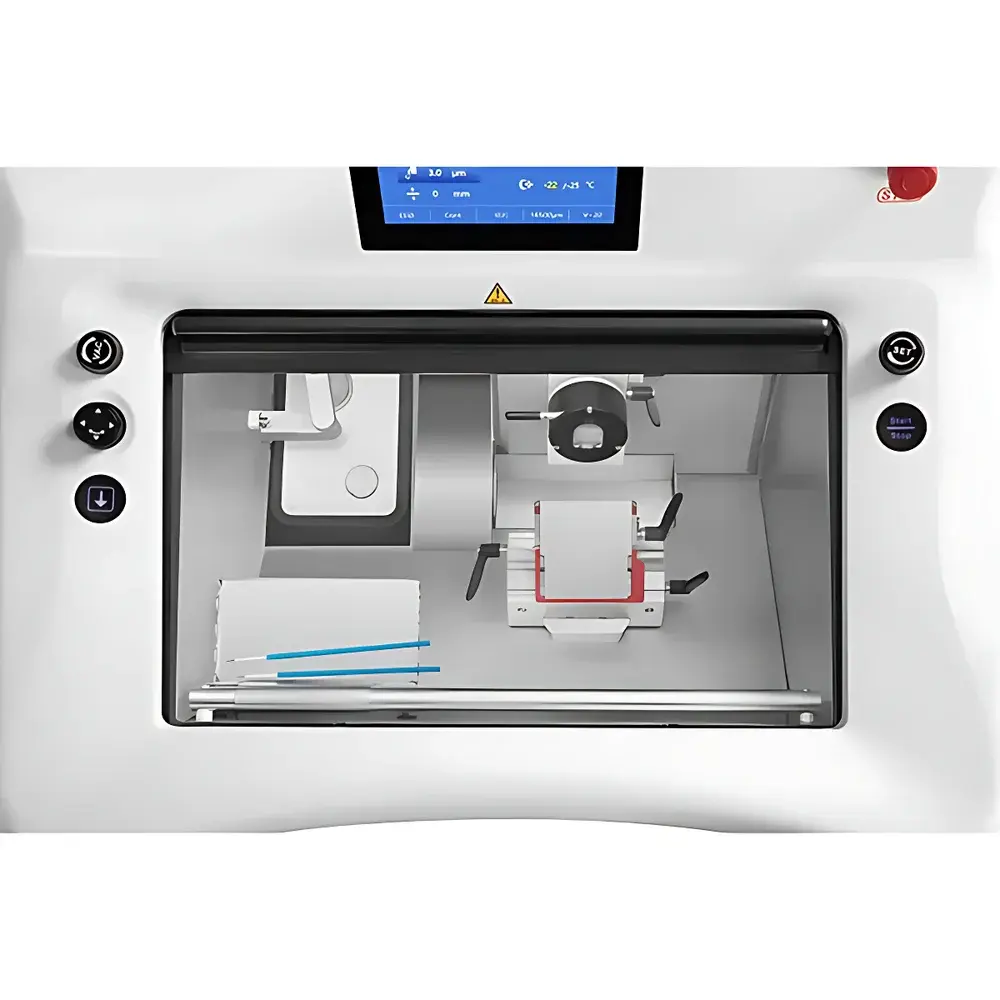
RWD FS800A Cryostat Microtome
| Brand | RWD |
|---|---|
| Origin | Guangdong, China |
| Manufacturer Type | Direct Manufacturer |
| Country of Origin | China |
| Model | FS800A |
| Quotation | Upon Request |
| Section Thickness Range | 0.5 – 100 µm |
| Horizontal Travel | 28 mm |
| Vertical Travel | 70 mm |
Overview
The RWD FS800A Cryostat Microtome is a fully automated, dual-zone refrigerated cryostat engineered for high-fidelity frozen sectioning in clinical intraoperative pathology and advanced life science research. Unlike conventional single-zone cryostats, the FS800A implements independent temperature control for both the specimen head and chamber cabinet—enabling precise thermal decoupling critical for heterogeneous tissue types (e.g., fatty breast tissue vs. fibrous muscle or delicate neural specimens). Its operational principle relies on controlled heat extraction via a multi-stage cooling architecture: a variable-frequency compressor drives primary refrigeration, while a secondary Peltier-based cooling loop delivers rapid, localized thermal stabilization at the specimen stage. This design ensures minimal ice crystal formation during sectioning, preserving antigenicity and RNA integrity—key prerequisites for immunohistochemistry (IHC), fluorescence in situ hybridization (FISH), and spatial transcriptomics workflows.
Key Features
- Dual-Zone Independent Refrigeration: Separate compressor-driven cabinet cooling and active specimen-head thermoregulation (via combined refrigerant circulation and semiconductor elements) enable simultaneous optimization of ambient chamber stability and sample-specific thermal setpoints.
- Precision Sectioning Mechanics: A hardened stainless-steel cross-roller bearing guide system coupled with a five-phase high-resolution stepper motor and aerospace-grade aluminum horizontal feed carriage ensures sub-micron positional repeatability across the full 28 mm horizontal travel range.
- Intelligent Auto-Cutting Modes: Four programmable sectioning protocols—including standard continuous cut, skip-cut, ribbon mode, and window-cut—allow adaptive response to tissue brittleness, embedding medium viscosity, and desired section yield per cycle.
- Ozone-Free UV Decontamination: An integrated 254 nm ultraviolet irradiation system operates continuously or on-demand at any chamber temperature, providing validated microbial reduction without ozone generation—compliant with ISO 15223-1 labeling requirements for medical devices.
- Touchscreen Human-Machine Interface: A 10.1-inch capacitive display with glove-compatible operation supports real-time temperature monitoring, protocol recall, motorized knife advance calibration, and error diagnostics with contextual help overlays.
Sample Compatibility & Compliance
The FS800A accommodates standard OCT-embedded tissue blocks (up to 30 × 30 × 20 mm) and supports both disposable steel knives and reusable tungsten-carbide blades. Its temperature range spans –5°C to –35°C (specimen head) and –15°C to –30°C (chamber), meeting ASTM E2912-22 guidelines for cryomicrotomy environmental control. The system adheres to IEC 61010-1:2010 safety standards for laboratory equipment and incorporates traceable temperature logging compatible with GLP/GMP documentation workflows. Optional audit trail modules support 21 CFR Part 11–compliant electronic records when integrated with validated LIMS environments.
Software & Data Management
Embedded firmware enables protocol storage (≥100 user-defined presets), automatic temperature ramping profiles, and timestamped event logging (e.g., knife advancement count, UV activation duration, door-open intervals). Exportable CSV logs include chamber temperature variance (±0.3°C over 8 h), specimen head thermal drift (<0.1°C/min), and motor step accuracy metrics. No cloud connectivity is included by default; all data resides locally on industrial-grade eMMC storage—ensuring compliance with HIPAA and GDPR data residency requirements.
Applications
- Intraoperative frozen section diagnosis requiring turnaround times under 15 minutes per specimen
- Pre-analytical preparation for multiplexed IHC panels (e.g., PD-L1, CD8, Ki-67) where epitope preservation is temperature-sensitive
- Frozen tissue banking with RNA-seq compatibility—validated for >95% RIN retention in brain and liver samples sectioned at –22°C
- Spatial omics workflows including Visium HD and Xenium, where section thickness uniformity (CV < 3.5% across 100 µm cuts) directly impacts probe hybridization efficiency
- Neuroscience studies involving myelinated nerve bundles or hippocampal subregions requiring minimal compression artifact
FAQ
What is the minimum achievable section thickness with the FS800A, and what factors influence reproducibility at sub-1 µm levels?
The instrument achieves a nominal lower limit of 0.5 µm; however, consistent sub-1 µm sectioning requires optimized embedding, knife sharpness, and temperature matching between specimen and knife edge—typically –25°C for neural tissue and –18°C for adipose-rich samples.
Does the FS800A support integration with third-party digital pathology scanners or LIS systems?
Yes—via RS-232 and Ethernet interfaces, it outputs standardized ASCII status codes and temperature telemetry compatible with common middleware (e.g., Sunquest, Cerner CoPath). Custom API development is available under NDA.
How frequently must the UV lamp be replaced, and is intensity calibration traceable to NIST standards?
Lamp lifetime is rated at 8,000 hours; integrated photodiode monitoring triggers replacement alerts. Intensity verification kits (traceable to NIST SRM 2032) are offered as optional accessories.
Is the waste fluid collection system compliant with biohazard containment regulations for BSL-2 laboratories?
The sealed, removable waste reservoir meets ANSI/ASHRAE 110-2016 containment criteria and includes hydrophobic filter membranes rated for aerosol capture down to 0.3 µm.



