


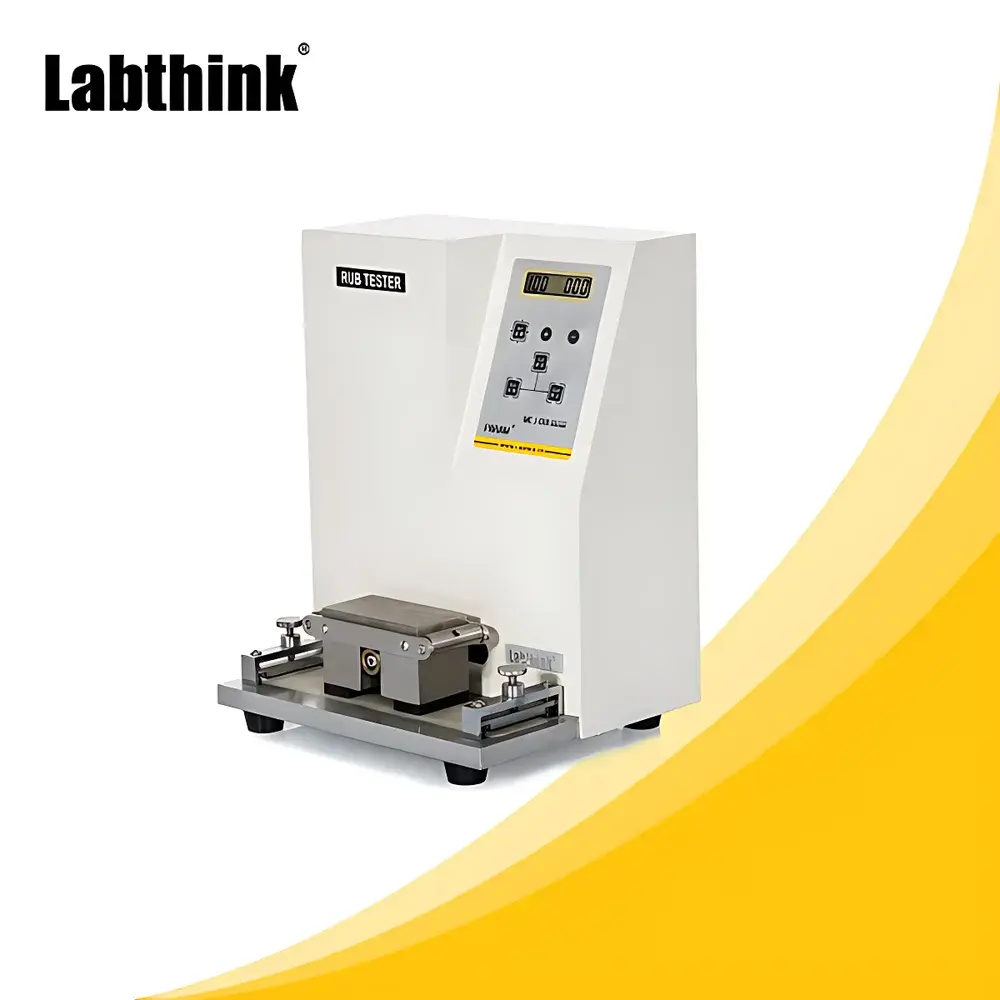
Labthink MCJ-01A Ink Abrasion Tester for Printed Materials
| Brand | Labthink |
|---|---|
| Model | MCJ-01A |
| Origin | Shandong, China |
| Manufacturer | Labthink Instruments Co., Ltd. |
| Application | Ink adhesion & coating abrasion resistance testing on printed packaging |
| Standard Compliance | GB/T 7706 (Letterpress decorative printed products) |
| Test Load | 20 ± 0.2 N |
| Stroke Frequency | 3 cycles per minute (cpm) |
| Abrasion Area | 155 mm (L) × 50 mm (W) |
| Cycle Count Range | 0–999 |
| Specimen Size | 230 mm (L) × 50 mm (W) |
| Power Supply | AC 220 V, 50 Hz |
| Dimensions (L×W×H) | 260 × 230 × 360 mm |
| Net Weight | 22 kg |
Overview
The Labthink MCJ-01A Ink Abrasion Tester is an electromechanical instrument engineered for quantitative evaluation of surface coating integrity—specifically ink layer adhesion and mechanical durability—on flexible packaging substrates, printed paperboard, labels, and PS plates. It operates on the principle of controlled linear reciprocating motion under defined normal load and fixed stroke frequency, simulating real-world handling, stacking, transport, and consumer interaction conditions that induce mechanical wear. Unlike optical or chemical degradation assessments, this tester delivers objective, repeatable mechanical stress data aligned with physical failure modes: ink rub-off, pigment delamination, and topcoat chipping. Its design adheres to the metrological requirements of GB/T 7706, which specifies test methodology for letterpress decorative printed products, and serves as a foundational reference for internal quality control protocols in packaging R&D and production QA environments.
Key Features
- Microprocessor-controlled operation with embedded firmware ensuring precise cycle counting, load consistency, and timing repeatability across extended test sequences.
- Integrated friction platform with rigid PVC base and standardized contact geometry (155 mm × 50 mm), guaranteeing uniform pressure distribution and eliminating edge-effect variability during abrasion.
- Quiet-running linear actuation mechanism—designed for laboratory environments where acoustic interference must be minimized during concurrent instrumentation use.
- Intuitive PVC membrane keypad and LCD display enable direct parameter input (cycle count, start/stop) and real-time status feedback without external software dependency.
- Power-loss memory function retains set parameters and accumulated cycle count during unexpected power interruption, preventing data loss and enabling resumption from last valid state.
- Modular sample holder accommodates specimens up to 230 mm × 50 mm, supporting standard sheet formats used in flexographic, gravure, and offset print validation workflows.
Sample Compatibility & Compliance
The MCJ-01A accepts flat, rigid or semi-rigid substrates including coated paper, laminated films, aluminum foil composites, corrugated board facestock, and photopolymer PS plates. Surface curvature, excessive flexibility (>5% tensile elongation at break), or dimensional instability under 20 N load are excluded from valid test scope. The instrument fulfills essential metrological criteria referenced in GB/T 7706 and provides traceable output suitable for internal audit documentation. While not certified to ISO/IEC 17025 as a standalone testing laboratory, its operational parameters align with good manufacturing practice (GMP) expectations for equipment qualification—particularly Installation Qualification (IQ) and Operational Qualification (OQ)—when deployed within regulated packaging supply chains serving pharmaceutical or food-grade applications.
Software & Data Management
The MCJ-01A operates as a stand-alone hardware system with no proprietary PC software required. All test configuration and result logging occur via onboard interface; numerical outputs (total cycles completed, pass/fail threshold reached) are displayed and retained locally. For integration into enterprise quality management systems (QMS), users may manually transcribe cycle counts and visual assessment notes (e.g., ISO 105-X12 grayscale rating of transferred ink) into validated electronic records. The device supports 21 CFR Part 11 compliance when paired with appropriate QMS platforms—provided user-defined audit trails, electronic signatures, and data integrity controls are implemented at the system level, not within the tester itself.
Applications
- Evaluation of ink adhesion strength following solvent-based, UV-curable, or water-based printing processes.
- Comparative assessment of varnish, lacquer, or matte/gloss coating performance under mechanical shear stress.
- PS plate durability screening for commercial printing press qualification—correlating lab-scale abrasion cycles with estimated press run length (e.g., impressions per plate life).
- Root-cause analysis of field complaints related to scuffing, smudging, or color transfer during logistics handling.
- Pre-release verification of label adhesion integrity on HDPE, PET, or glass containers subjected to automated packaging line friction.
- Supporting ASTM D5264 (Standard Practice for Determining Resistance of Printed Materials to Rubbing) correlation studies when combined with standardized abrasive media and visual evaluation protocols.
FAQ
Does the MCJ-01A support variable test loads or speeds beyond the specified 20 N and 3 cpm?
No. The instrument is calibrated and validated exclusively for 20 ± 0.2 N normal force and 3 cpm stroke frequency per GB/T 7706. Altering these parameters invalidates conformance to the standard and voids traceability.
Can the tester accommodate cylindrical samples such as printed tubes or bottles?
No. Sample geometry must be planar and dimensionally stable under static load. Curved surfaces require alternative test methods (e.g., rotary abrasion per ASTM D4060).
Is calibration certification included with shipment?
Yes. Each unit ships with a factory calibration report documenting load cell verification against NIST-traceable deadweight standards and cycle timing accuracy measured with Class 0.1 digital stopwatch.
What maintenance is required to ensure long-term measurement stability?
Biannual inspection of linear guide rails for particulate accumulation, lubrication of drive mechanism per manufacturer’s technical bulletin, and annual verification of applied load using calibrated force gauge.
How is pass/fail determined for a given test?
Pass/fail is defined externally by user-established acceptance criteria—typically based on visual assessment (e.g., ISO 105-X12 gray scale rating ≥4) or instrumental colorimetric delta-E change ≤2.0 after specified cycle count. The instrument reports only cycle completion; interpretation remains a quality protocol responsibility.






