
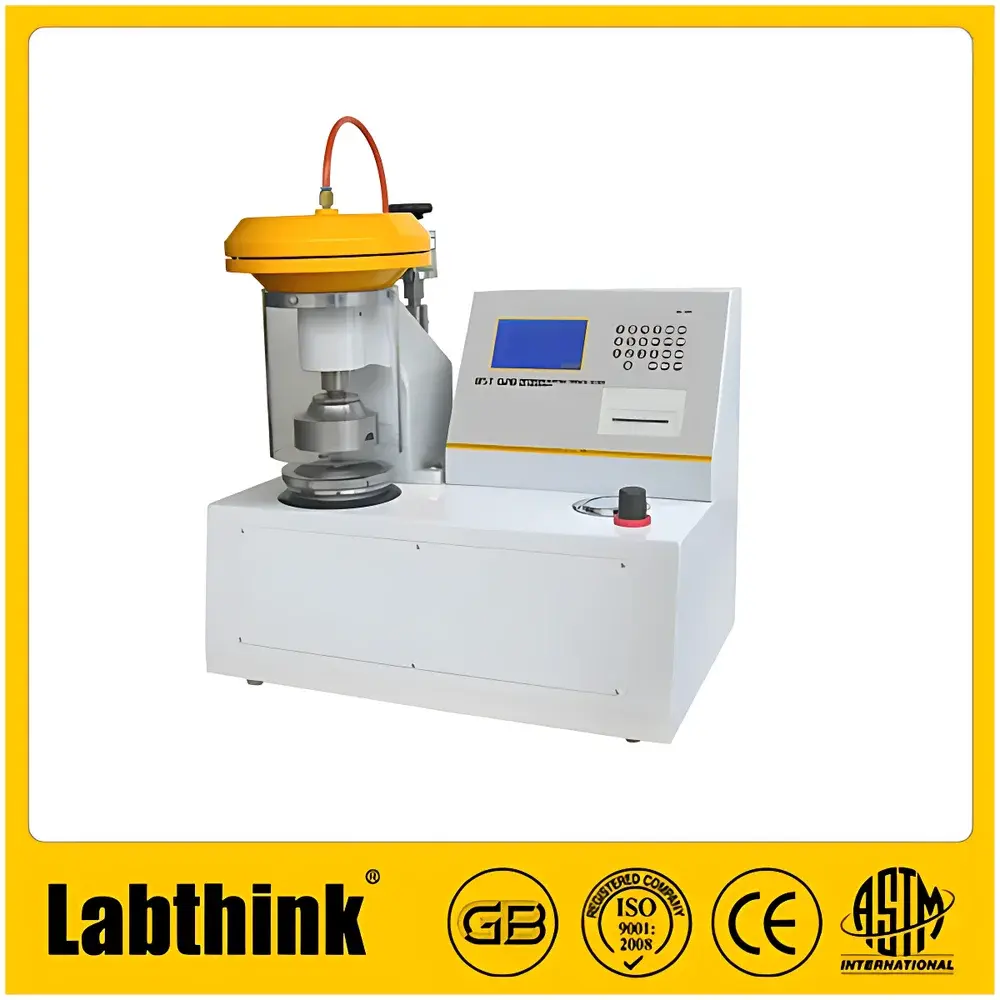
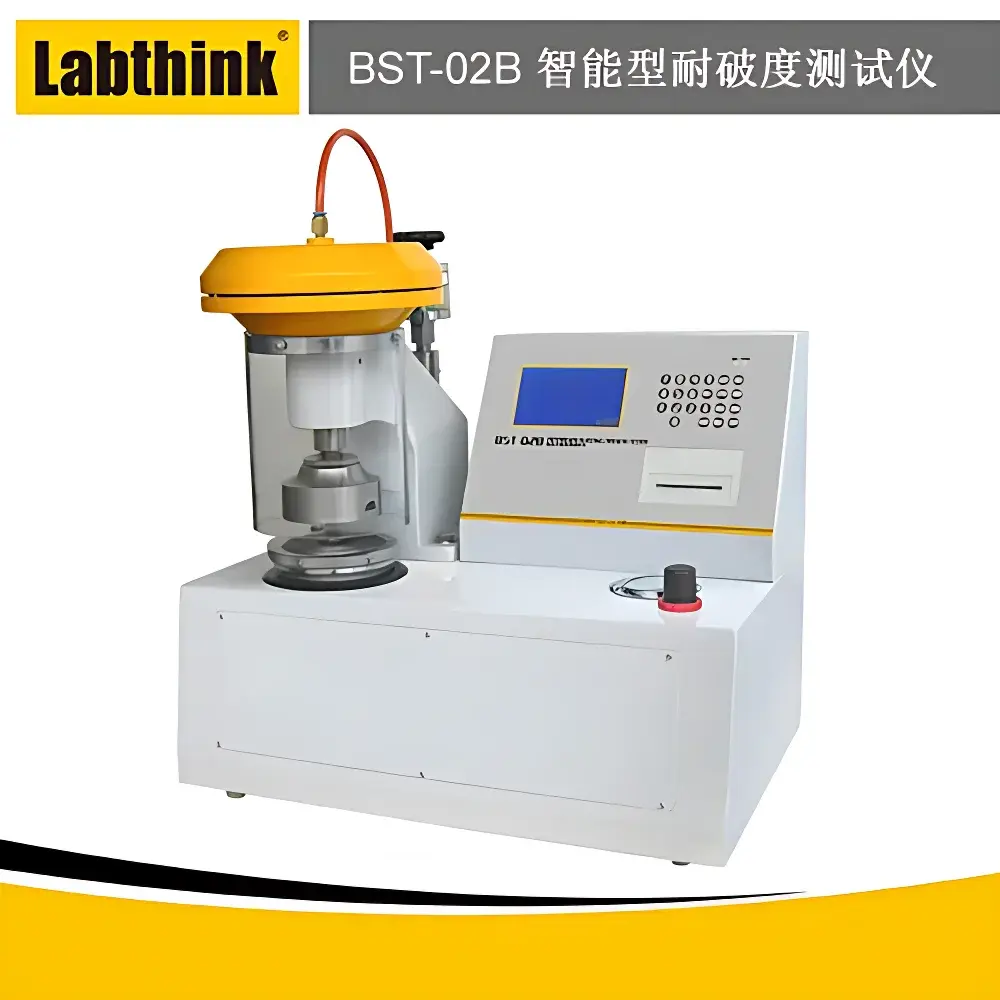
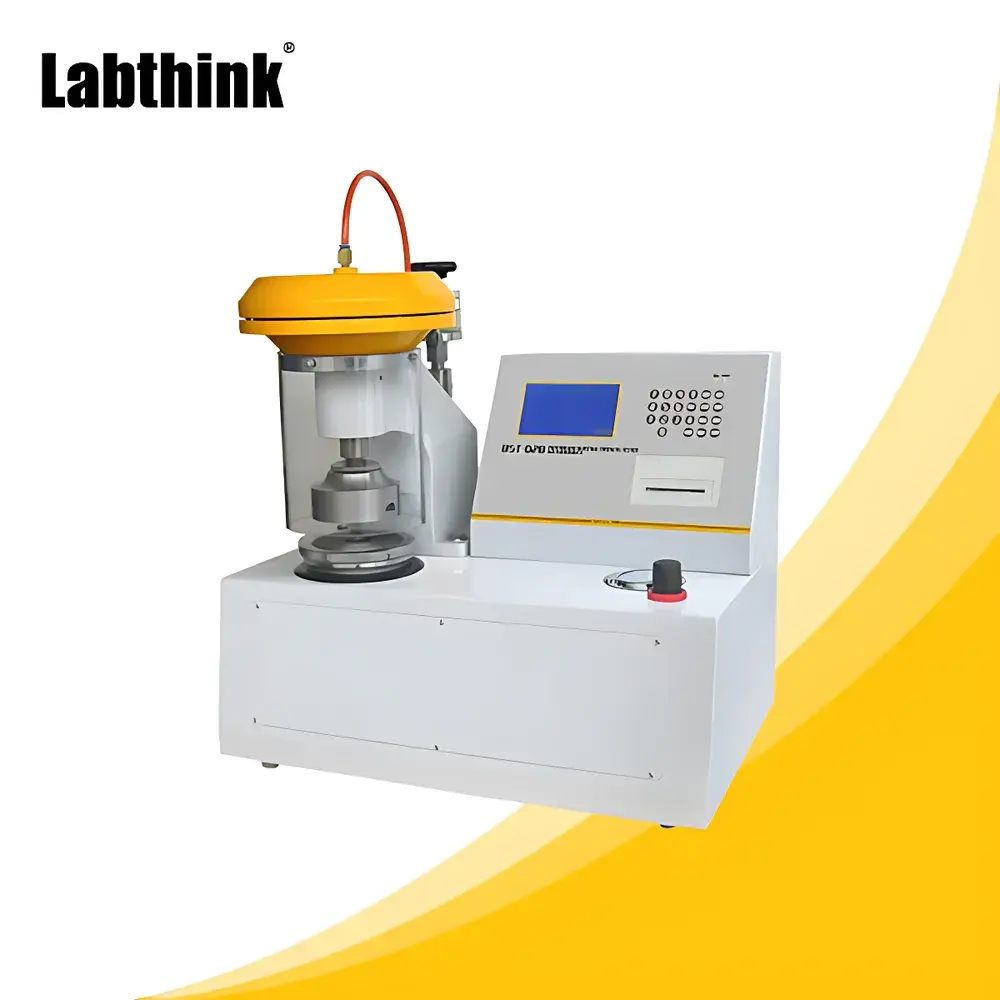
Labthink BST-02B Automatic Bursting Strength Tester for Corrugated Boxes and Paperboard
| Brand | Labthink |
|---|---|
| Model | BST-02B |
| Measurement Range | 250–5600 kPa |
| Accuracy | ≤0.5% FS |
| Resolution | 0.1 kPa (low range) / 1 kPa (high range) |
| Hydraulic Oil Flow Rate | 170 ± 15 mL/min (methyl silicone oil) |
| Diaphragm Resistance | 170–220 kPa (10 mm dome height) |
| Clamp Pressure | >690 kPa (adjustable) |
| Clamp Ring Inner Diameter | Φ31.5 ± 0.05 mm (upper & lower) |
| Air Supply Requirement | 0.02–0.3 m³/min at 0.6–0.7 MPa |
| Dimensions | 530 × 350 × 600 mm |
| Weight | 85 kg |
| Power | AC 220 V, 50 Hz |
| Compliance | GB/T 1539, GB/T 6545, ISO 2759 |
Overview
The Labthink BST-02B Automatic Bursting Strength Tester is a precision-engineered instrument designed specifically for evaluating the bursting resistance of corrugated fiberboard, solid fiberboard, and multi-ply paperboard used in packaging applications. It operates on the standardized hydraulic diaphragm method defined in ISO 2759, GB/T 1539, and GB/T 6545: a conditioned test specimen is clamped uniformly between upper and lower annular rings, then subjected to controlled hydraulic pressure via a flexible rubber diaphragm until rupture occurs. The peak pressure recorded—expressed in kPa, kgf/cm², or lbf/in²—represents the material’s bursting strength, a critical parameter for predicting box integrity under compressive stacking loads and handling stresses during distribution.
Built around a microprocessor-controlled closed-loop hydraulic system, the BST-02B integrates real-time force monitoring, automatic peak-hold functionality, and dynamic curve visualization of pressure vs. time. Its pneumatic clamping mechanism ensures consistent, operator-independent sample fixation across variable thicknesses (up to 12 mm), minimizing edge effects and improving inter-laboratory reproducibility. The system employs methyl silicone oil as the hydraulic medium—non-corrosive, non-volatile, and thermally stable—ensuring long-term calibration integrity and compliance with material compatibility requirements specified in ISO 2759 Annex A.
Key Features
- Microcomputer-based control architecture with embedded real-time operating system for deterministic response and minimal latency in burst detection
- 5-inch high-contrast LCD interface with intuitive Chinese menu (English firmware optional); supports dual-language operation without hardware modification
- Automatic peak-locking algorithm with millisecond-level sampling rate (≥100 Hz) to capture true rupture point, eliminating manual interpretation bias
- Multi-unit conversion engine supporting kPa, kgf/cm², and lbf/in²—values recalculated in real time with traceable NIST-traceable scaling coefficients
- Pneumatically actuated clamping system with adjustable pressure regulation (≥690 kPa nominal clamp force), ensuring uniform stress distribution across heterogeneous board structures
- Integrated thermal-stable silicone oil delivery system with calibrated flow rate (170 ± 15 mL/min) and integrated filtration to prevent particulate contamination of the diaphragm chamber
- Non-volatile memory retention: all test data—including timestamp, sample ID, raw curve, max/min/mean values, and bursting coefficient—are preserved during power interruption
- Onboard thermal printer with configurable report layout; outputs include test date/time, sequence number, individual readings, statistical summary, and compliance flag against user-defined limits
Sample Compatibility & Compliance
The BST-02B accommodates standard test specimens measuring 145 mm × 145 mm (per ISO 2759) and accepts board calipers from 0.15 mm to 12.0 mm without mechanical reconfiguration. Its fixed-diameter clamping rings (Φ31.5 ± 0.05 mm) conform precisely to ISO 2759 dimensional tolerances, enabling direct comparability with reference laboratories participating in international round-robin studies. The instrument meets full regulatory alignment with GB/T 1539 (Chinese national standard for cardboard bursting strength), GB/T 6545 (corrugated board testing), and ISO 2759:2021 (paper and board — Determination of bursting strength). All measurement electronics are CE-marked and comply with IEC 61000-4 electromagnetic immunity standards. Optional software modules support 21 CFR Part 11-compliant audit trails, electronic signatures, and role-based access control for GLP/GMP environments.
Software & Data Management
An optional PC-based analysis suite (Labthink BurstSoft v3.x) connects via RS-232 serial interface to enable advanced post-test evaluation. The software imports native binary curve files (.bdt), overlays multiple test runs for comparative analysis, applies ISO 2759-compliant smoothing filters, and exports results to CSV, PDF, or XML formats compatible with LIMS integration. Calibration logs, maintenance records, and user activity histories are stored with immutable timestamps. Data encryption (AES-128) and session timeout policies satisfy internal IT security policies for regulated industries. Firmware updates are delivered via signed .hex packages verified through SHA-256 checksums prior to installation.
Applications
- Quality assurance of single- and double-wall corrugated shipping containers prior to palletization
- R&D validation of recycled fiber blends, starch-based coatings, and moisture-barrier laminates
- Supplier qualification testing per ASTM D7265 (standard specification for containerboard) and TAPPI T 403
- Correlation studies between bursting strength and edge crush test (ECT) or compression performance
- Root cause analysis of field failures linked to insufficient board tensile or burst resistance
- Process capability assessment (Cp/Cpk) for paper machine basis weight and refining control loops
FAQ
What hydraulic fluid is required for operation?
Methyl silicone oil meeting ISO VG 10 specifications—non-corrosive, low volatility, and stable over −20 °C to +80 °C—is mandatory. Mineral oils or glycerin-based fluids are incompatible and void calibration.
Is an air compressor included with the system?
No. Users must supply a clean, dry, oil-free compressed air source delivering 0.02–0.3 m³/min at 0.6–0.7 MPa. A refrigerated dryer and 5-μm particulate filter are strongly recommended.
Can the instrument be validated per IQ/OQ protocols?
Yes. Labthink provides vendor-qualified Installation Qualification (IQ) and Operational Qualification (OQ) documentation templates aligned with ISO/IEC 17025 and ASTM E2500. On-site PQ support is available upon request.
How often does the rubber diaphragm require replacement?
Under normal usage (≤50 tests/day), the diaphragm maintains metrological integrity for ≥12 months or 5,000 cycles—whichever occurs first. Replacement kits include NIST-traceable calibration verification certificates.
Does the system support networked data export to enterprise systems?
When equipped with the optional Ethernet-to-RS232 converter and BurstSoft Enterprise Edition, the BST-02B supports scheduled FTP uploads, OPC UA server integration, and RESTful API endpoints for MES/ERP synchronization.





