
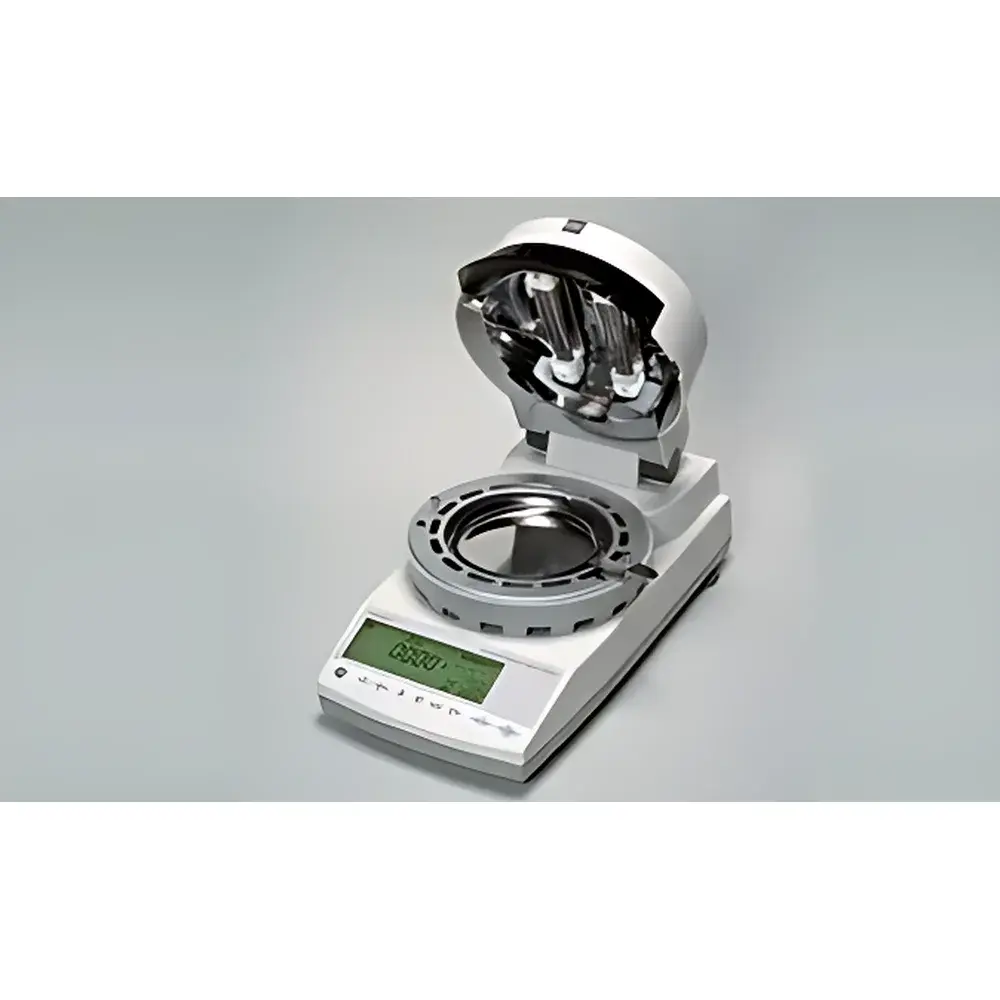
Shimadzu MOC-120H Infrared Moisture Analyzer
| Brand | Shimadzu |
|---|---|
| Origin | Japan |
| Model | MOC-120H |
| Measurement Principle | Infrared Heating + Gravimetric Loss-on-Drying |
| Weighing Range | 120 g |
| Minimum Readability | 0.001 g |
| Moisture Content Range | 0.01–100.00% |
| Moisture Resolution | 0.01% |
| Sample Pan Diameter | 130 mm |
| Heating Source | Medium-Wave Quartz Infrared Heater |
| Temperature Setting Range | 30–180 °C (1 °C increments) |
| Heater Lifetime | 20,000–30,000 hours |
| Power Supply | AC 100–120 V / 220–240 V, max. 640 W |
| Dimensions (W×D×H) | 220 × 415 × 190 mm |
| Weight | 4.5 kg |
| Operating Environment | 5–40 °C, ≤85% RH |
| Interface | RS-232C (direct Excel data export) |
| Predefined Modes | 10 |
| Stop Criteria | Auto-stop, Time-stop |
| Drying Profiles | Standard, Rapid, Slow, Stepwise, Predictive (Comparative) |
Overview
The Shimadzu MOC-120H Infrared Moisture Analyzer is a high-precision gravimetric instrument engineered for rapid, reproducible moisture content determination across diverse solid and semi-solid materials. It operates on the standardized loss-on-drying (LOD) principle: sample mass is continuously monitored during controlled infrared heating, and moisture content is calculated as the percentage mass loss relative to the initial dry-weight equivalent. Unlike conventional halogen or near-infrared systems, the MOC-120H employs a medium-wavelength quartz infrared heater optimized for uniform thermal penetration—minimizing surface charring while ensuring efficient internal water evaporation across heterogeneous matrices. Its core weighing system integrates Shimadzu’s proprietary Uni Bloc single-piece electromagnetic force compensation sensor, delivering exceptional stability against ambient temperature fluctuations and enabling consistent 0.001 g readability throughout extended measurement cycles. Designed for routine QC/QA laboratories, R&D facilities, and production environments subject to GLP and GMP requirements, the MOC-120H supports method validation, process monitoring, and raw material release testing in compliance with ASTM E1064, ISO 712, USP <921>, and AOAC Official Methods.
Key Features
- Uni Bloc monolithic weighing sensor ensures long-term drift resistance and maintains 0.001 g resolution under variable lab conditions.
- 130 mm wide sample pan enables uniform dispersion of up to 120 g of material—reducing edge effects and improving drying homogeneity.
- Medium-wave quartz infrared heater delivers balanced energy absorption across organic polymers, pharmaceutical powders, foodstuffs, and mineral-based samples, with rated service life of 20,000–30,000 hours.
- Nine configurable drying protocols—including automatic endpoint detection, fixed-time termination, rapid/slow/stepwise heating, and predictive comparative analysis—support method development and regulatory traceability.
- Ten user-definable measurement modes store complete parameter sets (temperature profile, stop condition, monitoring interval), allowing one-touch recall for SOP-compliant operation.
- Real-time analog bar graph display visualizes mass change rate during drying, aiding endpoint estimation and process understanding without interrupting measurement.
- Integrated “Direct-Through Window” function enables live data streaming to Microsoft Excel via standard RS-232C cable—no driver installation or third-party software required.
- Automatic tare compensation corrects zero-point drift dynamically during prolonged assays; built-in deviation correction aligns results with reference methods (e.g., Karl Fischer titration or oven-dry standards).
- Backlit LCD panel (240 × 128 pixels) ensures legibility in low-light environments; ergonomic layout minimizes operator error during high-throughput workflows.
Sample Compatibility & Compliance
The MOC-120H accommodates granular, powdered, paste-like, and fibrous samples—including APIs, excipients, dairy powders, cereals, soil aggregates, and industrial catalysts—without requiring pre-grinding or solvent extraction. Its wide temperature range (30–180 °C, adjustable in 1 °C steps) permits optimization for thermally sensitive compounds (e.g., vitamins, enzymes) and refractory materials (e.g., clays, ceramics). All firmware and hardware design elements adhere to IEC 61000-4 electromagnetic compatibility standards. Data integrity features—including timestamped measurements, non-editable audit trails, and RS-232C output logs—support compliance with FDA 21 CFR Part 11 when used within validated laboratory information management systems (LIMS). The instrument meets CE marking requirements and conforms to JIS Z 8806 for moisture content determination methodology.
Software & Data Management
No dedicated software installation is required: raw mass vs. time datasets stream directly into Excel via RS-232C, enabling immediate statistical analysis, curve fitting (first-order drying kinetics), and report generation. Each measurement record includes date/time stamp, operator ID (manually entered), method name, temperature setpoint, final moisture %, standard deviation (if replicate mode enabled), and drying curve metadata. Optional thermal printer (sold separately) produces hard-copy reports with graphical drying profiles and numeric summaries—fully compliant with internal QA documentation protocols. For enterprise integration, ASCII-formatted output is compatible with common LIMS and ELN platforms using standard serial communication protocols.
Applications
- Pharmaceutical manufacturing: moisture verification of tablet granules, lyophilized products, and packaging desiccants per USP <921>.
- Food quality control: rapid batch release testing of flour, coffee, spices, and infant formula against Codex Alimentarius moisture limits.
- Chemical industry: incoming inspection of silica gels, molecular sieves, and polymer resins where residual solvent affects catalytic activity.
- Agricultural labs: grain moisture assessment for storage stability prediction and trade compliance (ISO 6540, ISO 712).
- Materials science: monitoring hygroscopic uptake in composites, battery electrode coatings, and ceramic green bodies during formulation development.
FAQ
What calibration standards are recommended for routine verification?
Shimadzu recommends certified anhydrous sodium tartrate (15.66% H₂O) and sodium chloride-saturated solution (75% RH equilibrium) for performance qualification. Daily zero calibration using the built-in auto-tare function is sufficient for most QC applications.
Can the MOC-120H be validated for GMP environments?
Yes—the instrument supports IQ/OQ documentation packages; its deterministic heating profile, traceable mass measurement, and unalterable data export meet ALCOA+ principles when operated within a controlled change-management system.
Is the infrared heater replaceable by the user?
The quartz heater module is field-replaceable using standard Torx tools and requires no recalibration; replacement part number is 207-63301.
Does the device support multi-language UI?
The display interface is fixed to English and Japanese; no additional language firmware is available.
How is thermal uniformity verified across the sample pan?
Shimadzu provides a thermal mapping protocol using calibrated thermocouple arrays (optional accessory kit); typical radial temperature deviation is ≤±2.5 °C at 105 °C across the 130 mm pan surface.




