
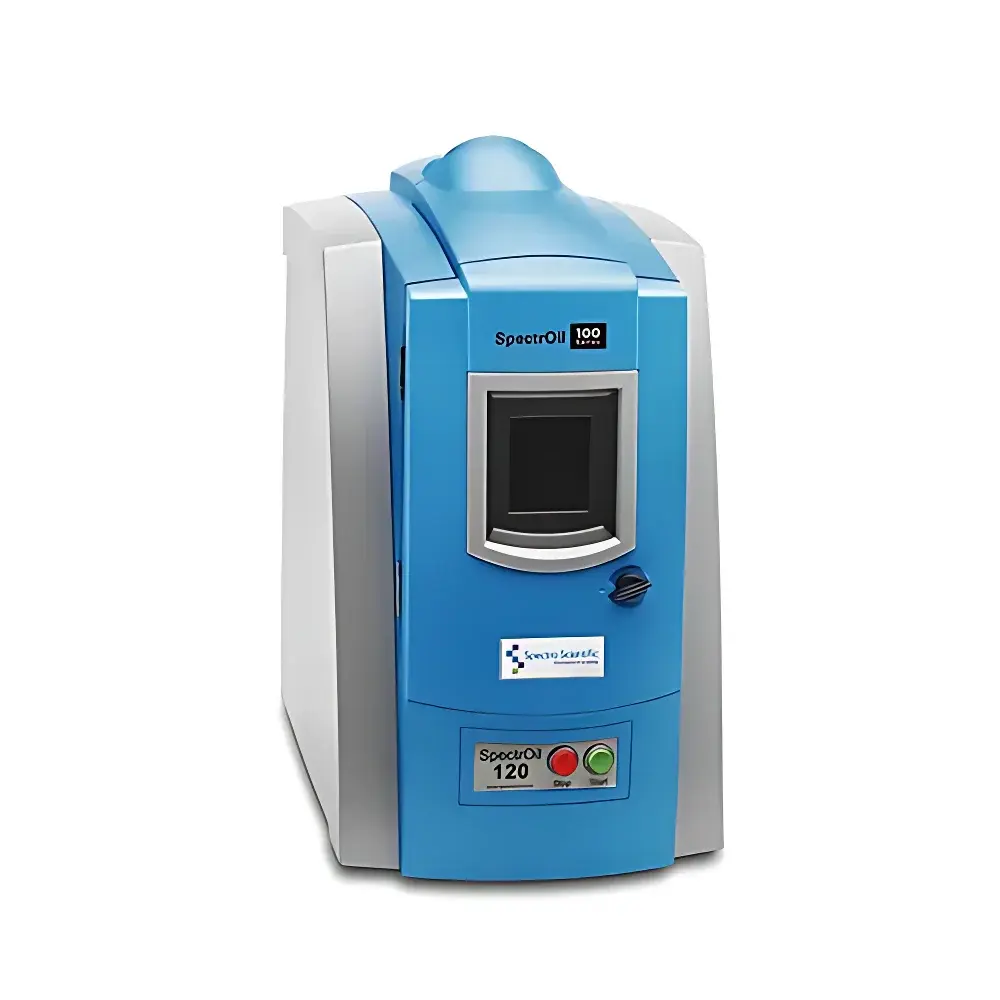
Spectro Scientific SpectrOil 100 Rotating Disk Electrode (RDE) Oil Elemental Spectrometer
| Brand | Spectro Scientific |
|---|---|
| Origin | USA |
| Model | SpectrOil 100 |
| Compliance | ASTM D6595, NB/SH/T 0865-2013, ASTM D6728 |
| Detection Principle | Rotating Disk Electrode Atomic Emission Spectrometry (RDE-AES) |
| Sample Type | Used lubricating oils, coolants, fuels, greases |
| Analysis Time per Sample | ≤30 s |
| Elements Standard | 24 elements (Al, Cd, Cr, Cu, Fe, Pb, Mg, Mn, Mo, Ni, Ag, Sn, Ti, V, Zn, Sb, B, Ca, K, Si, Na, Ba, P, Li) |
| Optional Elements | Sr, Bi, As, In, Co, Zr, W, Ce, Nb, Rh |
| Optical Detector | Dual-layer CCD array |
| Gas Requirement | None |
| Power Supply | Standard AC mains (100–240 VAC) |
| Form Factor | Benchtop, portable design |
| Software Compliance | FDA 21 CFR Part 11 ready (audit trail, electronic signature support), GLP/GMP data integrity features |
Overview
The Spectro Scientific SpectrOil 100 is a benchtop rotating disk electrode atomic emission spectrometer (RDE-AES) engineered for rapid, precise elemental analysis of used lubricating oils, coolants, fuels, and greases. Unlike inductively coupled plasma (ICP) or X-ray fluorescence (XRF) systems, the SpectrOil 100 employs a robust, gas-free RDE excitation source—where a rotating metal disk electrode immersed in the oil sample generates a stable plasma arc upon high-voltage discharge. This process volatilizes and atomizes trace metallic wear particles, contaminants, and additive elements directly from the liquid matrix, enabling quantitative multi-element detection without acid digestion or dilution. The instrument fully complies with ASTM D6595 (standard test method for elemental analysis of used lubricating oils by RDE-AES) and NB/SH/T 0865-2013 (Chinese national standard for oil spectral analysis), and supports ASTM D6728 for fuel analysis. Its compact footprint, absence of argon or other support gases, and direct liquid sampling make it uniquely suited for on-site lab environments, mobile maintenance units, and high-throughput condition monitoring centers.
Key Features
- Gas-free operation: Eliminates dependency on argon, helium, or nitrogen—reducing consumable costs and logistical complexity.
- Direct liquid sampling: No acid digestion, dilution, filtration, or solvent extraction required; oil samples are introduced neat via disposable capillaries.
- Sub-30-second analysis cycle: Full quantitative measurement of up to 24 elements per sample, including wear metals (Fe, Cu, Cr, Al), contaminants (Si, Na, B), and additives (Ca, Zn, P, Mg).
- Dual-layer CCD optical system: Provides superior signal-to-noise ratio and lower detection limits compared to traditional photomultiplier tube (PMT)-based RDE spectrometers—particularly critical for low-concentration wear particle detection.
- Benchtop modularity: Designed for flexible deployment in field labs, OEM service centers, or centralized analytical facilities; weighs under 25 kg and operates on standard AC power.
- Expandable elemental coverage: Optional 10-element package (e.g., Co, W, Ce, As, Rh) integrates seamlessly into existing calibration models—no hardware modification or recalibration downtime required.
- Automated standby mode: Maintains plasma readiness between analyses, minimizing warm-up delays and ensuring immediate response to urgent samples.
- Intuitive touch-enabled interface: Guided workflows reduce operator dependency; minimal training required for routine operation and QC verification.
Sample Compatibility & Compliance
The SpectrOil 100 is validated for direct analysis of mineral- and synthetic-based lubricants (engine oils, turbine oils, hydraulic fluids, gear oils), antifreeze/coolants (ethylene glycol and propylene glycol formulations), diesel and gasoline fuels, and semi-fluid greases (after mild homogenization). It meets ISO/IEC 17025 preconditions for accredited testing when operated within defined environmental controls (temperature stability ±2°C, vibration isolation). Method validation documentation—including limit of detection (LOD), limit of quantitation (LOQ), linearity (R² ≥ 0.999 over 0.1–100 ppm), and repeatability (RSD < 3% at 10 ppm)—is provided per ASTM D6595 Annex A1. The system supports full traceability for GLP and GMP-regulated environments, with configurable audit trails, user access levels, and electronic signature capability compliant with FDA 21 CFR Part 11.
Software & Data Management
Spectro’s proprietary SpectroSoft™ v5.2 platform provides integrated instrument control, spectral acquisition, multivariate calibration management, and trend analytics. Calibration models are factory-verified using NIST-traceable oil standards (SRM 2720a, 2721a) and include internal standard normalization (e.g., Yttrium or Scandium spike) to correct for viscosity and matrix effects. Data export supports CSV, XML, and LIMS-compatible ASTM E1394 formats. Built-in statistical process control (SPC) tools enable automated alarm generation based on absolute thresholds, rate-of-change (ROC), or modified Westgard rules. Historical datasets can be aggregated across fleets or asset groups to generate wear severity indices, lubricant depletion metrics, and predictive maintenance triggers—fully aligned with ISO 23171 (oil analysis reporting) and ISO 17359 (condition monitoring framework).
Applications
The SpectrOil 100 serves as the analytical core of predictive maintenance programs across energy, transportation, and heavy industry. In power generation, it monitors turbine oil for copper and iron spikes indicating bearing degradation or corrosion. In marine propulsion systems, it detects sodium and potassium ingress signaling seawater contamination in crankcase oils. Mining and rail operators use its rapid turnaround to screen gear oils for titanium and vanadium—early markers of gear tooth fatigue. Military depots deploy it for jet fuel analysis (per ASTM D6728) to verify thermal stability additives and detect catalytic metal residues from storage tanks. Its ability to quantify both wear metals and additive packages enables holistic lubricant health assessment—not merely “what’s wearing,” but “how well the oil is still protecting.”
FAQ
Does the SpectrOil 100 require daily calibration verification?
Yes—daily verification using a certified check standard (e.g., SpectroCheck™ QC oil) is recommended per ASTM D6595 Section 8.3 to ensure ongoing accuracy and compliance.
Can it analyze highly viscous oils such as gear oils or greases?
Yes—samples up to ISO VG 680 may be analyzed directly; greases require gentle warming (~40°C) and vortex mixing prior to loading, with no solvent addition.
Is method transfer possible from legacy PMT-based RDE instruments?
Yes—SpectroSoft includes cross-platform calibration migration tools; empirical correlation models are provided for seamless transition from Spectroil M-series or similar platforms.
What is the typical detection limit for iron (Fe) in engine oil?
Under standard operating conditions, the 3σ LOD for Fe is 0.12 ppm, verified per IUPAC definitions and confirmed with repeated analysis of blank mineral oil.
How is data integrity ensured during remote operation or networked deployment?
All data transactions are timestamped, digitally signed, and stored with immutable audit logs; role-based permissions prevent unauthorized parameter changes or result overrides.
Related Products





