
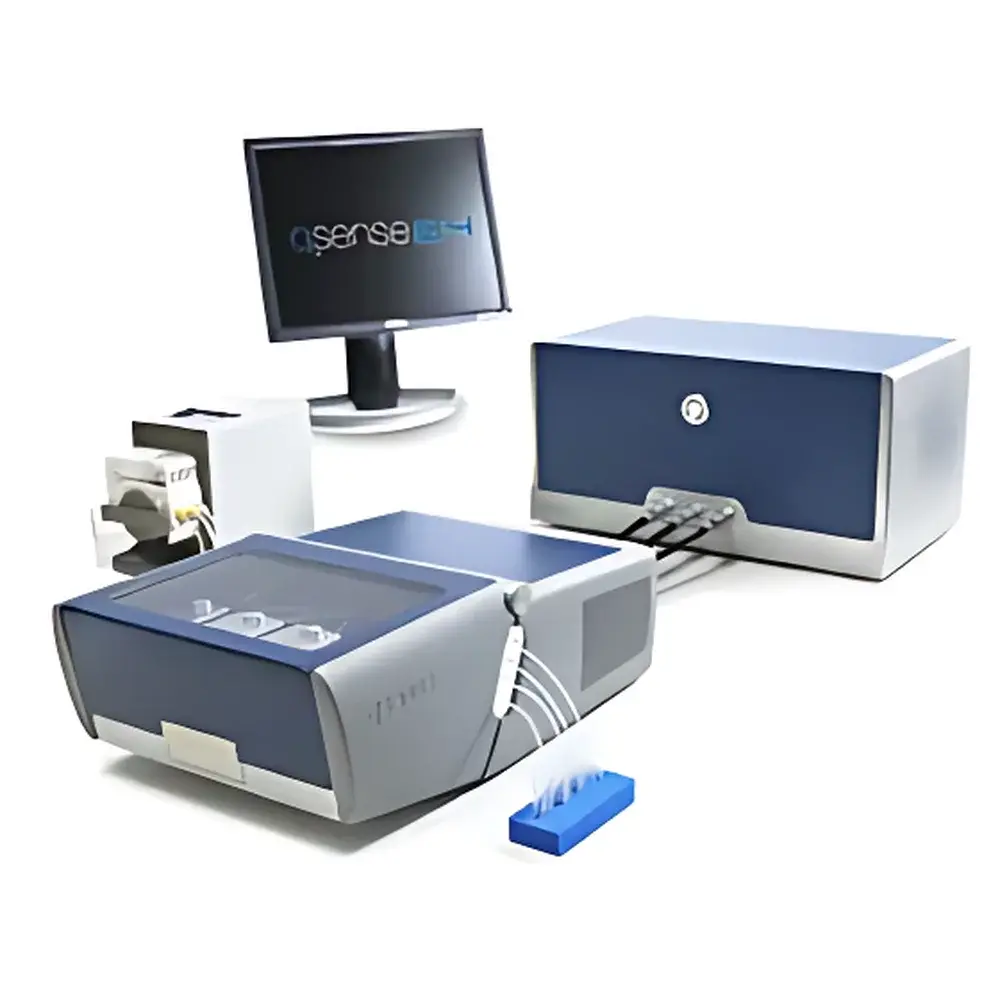
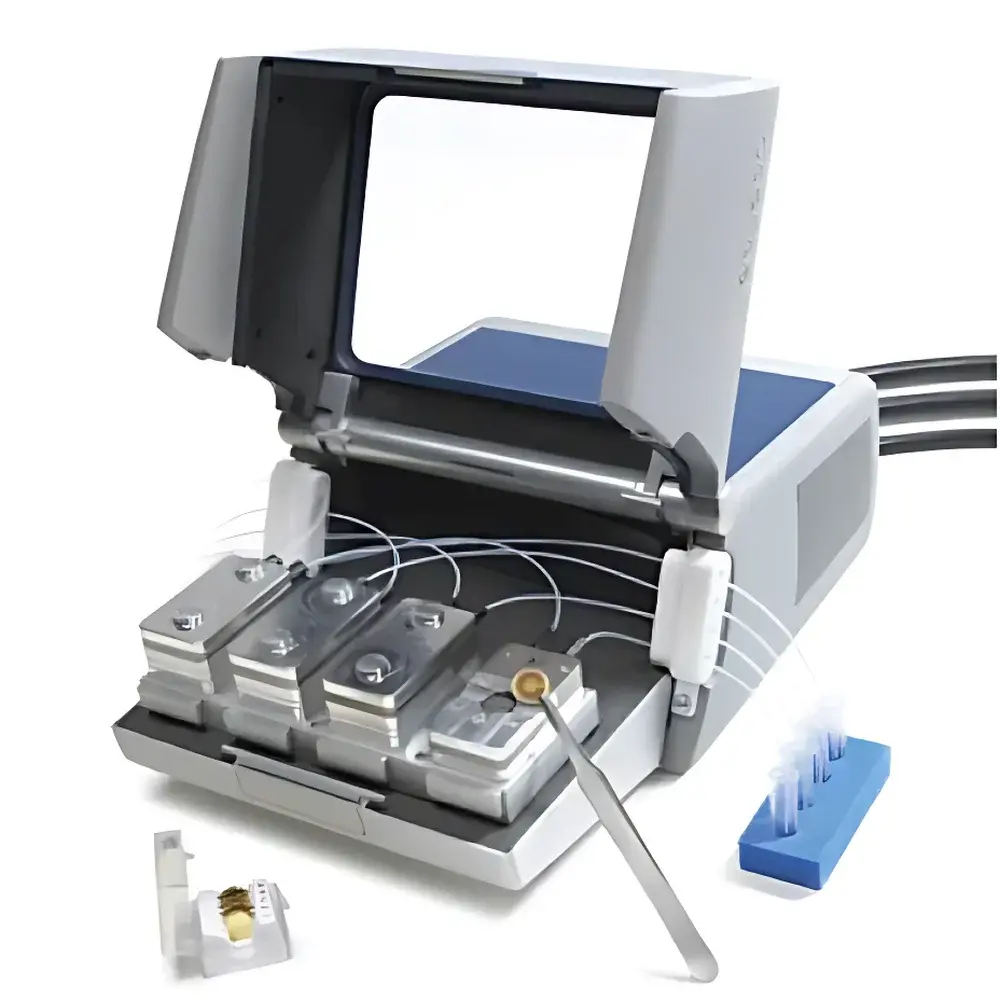
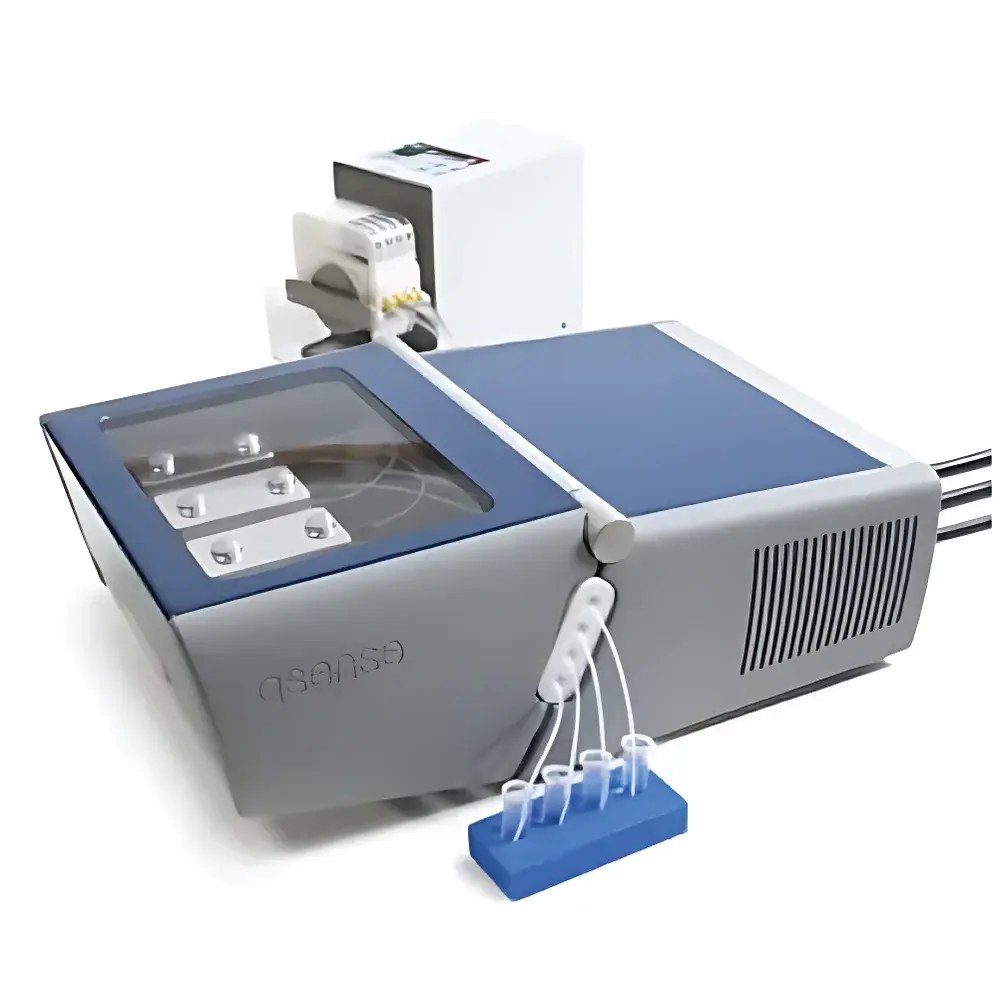
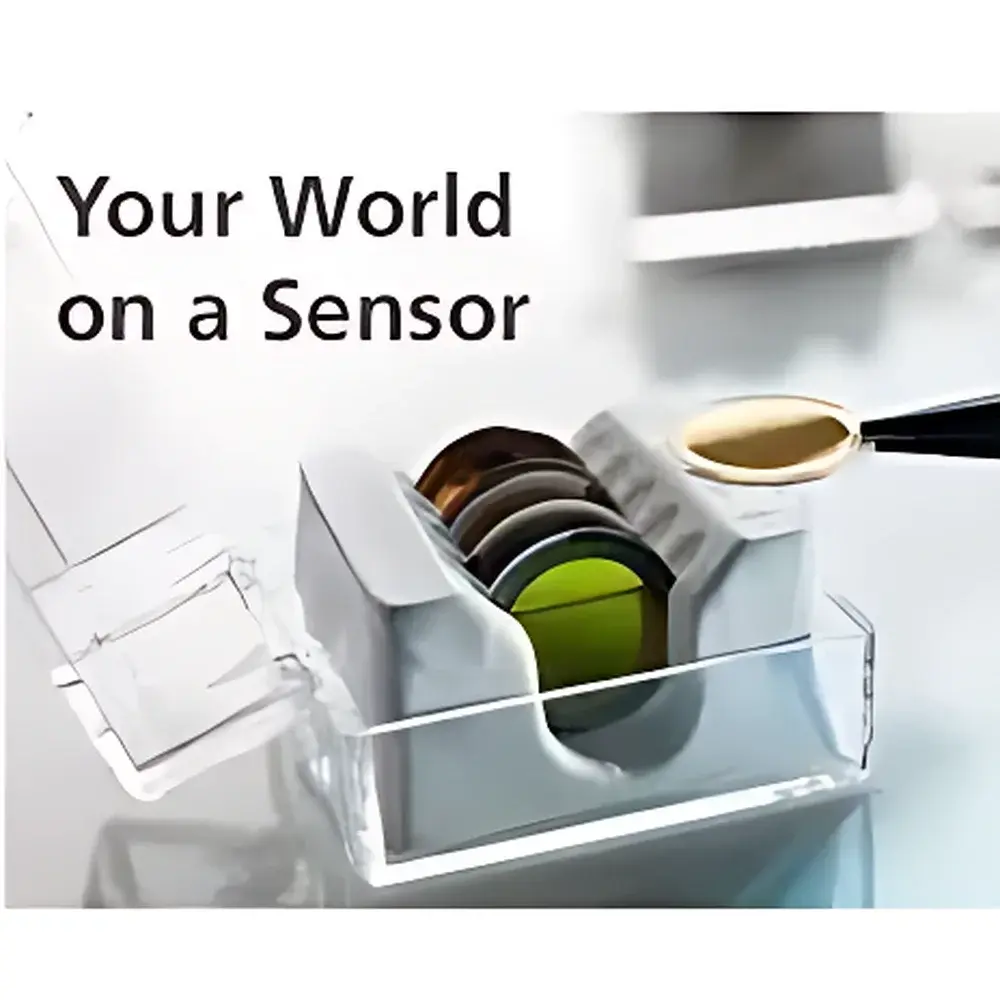
QSense Analyzer Advanced Four-Channel Quartz Crystal Microbalance with Dissipation Monitoring (QCM-D)
| Brand | QSense |
|---|---|
| Origin | Sweden |
| Model | Analyzer |
| Minimum Sample Volume | 40 µL |
| Temperature Range | 15–65 °C |
| Frequency Range | 1–70 MHz |
Overview
The QSense Analyzer Advanced Four-Channel Quartz Crystal Microbalance with Dissipation Monitoring (QCM-D) is a high-precision, real-time surface interaction analysis platform engineered for quantitative, label-free characterization of molecular adsorption, interfacial viscoelasticity, and dynamic layer formation at solid–liquid interfaces. Unlike conventional mass-sensing QCM systems, QCM-D operates on the principle of piezoelectrically excited shear-horizontal acoustic waves in AT-cut quartz crystals. When an alternating voltage is applied across the gold-coated electrodes, the crystal resonates at its fundamental or overtone frequencies (1–70 MHz). Upon adsorption of material onto the sensor surface—whether proteins, lipids, polyelectrolytes, cells, or synthetic polymers—the resonance frequency (Δf) decreases due to added mass, while the energy dissipation (ΔD) increases proportionally to the structural softness and internal friction of the adlayer. This dual-parameter output enables simultaneous determination of mass, thickness, shear viscosity, and shear elasticity via multi-frequency viscoelastic modeling—bypassing the rigid-film assumption inherent in the Sauerbrey equation. The Analyzer’s four independent flow channels support parallel, time-synchronized experiments under identical thermal and hydrodynamic conditions—critical for comparative studies, dose–response profiling, and reproducible method development in regulated environments.
Key Features
- Four-channel modular design with individual temperature-controlled flow cells (±0.02 °C stability), enabling true parallel experimentation and statistical robustness.
- Multi-harmonic QCM-D detection across up to 13 overtones (fundamental 5 MHz crystal, up to 65 MHz), delivering depth-resolved viscoelastic profiles of hydrated, soft films.
- Real-time acquisition at up to 200 data points per second per frequency—sufficient temporal resolution to capture rapid binding kinetics, enzymatic cleavage, or polymer swelling dynamics.
- Standardized fluidic architecture compatible with interchangeable sample cells: electrochemical QCM-D cells, optical flow cells (for combined QCM-D/ellipsometry), humidity-controlled chambers, high-temperature modules (up to 150 °C), and ALD-compatible sensor holders.
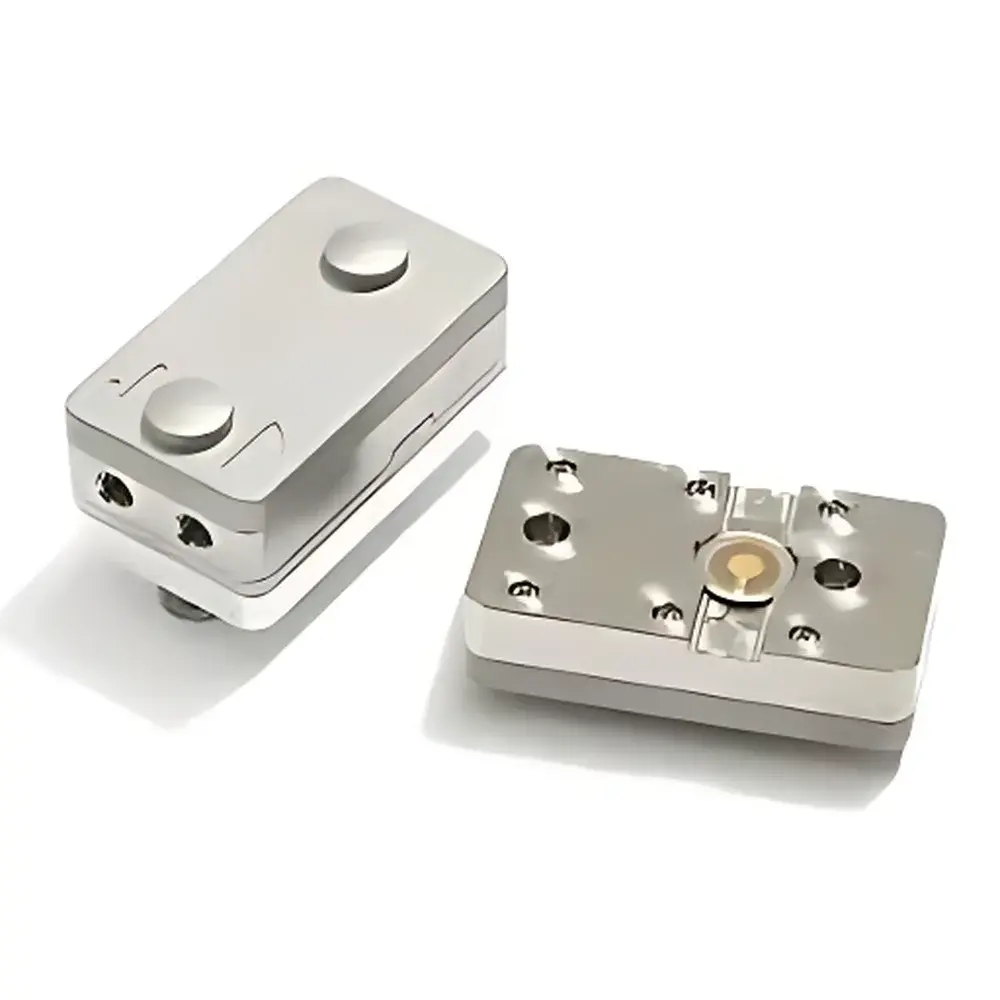
- Gold-coated, 14 mm diameter AT-cut quartz sensors (5 MHz) with ultra-smooth surface finish (<0.5 nm RMS roughness), optimized for reproducible biomolecular immobilization and low-noise signal transduction.
- Sub-nanogram mass sensitivity in liquid phase (~0.5 ng/cm² limit of detection) and dissipation resolution down to 4 × 10⁻⁸—enabling quantification of sub-monolayer conformational changes.
Sample Compatibility & Compliance
The QSense Analyzer supports diverse substrate chemistries—including bare gold, thiol-modified SAMs, silanized glass, plasma-polymerized coatings, and conductive polymers—allowing customization for specific interaction mechanisms (e.g., covalent coupling, electrostatic layer-by-layer assembly, or hydrophobic anchoring). All wetted components are chemically inert (PEEK, PTFE, stainless steel 316) and fully disassemblable for ultrasonic cleaning and sterilization. The system complies with ISO/IEC 17025 guidelines for analytical instrument qualification and supports GLP/GMP workflows through configurable audit trails, user access controls, and electronic signature capabilities in QSoft software. Experimental protocols align with ASTM E2982 (standard practice for QCM-D measurements of thin film properties) and FDA 21 CFR Part 11 requirements when deployed with validated software configurations.
Software & Data Management
QSoft v5.x provides integrated instrument control, real-time visualization, and advanced modeling—featuring built-in Voigt-based viscoelastic fitting, Sauerbrey conversion, and custom scripting (Python API) for automated batch analysis. Raw f/D time-series data are stored in HDF5 format with embedded metadata (sensor ID, temperature log, flow rate, timestamp), ensuring traceability and FAIR (Findable, Accessible, Interoperable, Reusable) data principles. Export options include CSV, MATLAB .mat, and export-ready figures compliant with journal submission standards (e.g., ACS, RSC, Elsevier). Remote monitoring and collaborative data review are supported via secure web interface; raw datasets can be archived directly to network drives or LIMS-integrated repositories.
Applications
- Protein–surface interactions: Quantifying adsorption kinetics, conformational rearrangement, and competitive displacement on functionalized biosensor surfaces.
- Lipid bilayer formation and membrane protein reconstitution: Monitoring vesicle fusion, bilayer integrity, and ligand-induced pore formation in real time.
- Polyelectrolyte multilayer (PEM) growth and stimuli-responsive swelling: Characterizing pH-, salt-, or temperature-triggered structural transitions with nanoscale mass and rigidity resolution.
- Cell adhesion and spreading dynamics: Tracking integrin-mediated attachment, cytoskeletal remodeling, and detachment under shear stress—without labels or fixation.
- Corrosion inhibition and coating degradation: Evaluating protective film formation, ion permeation, and interfacial delamination at metal–electrolyte interfaces.
- Drug delivery carrier interaction: Assessing micelle or liposome adsorption, payload release kinetics, and surface erosion profiles on model membranes.
- Catalyst surface fouling and regeneration: Mapping fouling layer accumulation and cleaning efficiency during continuous-flow catalytic reactions.
FAQ
What distinguishes QCM-D from conventional QCM?
QCM-D measures both resonance frequency shift (Δf) and energy dissipation (ΔD) simultaneously across multiple overtones, enabling quantitative viscoelastic modeling of soft, hydrated layers—whereas standard QCM assumes rigid, thin-film behavior and yields only mass estimates via the Sauerbrey relation.
Can the Analyzer perform electrochemical QCM-D experiments?
Yes—using the optional QSense EC module, which integrates potentiostat control, three-electrode electrochemistry, and synchronized f/D acquisition to correlate Faradaic processes with interfacial mass/viscoelastic changes.
Is temperature control precise enough for thermodynamic binding studies?
The integrated Peltier system maintains ±0.02 °C stability across the full 15–65 °C range, supporting van’t Hoff analysis and Arrhenius-based kinetic modeling with high confidence intervals.
How is data integrity ensured for regulatory submissions?
QSoft supports 21 CFR Part 11-compliant operation when configured with role-based access, electronic signatures, and immutable audit logs—validated per IQ/OQ/PQ protocols upon installation.
What sample volume is required per channel for continuous-flow experiments?
Minimum working volume above the sensor is ~40 µL; typical flow rates range from 50–200 µL/min, allowing efficient reagent use and compatibility with precious biological samples.
Related Products





