
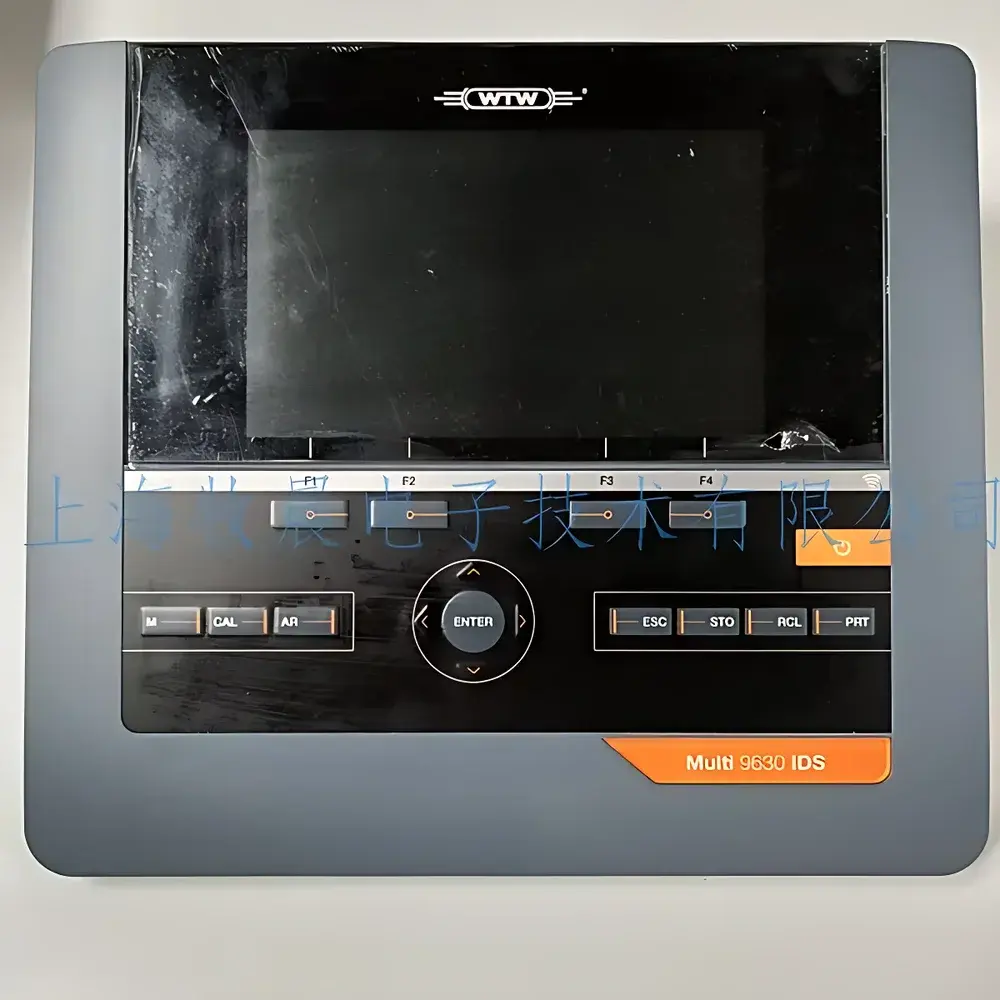
WTW Multi 9630 IDS Digital Multiparameter Laboratory Analyzer
| Brand | WTW |
|---|---|
| Origin | Germany |
| Model | Multi 9630 |
| Instrument Type | Portable/Laboratory Multiparameter Water Quality Analyzer |
| Detection Principle | Electrochemical (pH, ORP, Conductivity, DO) + Optical (Turbidity) |
| Measured Parameters | pH, ORP, Dissolved Oxygen (DO), Conductivity, Turbidity |
| Display | Backlit Graphic LCD |
| Data Storage | 10,000 automatic / 500 manual entries |
| Measurement Channels | 3 simultaneous IDS probe inputs |
| Connectivity | USB-B, USB-A (for printer/storage), optional wireless module |
| Compliance | QSC (Quality Sensor Control), CMC (Continuous Measurement Control), IP43 enclosure |
| Power | 4 × 1.5 V AA batteries or USB-B powered |
| Probe Interface | Digital IDS (Intelligent Digital Sensor) with auto-recognition and embedded calibration memory |
Overview
The WTW Multi 9630 IDS is a high-precision, digital multiparameter laboratory analyzer engineered for rigorous water quality assessment in environmental monitoring labs, municipal water facilities, research institutions, and industrial process control environments. Built upon WTW’s Intelligent Digital Sensor (IDS) platform, the instrument employs fully digitized signal acquisition and transmission—eliminating analog noise, cable-length limitations, and calibration drift associated with conventional analog electrodes. Each IDS probe houses its own microprocessor, factory-stored calibration data, sensor-specific configuration parameters, and real-time diagnostic metadata. The Multi 9630 reads this information automatically upon connection, ensuring traceable, operator-independent setup and full metrological integrity across measurement sessions. Its electrochemical measurement architecture supports pH, ORP, conductivity (including salinity, TDS, and resistivity), and optical-based turbidity detection via integrated LED/photodiode optics compliant with ISO 7027. Dissolved oxygen is measured using either optical luminescence (LDO) or Clark-type electrochemical sensors—both supported natively via IDS interface. Designed for GLP-compliant workflows, the system records full audit trails including timestamped measurements, probe identification, calibration history, and environmental compensation values (e.g., temperature, pressure, salinity).
Key Features
- Digital IDS probe interface with plug-and-play auto-recognition and embedded calibration memory
- Three independent measurement channels enabling simultaneous, synchronized acquisition of up to three parameters (e.g., pH + DO + conductivity)
- QSC (Quality Sensor Control) diagnostics providing real-time evaluation of electrode health, response time, offset stability, and membrane integrity
- CMC (Continuous Measurement Control) continuously monitors signal consistency and alerts users to deviations beyond predefined tolerance bands
- Backlit graphic LCD display with intuitive icon-driven navigation and multilingual UI support (English, German, French, Spanish, Chinese)
- Antimicrobial keypad surface certified to ISO 22196 for sustained hygienic operation in shared lab environments
- Onboard data storage capacity of 10,000 automatic readings plus 500 manually triggered entries, each tagged with date/time, probe ID, and user-defined sample ID
- USB-B port for direct PC connectivity and firmware updates; USB-A host port supporting thermal printers (58 mm wide) and USB flash drives for CSV/Excel-compatible export
- Optional Bluetooth/Wi-Fi wireless module for remote probe deployment and live data streaming to LIMS or cloud platforms
Sample Compatibility & Compliance
The Multi 9630 accommodates aqueous samples across diverse matrices—including drinking water, wastewater effluents, surface water, groundwater, aquaculture systems, and industrial process streams. Its IDS probes are chemically resistant to common interferents (e.g., sulfides, chlorine residuals, humic acids) and feature interchangeable sensor caps for field-replaceable optical windows or membrane assemblies. The system meets IEC 61000-6-3 (EMC emissions), IEC 61000-6-2 (immunity), and carries CE marking under the EU Low Voltage Directive. For regulated environments, it supports 21 CFR Part 11–compliant data handling when paired with WTW LabX software (audit trail, electronic signatures, role-based access). All turbidity measurements adhere to ISO 7027:2016 (nephelometric method); conductivity results comply with ISO 7888 and ASTM D1125; pH and ORP measurements follow ISO 10523 and ISO 11282 protocols.
Software & Data Management
Data export is natively supported in .csv format compatible with Microsoft Excel, MATLAB, and statistical analysis packages. Optional LabX Light software enables centralized instrument management, automated report generation (PDF/HTML), calibration scheduling, and compliance-ready documentation. Raw datasets include embedded metadata: sensor serial number, calibration date/stamp, temperature-compensated values, raw mV/mA signals, and QSC diagnostic flags. The internal clock maintains ±10 s/month accuracy and synchronizes with NTP servers when connected via USB-Ethernet adapter. All stored data are write-protected until explicitly exported or deleted, preventing accidental overwrites during extended deployments.
Applications
- Regulatory compliance testing for EPA Method 180.1 (turbidity), 365.2 (phosphate), and ASTM D3223 (conductivity)
- Drinking water treatment plant monitoring: coagulation/flocculation control, disinfection residual tracking, and distribution system integrity verification
- Wastewater treatment optimization: aeration basin DO profiling, nitrification/denitrification monitoring, and sludge blanket level estimation via turbidity gradients
- Environmental field studies: longitudinal river surveys, lake stratification profiling, and wetland biogeochemical flux assessments
- Academic research requiring high-fidelity, time-synchronized multivariate datasets for kinetic modeling or multivariate statistical analysis
FAQ
Does the Multi 9630 support non-IDS analog electrodes?
Yes—via optional ADA 94 adapters (DIN or BNC), enabling legacy pH, ORP, and ISE electrodes to interface with the IDS bus while retaining basic functionality.
How does QSC differ from traditional electrode diagnostics?
QSC evaluates dynamic sensor behavior—not just endpoint stability—but quantifies response slope, zero drift, hysteresis, and membrane hydration state using proprietary algorithms embedded in each IDS probe.
Can data be exported directly to LIMS without third-party software?
Yes—the USB-A port supports mass-storage-class USB drives preformatted with standardized folder structures recognized by most LIMS ingestion modules.
Is temperature compensation applied automatically across all parameters?
Yes—integrated Pt1000 RTD or NTC thermistor in every IDS probe provides real-time, parameter-specific temperature compensation per ISO/ASTM standards.
What is the battery life under continuous operation?
Approximately 200 hours with alkaline AA cells at 25°C and default screen brightness; power consumption drops to <1.2 mA in sleep mode.
Related Products







