
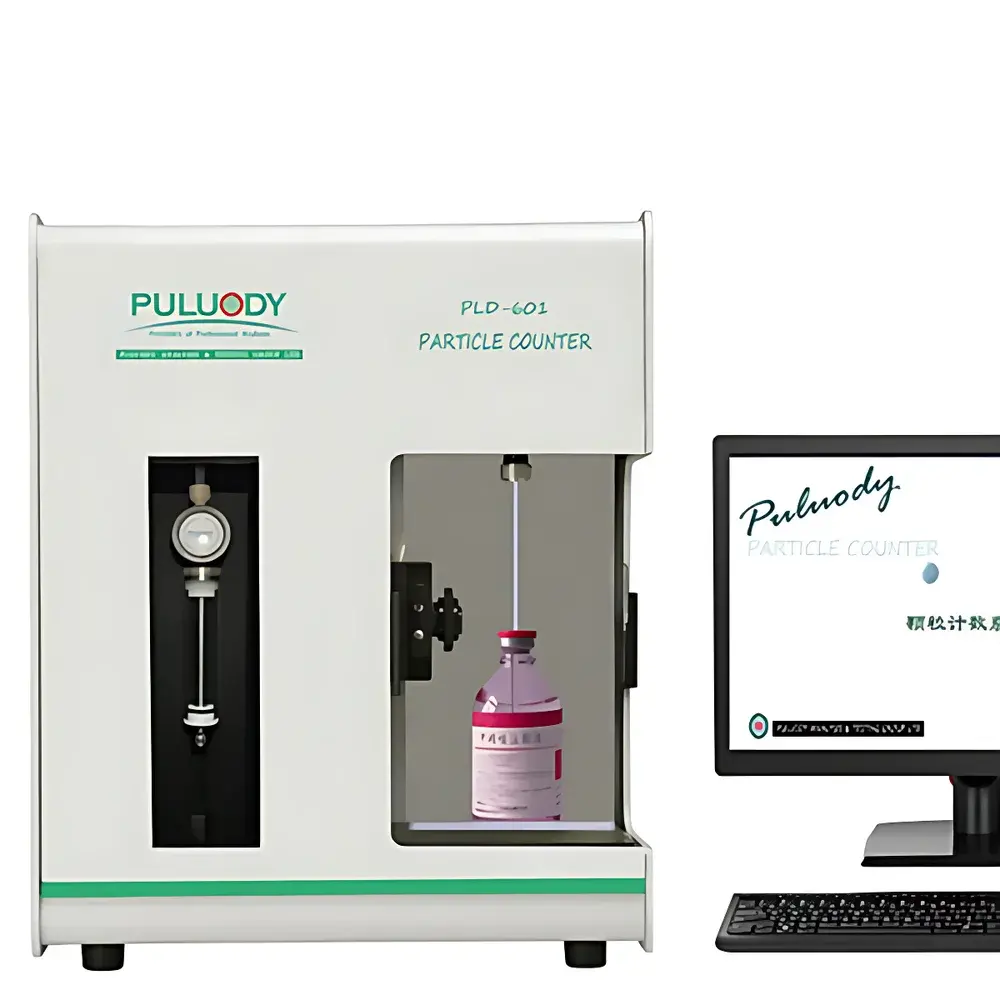
PULUODY PLD-601Z Disposable Needle-Style Insoluble Particle Counter
| Brand | PULUODY |
|---|---|
| Origin | Shaanxi, China |
| Model | PLD-601Z |
| Instrument Type | Optical Particle Counter (Light Obscuration Principle) |
| Detection Principle | Dual-Laser Narrow-Beam Light Obscuration |
| Sensor Generation | 8th-Generation Dual-Laser Sensor |
| Flow Control | Precision Metering Plunger Pump + Ultra-Precise Electromagnetic Flow Control System |
| Sample Introduction | Disposable Needle Sampling Probe |
| Channel Resolution | 1000 Adjustable Channels (Down to 0.01 µm) |
| Detection Range | 1–450 µm (Extended options: 0.03–3000 µm) |
| Accuracy | ±3% typical (per ChP 2020 & USP <788>) |
| Repeatability | ≤3% coincidence error at 1000 particles/mL |
| Flow Rate | 5–150 mL/min (sampling), 5–500 mL/min (rinse) |
| Temperature Range | Fluid 0–80 °C |
| Compliance | Meets ChP 0903, USP <788>/<789>, EP 10.0, BP 2019, JP 17, ISO 21501-4, ISO 11171, GB/T 11446.9–2013, YBB00272004–2015, GB 8368 |
| Software | V8.9 Regulatory-Grade Analysis Suite (FDA 21 CFR Part 11 Compliant) |
| Data Integrity | Audit Trail, Electronic Signature, Role-Based 5-Tier User Permissions, Auto Backup/Restore, Power-Fail Recovery |
Overview
The PULUODY PLD-601Z Disposable Needle-Style Insoluble Particle Counter is an optical particle counter engineered for high-precision, regulatory-compliant particulate analysis in parenteral drug manufacturing, biopharmaceutical process monitoring, and ultra-pure fluid quality assurance. It operates on the light obscuration (LO) principle—where particles suspended in a liquid stream pass through a focused dual-laser narrow-beam detection zone, generating pulse signals proportional to their cross-sectional area. The instrument’s 8th-generation dual-laser sensor delivers enhanced signal-to-noise ratio and superior discrimination of sub-micron particles, particularly critical for detecting low-abundance, high-risk insoluble particulates in injectables and ophthalmic solutions. Unlike fixed-flow cuvette-based systems, the PLD-601Z employs a disposable needle probe interface—eliminating carryover risk, reducing cleaning validation burden, and enabling rapid transition between diverse sample matrices including lyophilized powder reconstitutes, viscous concentrates, and sterile-filtered water-for-injection (WFI). Its architecture aligns with current Good Manufacturing Practice (cGMP) expectations for analytical instrumentation used in quality control laboratories subject to FDA, EMA, PMDA, and NMPA inspections.
Key Features
- Disposable needle sampling probe ensures zero cross-contamination between samples—critical for sterility-critical workflows and multi-product facilities.
- Dual-laser narrow-beam optical sensor (8th generation) optimized for high-resolution detection from 1 µm to 450 µm, with optional extended range down to 0.03 µm or up to 3000 µm via sensor configuration.
- Two-stage precision flow control: a calibrated metering plunger pump for volumetric accuracy (<±1%) and an ultra-stable electromagnetic flow regulation system for real-time velocity stabilization (±0.5% CV).
- 1000 fully customizable particle size channels—enabling granular compliance reporting per pharmacopoeial thresholds (e.g., ≥10 µm and ≥25 µm per USP , or ≥5 µm and ≥25 µm per EP 10.0).
- V8.9 regulatory software platform compliant with FDA 21 CFR Part 11: featuring electronic signatures, immutable audit trail, role-based 5-tier access control, automatic data backup, and power-fail recovery.
- Thermally stabilized fluid path supports testing across 0–80 °C—allowing direct analysis of temperature-sensitive biologics without pre-conditioning delays.
- Integrated rinse cycle with programmable flow rate (5–500 mL/min) and duration ensures complete system decontamination prior to next sample.
Sample Compatibility & Compliance
The PLD-601Z is validated for use with a broad spectrum of pharmaceutical and industrial liquids requiring particulate quantification under compendial or industry-standard protocols. Primary applications include: solution-type injectables (IV, IM, SC), sterile powders for reconstitution, concentrated injectables, ophthalmic preparations, vaccines, WFI, purified water (PW), and ultrapure water (UPW). It also supports evaluation of filtration efficiency—including terminal sterilizing filters (e.g., 0.22 µm PVDF membranes) and pre-filtration integrity assessment. The system meets or exceeds requirements specified in Chinese Pharmacopoeia (ChP) General Chapter 0903 (2015 & 2020 editions), USP , , and , European Pharmacopoeia 10.0, British Pharmacopoeia 2019, Japanese Pharmacopoeia JP17, WHO International Pharmacopoeia IV, and ISO 21501-4 for calibration and verification. All measurement traceability is supported by accredited calibration using NIST-traceable polystyrene latex standards (PSL) or certified reference materials per JJG 1061, ISO 21501-4, and ISO 11171.
Software & Data Management
The embedded V8.9 analysis software provides a fully auditable, ALCOA+ (Attributable, Legible, Contemporaneous, Original, Accurate) compliant environment. Each test session automatically logs operator ID, timestamp, instrument parameters, calibration status, and raw pulse data. Audit trails record all user actions—including method edits, result overrides, and report exports—with tamper-proof hashing. Electronic signatures are enforced for critical steps: test initiation, result approval, and calibration verification. Data export supports CSV, PDF, and XML formats compatible with LIMS integration. Backups are scheduled automatically to network drives or external media; restoration preserves full metadata integrity. The software includes built-in templates for ChP, USP, EP, and ISO reporting, with configurable pass/fail logic based on batch volume, container size, and pharmacopoeial acceptance criteria.
Applications
- Pharmaceutical QC labs performing routine insoluble particle testing per ChP 0903 or USP on final containers, bulk intermediates, and excipient solutions.
- Biomanufacturing process development teams assessing filter fouling, leachables, and extractables during downstream purification.
- Medical device manufacturers evaluating particulate shedding from infusion sets, syringes, IV bags, and stoppers per GB 8368 and YBB00272004–2015.
- Semiconductor fabs monitoring CMP slurries, etchants, and rinse waters for sub-100 nm contamination per SEMI F63 and ISO 14644-9.
- Electronics-grade water systems validating UPW cleanliness against ASTM D5127 and IEST-STD-CC1246E.
- Chemical R&D labs characterizing dispersion stability of nanomaterials, pigments, and functional fluids per ISO 20979 and ASTM D7500.
FAQ
Does the PLD-601Z comply with FDA 21 CFR Part 11 requirements?
Yes—the V8.9 software implements full electronic signature capability, audit trail logging, and role-based permissions aligned with Part 11 Subpart B controls.
Can the instrument be used for both aqueous and organic solvents?
Yes—provided compatibility with wetted materials (316L SS, PEEK, fused silica); solvent selection must consider refractive index matching and sensor window wettability.
Is third-party calibration and certification available?
Yes—certified calibration services are offered by CNAS-accredited providers including the National Northwest Metrology Testing Center and the Defense Science & Technology Commission Level-1 Particle Metrology Station No. 116.
What is the minimum detectable particle size with standard configuration?
The base configuration detects particles ≥1 µm with >95% counting efficiency (per ChP 2020 calibration); optional configurations support 0.03 µm detection using enhanced optics and signal processing.
How is sample carryover prevented between analyses?
The disposable needle probe eliminates internal fluid path contact; combined with automated high-flow rinse cycles (up to 500 mL/min), carryover is below detection limits per USP verification protocols.



