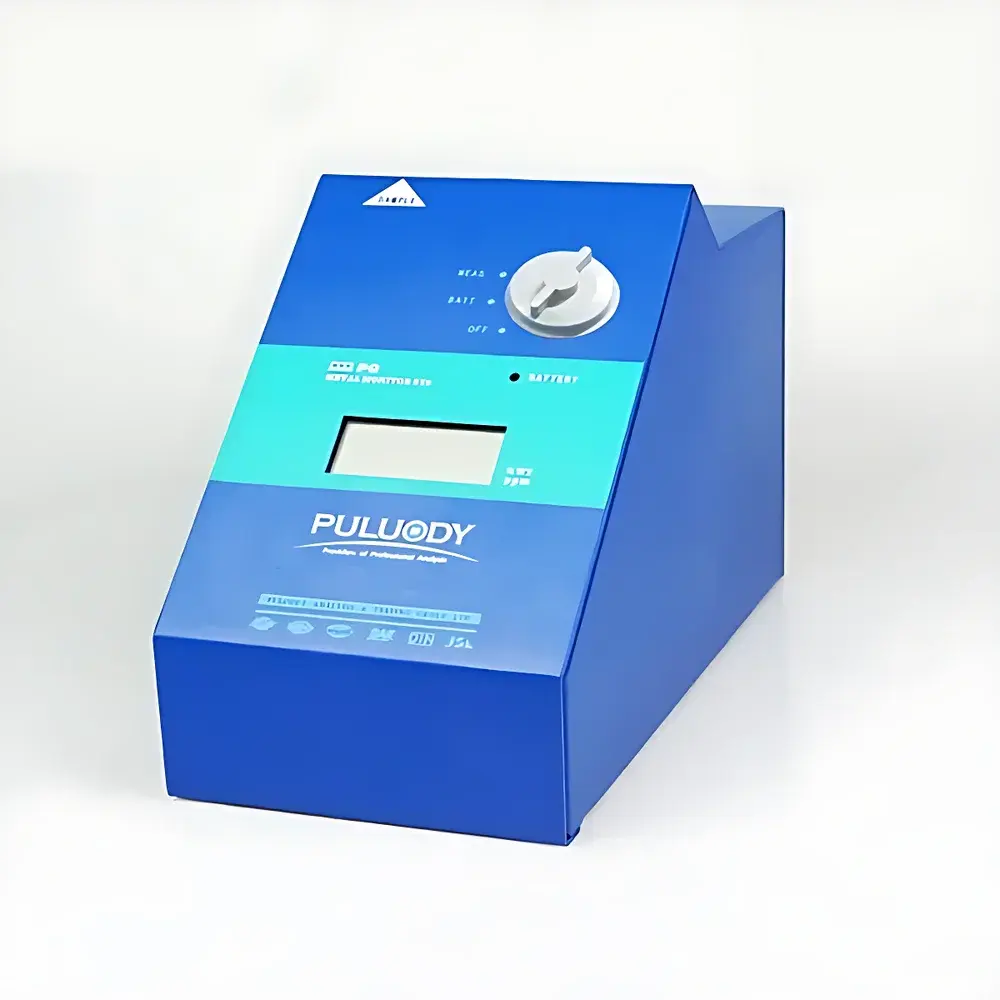
PULUODY PQ-2A Automatic Ferrography Analyzer
| Brand | PULUODY |
|---|---|
| Origin | United Kingdom |
| Manufacturer | PULUODY Analysis & Testing Group Ltd. |
| Type | Imported Industrial Instrument |
| Model | PQ-2A |
| Sensitivity | 0.1 mg/g |
| Max. Iron Concentration Range | 30,000 mg/g |
| Detectable Particle Size | >5 µm |
| Sample Volume | 2–5 mL per test |
| Operating Temperature | 0–55 °C |
| Power Supply | 220 V ±15%, 50 Hz or portable DC power |
Overview
The PULUODY PQ-2A Automatic Ferrography Analyzer is a precision-engineered instrument designed for rapid, non-destructive quantification of ferromagnetic wear debris in lubricating oils and greases. It operates on the principle of magnetic susceptibility-based electromagnetic induction: a calibrated excitation coil generates a stable magnetic field, and proprietary high-sensitivity magnetoresistive sensors detect minute perturbations induced by ferrous particles suspended in the oil matrix. The magnitude of signal deviation correlates linearly with iron mass concentration, enabling direct readout in standardized units—milligrams per gram (mg/g) or parts per million (ppm). Unlike spectroscopic or filtration-based methods, the PQ-2A requires no sample digestion, solvent extraction, or dilution, eliminating chemical handling risks and procedural variability. Its design reflects four decades of refinement in oil condition monitoring, aligning with ISO 4406, ASTM D7690 (Standard Test Method for Quantitative Ferrography), and industry best practices for predictive maintenance in rotating machinery.
Key Features
- Ultra-low detection limit of 0.1 mg/g (100 ppm), enabling early-stage wear detection before catastrophic failure thresholds are reached
- Full measurement cycle completed in under 8 seconds—from sample loading to validated concentration output
- Robust electromagnetic architecture with active temperature compensation and baseline drift correction algorithms
- Integrated signal processing engine that suppresses interference from non-ferrous contaminants, base oil dielectric effects, and ambient thermal fluctuations
- Compact benchtop footprint (280 × 220 × 190 mm) with shock-absorbing chassis and IP54-rated enclosure for field deployment in industrial environments
- No consumables, reagents, or calibration standards required during routine operation—reducing total cost of ownership and operational complexity
Sample Compatibility & Compliance
The PQ-2A accommodates a broad spectrum of petroleum-based and synthetic lubricants, including mineral hydraulic oils (ISO VG 32–68), gear oils (EP and non-EP), turbine oils, compressor oils, and semi-solid greases (after minimal homogenization). It complies with functional requirements outlined in ISO 17359:2014 (Condition monitoring and diagnostics of machines — General guidelines) and supports traceability frameworks aligned with GLP and GMP audit protocols. Data integrity safeguards include timestamped measurement logs, operator ID tagging, and immutable storage of raw sensor waveforms—ensuring full compliance with FDA 21 CFR Part 11 when integrated into regulated maintenance workflows.
Software & Data Management
The analyzer interfaces via USB or optional Bluetooth 5.0 with PULUODY’s FerroView™ desktop software (Windows 10/11 compatible), which provides real-time spectral visualization, trend analysis across multi-sample datasets, and automated alert generation based on user-defined wear severity thresholds. All measurements are stored in encrypted SQLite databases with SHA-256 hashing for tamper-evident recordkeeping. Export formats include CSV, PDF reports (with embedded metadata), and XML for integration into CMMS platforms such as IBM Maximo or SAP PM. Audit trails capture every action—including parameter modification, firmware updates, and calibration verification events—with full rollback capability.
Applications
The PQ-2A serves as a frontline diagnostic tool in mission-critical asset management programs across aerospace propulsion systems, naval marine engines, wind turbine gearboxes, power generation turbines, rolling mill drives, mining haul trucks, and railway traction motors. Its ability to quantify ferrous debris load without altering sample chemistry makes it indispensable for validating oil change intervals, verifying filter efficiency, assessing bearing fatigue progression, and supporting root-cause analysis following unscheduled downtime. Field studies conducted under ASTM D7690 interlaboratory protocols demonstrate inter-unit reproducibility within ±2.3% RSD at 500 mg/g iron concentration.
FAQ
Does the PQ-2A require daily calibration?
No. The system employs self-referencing magnetic null-point verification prior to each measurement and does not rely on physical reference standards. Annual verification using certified ferrofluid reference samples is recommended for ISO/IEC 17025 accreditation.
Can it distinguish between different types of iron alloys (e.g., steel vs. cast iron)?
No. The PQ-2A quantifies total ferromagnetic mass concentration only; elemental differentiation requires complementary techniques such as SEM-EDS or ICP-OES.
Is the instrument suitable for used oil analysis in ISO Class 1 cleanrooms?
Yes. Its solid-state sensor design emits no ionizing radiation, volatile organics, or particulate exhaust, meeting ISO 14644-1 Class 5 environmental compatibility requirements.
What maintenance is required beyond routine cleaning?
None. There are no moving parts, optical windows, or fluidic pathways. Wipe-down of the sample chamber with lint-free isopropyl alcohol is sufficient between analyses.
How is data security ensured during remote firmware updates?
All OTA updates are digitally signed using RSA-2048 keys and verified against embedded public key infrastructure before installation; rollback to previous stable version is automatic if signature validation fails.