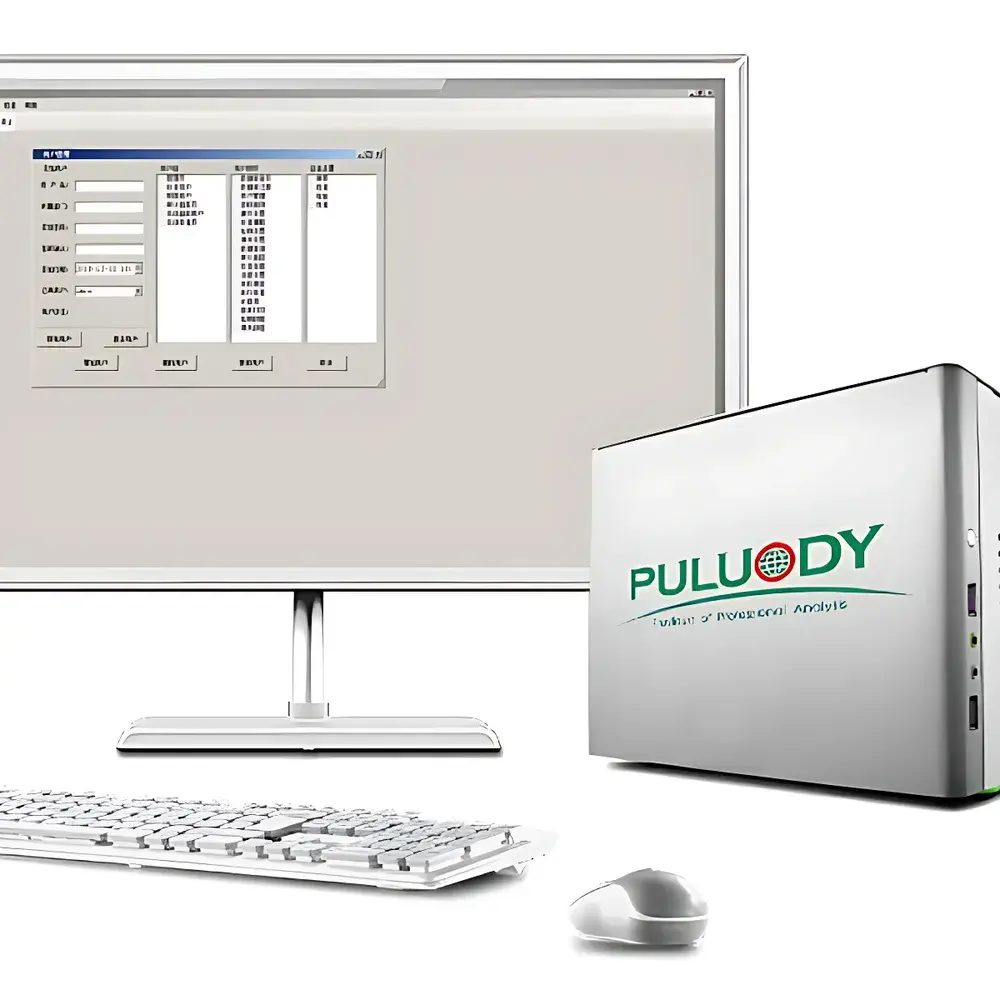

PULUODY PMT-2DN Low-Viscosity Photoresist Liquid Particle Counter
| Brand | PULUODY |
|---|---|
| Origin | Sichuan, China |
| Manufacturer Type | Authorized Distributor |
| Country of Origin | China |
| Model | PMT-2DN |
| Price | USD 75,000 (FOB) |
| Detection Principle | Dual-Laser Narrow-Beam Light Scattering |
| Sensor Generation | 8th-Generation Dual-Laser Optical Sensor |
| Flow Control | Precision Plunger Pump + Electromagnetic Flow Regulation |
| Calibration Standards | JJG 1061, ISO 21501-4, Polystyrene Latex (PSL) Reference Standards |
| Detection Range | 0.1–0.5 µm (standard) |
| Customizable | 1–100 µm or 4–70 µm (c) |
| Minimum Detectable Size | 0.1 µm (c) |
| Sampling Accuracy | < ±1% |
| Measurement Accuracy | < ±3% (typical) |
| Coincidence Limit | ≤2.5% at 1000 particles/mL |
| Output Interface | 4–20 mA analog output |
| Alarm Function | Configurable particle concentration threshold alert |
| Data Reporting | Particles per mL + ISO 4406 / NAS 1638 contamination code |
| Power Input | 100–265 VAC, 50–60 Hz |
| Display & Control | Color LCD touchscreen + optional wireless keyboard/mouse |
| Software | PULUODY V8.3 Analysis & Calibration Suite (PC & embedded) |
Overview
The PULUODY PMT-2DN Low-Viscosity Photoresist Liquid Particle Counter is an engineered solution for real-time, high-sensitivity particulate contamination monitoring in ultra-clean semiconductor process fluids. Designed specifically for low-viscosity photoresists, developer solutions, rinse agents, and ultrapure water (UPW), the instrument employs dual-laser narrow-beam light scattering technology—representing the 8th generation of optical particle detection developed by PULUODY Analytical Testing Group (UK). Unlike conventional single-wavelength systems, its dual-laser architecture enables enhanced signal discrimination across sub-micron size ranges, particularly critical for detecting 0.1–0.5 µm particles that dominate defect nucleation in advanced lithography nodes (≤7 nm). The system operates on the principle of Mie scattering with optimized hydrodynamic focusing, ensuring minimal sample perturbation and high reproducibility in laminar flow conditions. Its robust architecture supports both online integration into wet bench recirculation loops and offline laboratory analysis—making it a validated tool for process qualification, cleaning validation, and continuous contamination control in front-end-of-line (FEOL) fabrication environments.
Key Features
- Dual-laser narrow-beam optical sensor with independent wavelength channels for improved sizing resolution and reduced refractive index dependency
- Precision plunger pump combined with electromagnetic flow regulation ensures volumetric sampling accuracy better than ±1% and repeatability under dynamic process conditions
- Configurable detection thresholds from 0.1 µm (c) upward, including user-defined size bins (e.g., 4–70 µm (c)) aligned with SEMI F39 and ISO 14644-9 requirements
- Embedded V8.3 firmware with dual-mode operation: standalone touchscreen interface and PC-hosted analytical suite supporting audit trail, electronic signatures, and 21 CFR Part 11 compliance modules
- Analog 4–20 mA output with programmable alarm triggers for integration into factory SCADA and MES platforms
- Modular fluid path design using fluoropolymer-wetted components (e.g., PFA, ETFE) to prevent adsorption, leaching, or chemical degradation when handling aggressive solvents (e.g., PGMEA, ethyl lactate)
Sample Compatibility & Compliance
The PMT-2DN is validated for use with non-aqueous, low-viscosity (<5 cP) process liquids commonly employed in photolithography, including positive/negative tone photoresists, organic developers, anti-reflective coatings (ARC), and post-etch rinse formulations. It complies with ISO 21501-4 (determination of particle size distribution by light scattering), JJG 1061 (Chinese national metrological verification regulation for liquid particle counters), and supports traceable calibration using NIST-traceable polystyrene latex (PSL) standards. For GMP-regulated environments, the system supports GLP-compliant data integrity protocols—including immutable raw data logs, operator ID authentication, and time-stamped calibration records. All wetted materials meet SEMI C12 (ultra-high purity component certification) and USP Class VI biocompatibility criteria where applicable.
Software & Data Management
PULUODY V8.3 software provides integrated particle analysis, statistical trending, and metrological calibration management. The platform separates measurement acquisition from calibration execution—a design feature intended to eliminate cross-talk between operational and metrological functions. Data export supports CSV, PDF, and XML formats compatible with LIMS integration. Audit trails record all user actions, parameter changes, and calibration events with tamper-evident timestamps. Optional 21 CFR Part 11 modules include role-based access control, electronic signatures, and automated backup to network storage. Real-time dashboards display particle concentration vs. time, size distribution histograms, and ISO 4406 contamination codes—enabling rapid root-cause analysis during excursion investigations.
Applications
- In-line monitoring of photoresist dispense lines to detect filter breakthrough or tank contamination prior to wafer coating
- Qualification of point-of-use (POU) filtration systems for UPW and solvent delivery networks
- Validation of cleaning efficacy during photomask and reticle reclamation processes
- Batch release testing of photoresist formulations per SEMI D38 and IEC 60422 specifications
- Trend analysis of particle shedding from wet processing tools (e.g., spin coaters, track systems, immersion chillers)
- Support for ISO 14644-1 cleanroom classification of liquid handling subsystems
FAQ
What particle size ranges can the PMT-2DN resolve in photoresist applications?
The standard configuration detects particles from 0.1 µm (c) to 0.5 µm with calibrated sensitivity; extended ranges (1–100 µm or 4–70 µm (c)) are available via firmware configuration and application-specific calibration.
Is the system compatible with aggressive organic solvents used in advanced node lithography?
Yes—the fluidic path uses chemically inert fluoropolymers (PFA, ETFE), and the sensor housing is sealed against vapor ingress, enabling stable operation with PGMEA, cyclohexanone, and other low-surface-tension solvents.
How does the dual-laser detection improve measurement reliability compared to single-laser systems?
Dual-wavelength illumination reduces Mie resonance artifacts and improves sizing linearity across refractive index variations typical in polymer-based resists, yielding higher confidence in sub-100 nm particle quantification.
Can the PMT-2DN be integrated into existing factory automation infrastructure?
Yes—it provides 4–20 mA analog output, Modbus TCP/IP, and optional OPC UA support for seamless connection to PLCs, DCS, and semiconductor manufacturing execution systems (MES).
Does the instrument support regulatory audit requirements for qualified manufacturing environments?
Yes—V8.3 software includes configurable 21 CFR Part 11 modules, electronic signature workflows, and full audit trail generation required for FDA, ISO 13485, and IATF 16949 certified facilities.