
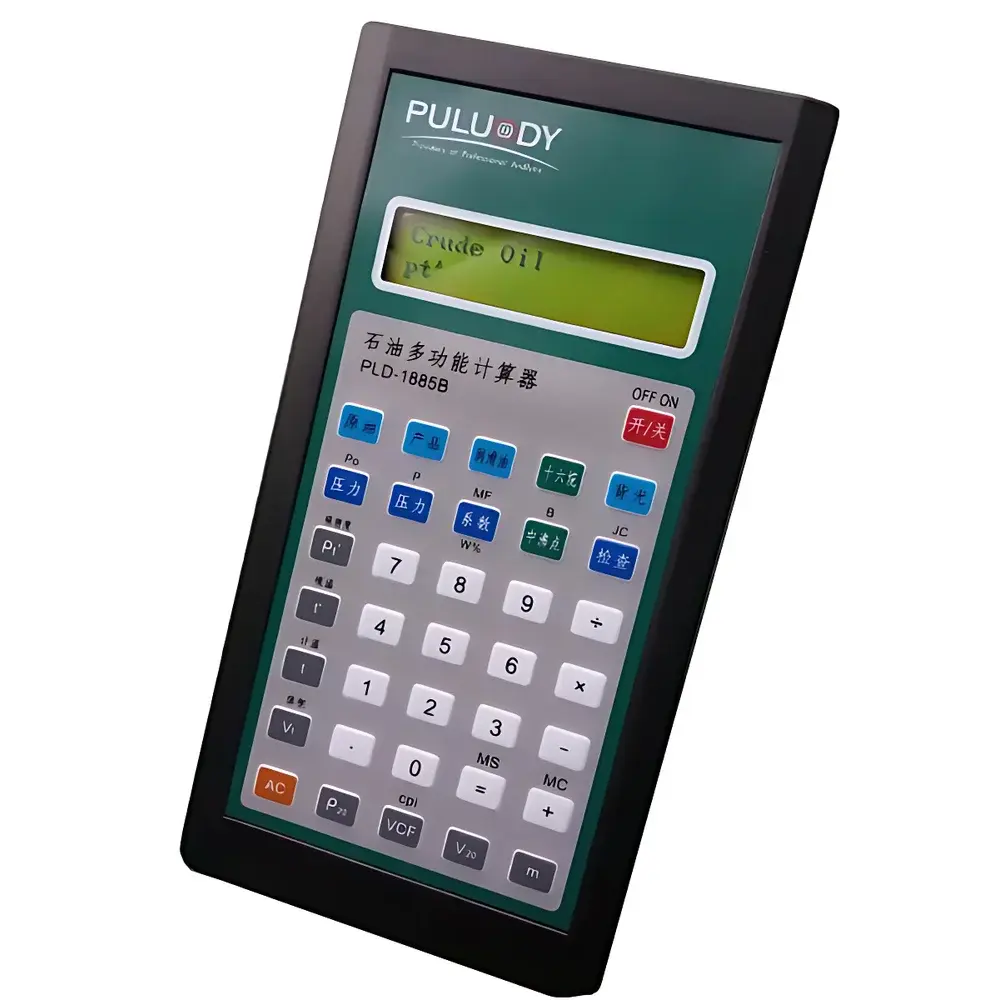
PULUODY PLD-1885B Petroleum Density & Volume Correction Calculator
| Brand | PULUODY |
|---|---|
| Model | PLD-1885B |
| Origin | Shaanxi, China |
| Power Supply | AC 220 V, 50 Hz or 4 × AAA batteries (1.5 V each) |
| Dimensions | 195 mm × 100 mm × 45 mm |
| Interface | USB 2.0 |
| Accuracy | ±0.0005 g/mL |
| Operating Temperature Range | User-defined (theoretical input range unrestricted |
| Compliance | GB/T 1884–2000, GB/T 1885–1998, GB/T 11139–1989 |
| Application Databases | Crude oil, petroleum products, lubricating oils, and distillate fuel cetane index |
Overview
The PULUODY PLD-1885B Petroleum Density & Volume Correction Calculator is a dedicated handheld computational instrument engineered for metrologically traceable oil quantity determination in custody transfer, refinery operations, and quality assurance laboratories. It implements the standardized physical models defined in GB/T 1884 (Standard Test Method for Density of Crude Oil and Petroleum Products) and GB/T 1885 (Petroleum Measurement Tables), enabling deterministic conversion between observed density (ρt), standard density at 20 °C (ρ20), volume correction factor (VCF), volume compression factor (cpi), and corrected mass (m) under variable temperature and pressure conditions. Unlike general-purpose calculators, the PLD-1885B embeds empirically derived ASTM D1250-04 / ISO 91-1 compliant algorithms—adapted to Chinese national standards—for volumetric thermal expansion and compressibility behavior across three distinct hydrocarbon classes: crude oil, refined petroleum products (e.g., gasoline, diesel), and lubricants. Its architecture supports dual-mode operation: real-time interactive calculation and batch parameter verification via built-in validation feedback.
Key Features
- Integrated triple-database engine covering crude oil, petroleum products, and lubricants—each with proprietary density-temperature correlation functions aligned with GB/T 1885–1998 Annexes A, B, and C.
- Cetane index computation module compliant with GB/T 11139–1989 (equivalent to ASTM D976), accepting input of API gravity and mid-boiling point to derive empirical cetane number estimates for distillate fuels.
- Modular calculation architecture: users may enter parameters in any sequence (e.g., ρt, t, P); intermediate values remain accessible during multi-step workflows.
- Real-time parameter audit function: pressing the “Check” key sequentially displays all entered inputs on the LCD screen, supporting GLP-aligned data integrity verification.
- Touch-sensitive membrane keypad with petroleum-standard symbology (e.g., “t′”, “P20”, “VCF”)—designed for glove-compatible operation in field or tank farm environments.
- Dual power configuration: low-power CMOS logic enables >120 hours of continuous operation on four AAA alkaline cells; optional AC adapter ensures uninterrupted desktop use.
- USB 2.0 interface facilitates firmware updates and calibration log export for internal QA documentation and 21 CFR Part 11–compatible audit trails (when paired with validated host software).
Sample Compatibility & Compliance
The PLD-1885B is validated exclusively for liquid hydrocarbon systems conforming to the compositional scope of GB/T 1885–1998. It does not support non-petroleum fluids (e.g., biodiesel blends exceeding 5% FAME, synthetic esters, or aqueous emulsions) without documented algorithmic revalidation. All density conversions adhere to the reference temperature of 20 °C and standard atmospheric pressure (101.325 kPa). For crude oil calculations involving water cut, the instrument applies the mass-weighted mixing rule per GB/T 1884 Annex D, requiring user input of measured water mass fraction (ws) to compute net oil mass (mc). Regulatory alignment includes full traceability to China’s JJG 972–2002 verification regulation for petroleum calculators and compatibility with ISO/IEC 17025–2017 requirements for computational equipment used in accredited testing laboratories.
Software & Data Management
Firmware is field-upgradable via USB connection using PULUODY’s certified configuration utility (v3.2+), which logs firmware version, calibration date, and operator ID to internal non-volatile memory. Exported calculation records include timestamp, input parameters, applied standard (e.g., “GB/T 1885–1998 Table 53A”), and final outputs (ρ20, V20, m)—formatted as CSV for integration into LIMS or ERP systems. Audit functionality satisfies basic GLP data integrity requirements: no parameter overwrite capability exists once “Calculate” is confirmed, and all check-mode reviews are time-stamped. The device stores up to 50 calculation histories locally; older entries auto-rotate upon overflow.
Applications
- Custody transfer reconciliation at pipeline terminals, marine loading arms, and railcar unloading facilities.
- In-process density verification during refinery blending operations where real-time VCF adjustment prevents over/under-delivery.
- Quality control labs performing routine compliance checks against GB 17930 (gasoline), GB 19147 (diesel), and SH/T 0656 (lubricant base oils).
- Field technicians conducting tank strapping corrections using portable temperature-compensated density readings.
- Educational use in petroleum engineering curricula for demonstrating ASTM D1250–derived volume correction principles.
FAQ
Does the PLD-1885B support API gravity conversion?
Yes—it computes API gravity from ρ20 using ASTM D1298–12 Equation 1, with automatic unit switching between kg/m³ and g/cm³.
Can it handle pressure-corrected volume calculations?
No—per GB/T 1885–1998, pressure effects are neglected below 1 MPa; users must apply external corrections for high-pressure custody transfer scenarios.
Is firmware validation documentation available?
Yes—PULUODY provides a Firmware Verification Report (FVR-PLD1885B-Rev4) upon request, including checksums, test case matrices, and uncertainty analysis per GUM (JCGM 100:2008).
What is the maximum valid temperature input for crude oil calculations?
While the UI accepts any numeric entry, GB/T 1884 specifies −20 °C to +100 °C for crude; extrapolation beyond this range violates standard applicability and voids metrological validity.
Does the calculator meet FDA 21 CFR Part 11 requirements?
Standalone operation does not fulfill Part 11; however, when integrated with PULUODY’s validated PC software suite (requiring electronic signatures and audit trail activation), full compliance is achievable for pharmaceutical excipient oil testing.





