
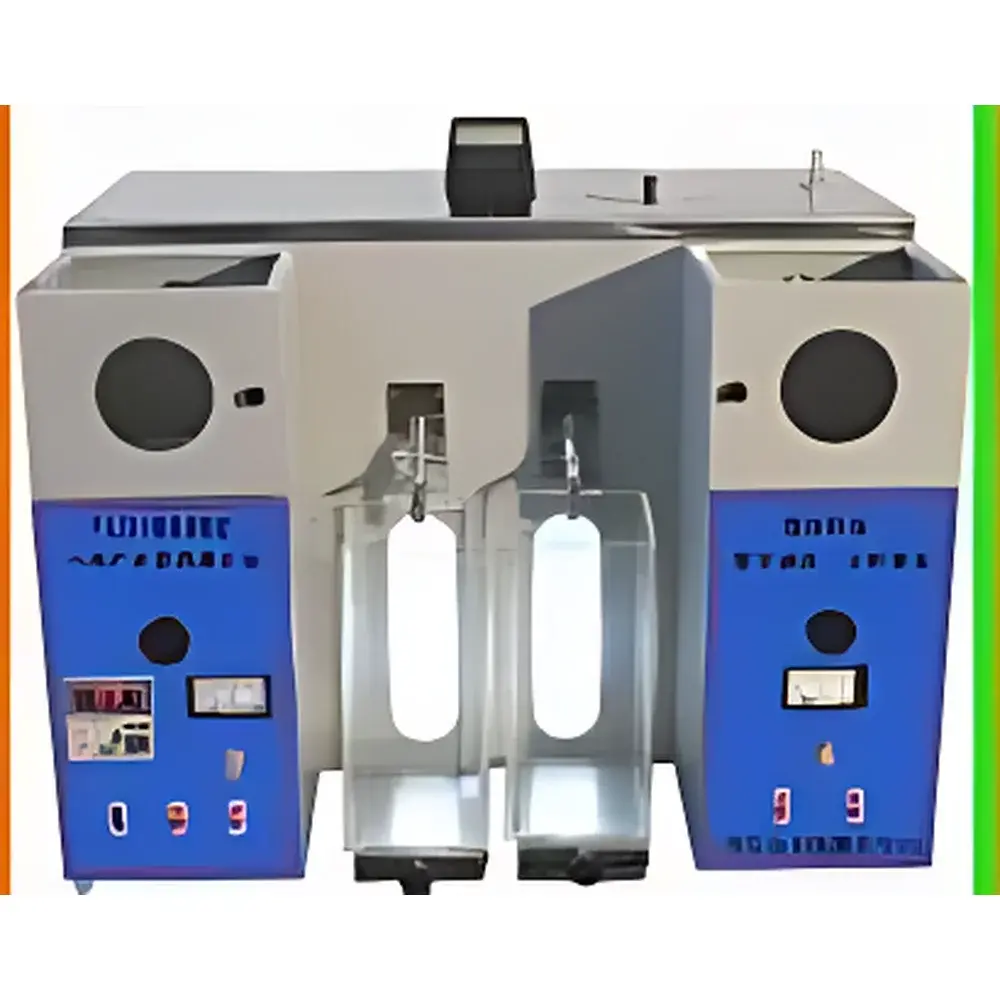
PULUODY PLD-6536C Gasoline Distillation Apparatus
| Brand | PULUODY |
|---|---|
| Origin | Shaanxi, China |
| Manufacturer Type | Direct Manufacturer |
| Country of Origin | China |
| Model | PLD-6536C |
| Heating Power | 0–2000 W (continuously adjustable) |
| Heating Chamber Vertical Adjustment Range | 35 mm |
| Flask Support Plate Aperture | Ø37.5 mm |
| Temperature Control Accuracy | ±0.5 °C |
| Temperature Display Resolution | 0.1 °C |
| Power Supply | AC 220 V ±10%, 50 Hz |
| Refrigeration System | Imported Compressor |
| Condensate Bath Temperature Range | 0–80 °C |
| Compliance | GB/T 6536, ASTM D86, ISO 3405 |
Overview
The PULUODY PLD-6536C Gasoline Distillation Apparatus is a precision-engineered laboratory instrument designed for standardized distillation analysis of light petroleum fractions in accordance with GB/T 6536, ASTM D86, and ISO 3405. It implements the classical batch distillation method under atmospheric pressure to determine the boiling point distribution—specifically, the initial boiling point (IBP), 10%, 50%, 90%, and final boiling point (FBP)—of volatile hydrocarbon liquids including gasoline, jet fuel, naphtha, kerosene, and diesel fuels. The apparatus operates on a fixed-volume, single-stage distillation principle where vaporization kinetics, condensation efficiency, and precise temperature monitoring are tightly coordinated to ensure reproducible fractional recovery data. Its architecture integrates thermal control, mechanical positioning, and cold-trap management into a unified system optimized for routine QC testing in refinery laboratories, petrochemical R&D centers, and third-party certification facilities.
Key Features
- Digitally regulated heating system with solid-state voltage controller (0–2000 W continuous adjustment), enabling accurate ramp-rate control per ASTM D86 specifications.
- Motorized vertical lift mechanism for heating mantle (35 mm travel range), facilitating safe and repeatable flask positioning and alignment with condenser inlet.
- Flame-retardant woven heating element embedded in thermally insulated mantle—designed to minimize thermal lag and improve energy efficiency over conventional coil-based systems.
- Hinged front access window for unobstructed visual inspection during setup, flask insertion, and real-time observation of boiling behavior and vapor path.
- Optically transparent acrylic condensate bath housing with integrated LED illumination and spring-loaded volumetric cylinder support—enabling clear visualization of distillate collection without interference from cooling media.
- High-stability digital temperature controller with ±0.5 °C accuracy and 0.1 °C display resolution, compliant with calibration traceability requirements for ISO/IEC 17025-accredited labs.
- Dual independent test stations permitting parallel analysis or method comparison under identical ambient and operational conditions.
- Imported hermetic compressor refrigeration unit maintaining condensate bath temperature between 0 °C and 80 °C with <±0.3 °C stability over 24-hour operation.
Sample Compatibility & Compliance
The PLD-6536C is validated for use with Class I–III petroleum distillates as defined in ASTM D4057 and IP 528. Compatible sample types include unleaded gasoline (ASTM D439, D4814), aviation turbine fuel (ASTM D1655), light naphthas (ASTM D86 Group 1), and middle distillates (kerosene, diesel per ASTM D975). All mechanical, thermal, and metrological subsystems conform to the dimensional, procedural, and instrumentation requirements stipulated in GB/T 6536–2023, ASTM D86–22, and ISO 3405:2020. The apparatus supports GLP-compliant documentation workflows when paired with external electronic lab notebooks (ELNs) or LIMS interfaces. No modifications are required to meet regulatory audit readiness for refinery quality assurance programs operating under API RP 2510 or ISO 9001:2015 frameworks.
Software & Data Management
While the PLD-6536C operates as a stand-alone benchtop instrument with analog-digital hybrid controls, its temperature and power outputs are compatible with optional RS-485 or USB-to-serial interface modules (sold separately). These enable integration with third-party data acquisition software such as LabVIEW™, MATLAB® Data Acquisition Toolbox, or custom SCADA platforms for automated logging of time–temperature–volume profiles. All recorded datasets retain full traceability—including operator ID, calibration certificate numbers, ambient humidity/pressure metadata, and instrument firmware version—supporting compliance with FDA 21 CFR Part 11 when used in regulated environments requiring electronic signature and audit trail functionality.
Applications
- Refinery process optimization: Correlation of distillation curves with reformer feedstock volatility and catalytic cracking severity.
- Fuel blending verification: Quantification of ethanol or MTBE cut points in oxygenated gasoline formulations.
- Regulatory conformance testing: Submission-ready reports for EPA Tier 3 gasoline certification (40 CFR Part 1090) and EU EN 228 compliance.
- Research-grade volatility profiling: Investigation of bio-derived hydrocarbon blends and synthetic paraffinic kerosene (SPK) distillation behavior.
- Educational laboratories: Hands-on instruction in petroleum fractionation principles, heat transfer dynamics, and standard method execution per ASTM E29 guidelines.
FAQ
Does the PLD-6536C comply with ASTM D86 for referee testing?
Yes—the mechanical configuration, temperature measurement uncertainty, and vapor condensation geometry fully satisfy the apparatus requirements defined in Annex A1 of ASTM D86–22.
Can it be used for biodiesel (B100) distillation analysis?
No—B100 falls outside the scope of ASTM D86 and GB/T 6536 due to thermal instability and polymerization risk above 300 °C; alternative methods such as ASTM D7343 or ISO 12937 are recommended.
Is calibration verification included with purchase?
A factory-issued calibration report (traceable to NIM, China) is provided, covering temperature sensor linearity, voltage output linearity, and bath temperature uniformity across the 0–80 °C range.
What maintenance intervals are recommended for the compressor refrigeration system?
Compressor oil and filter replacement every 24 months; annual leak check and refrigerant charge verification per ISO 8573-1 Class 4 air purity standards for laboratory cooling circuits.



