
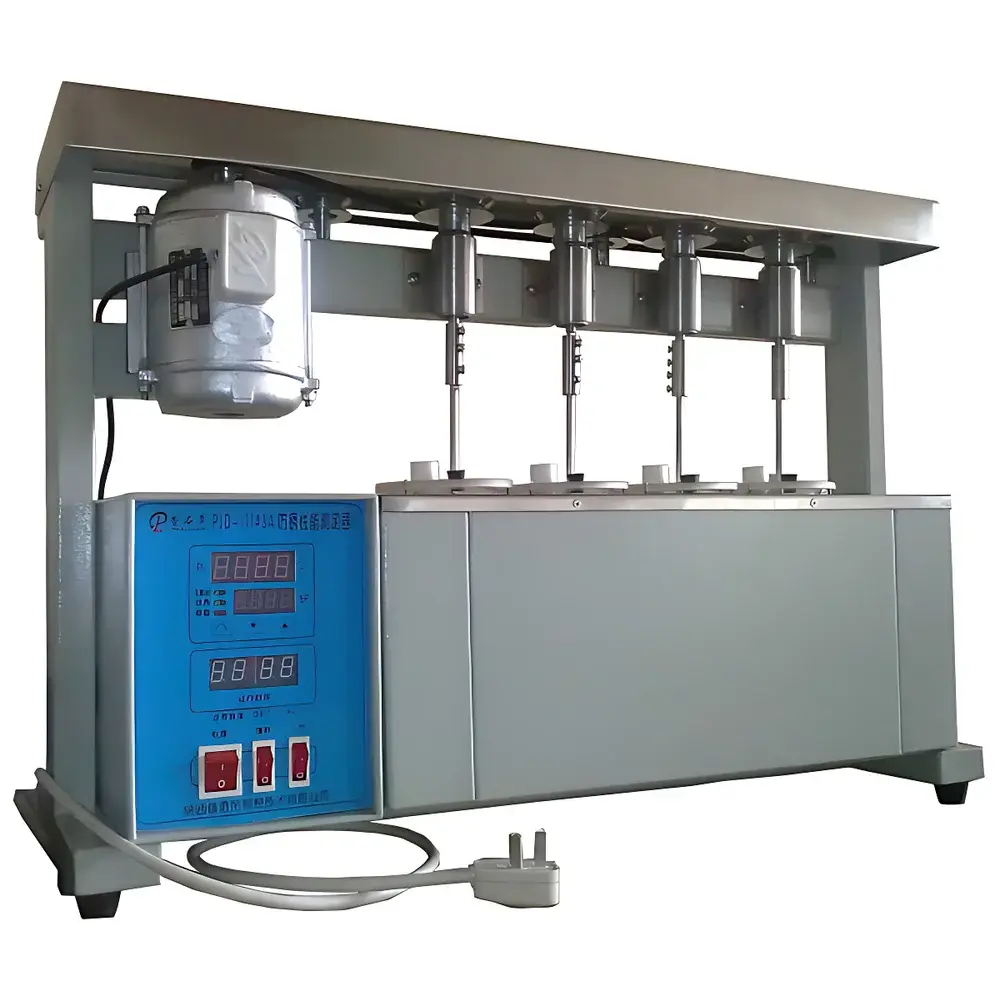
PULUODY PLD-11143A Liquid-Phase Rust Test Apparatus for Lubricating Oils
| Brand | PULUODY |
|---|---|
| Origin | Shaanxi, China |
| Manufacturer Type | Direct Manufacturer |
| Origin Category | Domestic (China) |
| Model | PLD-11143A |
| Pricing | Upon Request |
| Power Supply | 220 V ±10%, 50 Hz |
| Temperature Control Range | 0–100 °C |
| Temperature Display | Digital |
| Timing Range | 1 min – 24 h |
| Timer Display | Digital |
| Main Heating Power | 600 W / 220 V |
| Auxiliary Heating Power | 1000 W / 220 V |
| Temperature Control Accuracy | ±1.0 °C |
| Stirrer Speed | 1000 ±50 rpm |
| Test Stations | 4 |
| Ambient Operating Temperature | ~25 °C |
| Relative Humidity | ≤85% |
| Rust Specimen Polishing Unit Power | AC 220 V ±20 V, 90 W |
| Polishing Motor Speed | 1750 ±50 rpm |
Overview
The PULUODY PLD-11143A Liquid-Phase Rust Test Apparatus is a precision-engineered instrument designed to evaluate the rust-inhibiting performance of inhibited mineral oils—particularly turbine oils—when exposed to water under standardized laboratory conditions. It operates in strict accordance with the methodology defined in GB/T 11143–1989, “Test Method for Rust-Preventing Characteristics of Inhibited Mineral Oils in the Presence of Water,” which aligns functionally with ASTM D665 (Method A and B) and ISO 7120 for comparative international applicability. The apparatus subjects polished steel specimens (typically ASTM D665-compliant rust test bars) to immersion in an oil–water emulsion while maintaining precise thermal and mechanical agitation parameters. Rust formation on the specimen surface is assessed visually after a defined exposure period, providing quantitative pass/fail or semi-quantitative grading data essential for quality control, formulation validation, and regulatory compliance in lubricant manufacturing and refinery QA/QC laboratories.
Key Features
- Four independent test stations enabling parallel evaluation of multiple samples or replicates—enhancing throughput and statistical robustness.
- Stainless-steel water bath construction with corrosion-resistant components ensuring long-term reliability in humid, aqueous environments.
- Dual-zone heating system: primary 600 W heating element for precise bath temperature regulation, supplemented by a 1000 W auxiliary heater for rapid thermal stabilization across the full 0–100 °C range.
- High-reproducibility mechanical agitation: digitally controlled stirrer delivering consistent 1000 ±50 rpm rotation to maintain uniform oil–water dispersion and interfacial shear stress on immersed specimens.
- Integrated digital temperature and timer displays with ±1.0 °C control accuracy and programmable timing from 1 minute to 24 hours—supporting both standard 24-hour tests and accelerated protocols.
- Dedicated specimen polishing unit included: motor-driven abrasive polishing station (1750 ±50 rpm, 90 W) compliant with ASTM D665 surface preparation requirements, ensuring repeatable surface finish prior to immersion.
Sample Compatibility & Compliance
The PLD-11143A accommodates a broad range of petroleum-based fluids beyond turbine oils, including hydraulic oils, circulating oils, gear oils, and other formulations where water ingress poses a corrosion risk. It supports testing of liquids denser than water (e.g., certain synthetic esters or high-viscosity base stocks), provided phase separation behavior and specimen immersion geometry remain within method-defined limits. The instrument’s design conforms to the physical and procedural specifications of GB/T 11143–1989 and serves as a functional equivalent to ASTM D665-compliant systems. While not certified to IEC 61000 or CE by default (as a domestically manufactured lab instrument), its electrical architecture meets GB 4793.1 safety requirements for laboratory equipment. Data generated using this apparatus is suitable for inclusion in GLP-compliant reports when paired with documented SOPs, calibration records, and operator training logs.
Software & Data Management
The PLD-11143A is a hardware-centric, manually operated instrument with no embedded microprocessor or proprietary software interface. Temperature and time are monitored via front-panel digital indicators; all operational parameters are set manually. This analog-digital hybrid architecture ensures electromagnetic compatibility in electrically noisy refinery or industrial lab settings and eliminates firmware-related validation burdens. Users maintain full traceability through external logbooks or LIMS-integrated documentation workflows. For regulated environments requiring audit trails (e.g., ISO/IEC 17025-accredited labs or those operating under FDA 21 CFR Part 11 guidelines), laboratories are advised to implement complementary procedural controls—including timestamped calibration certificates for thermistors and timers, signed test records, and version-controlled SOPs referencing GB/T 11143–1989 test execution steps.
Applications
- Quality assurance of rust-inhibited turbine oils prior to shipment or commissioning in power generation facilities.
- Formulation screening for additive packages containing amine-based or carboxylate rust inhibitors.
- Comparative assessment of used oil samples to detect depletion of rust-inhibiting additives during service life.
- Supporting root-cause analysis in field failures involving bearing corrosion or journal oxidation.
- Validation of storage stability for blended lubricants exposed to humid ambient conditions.
- Teaching and method training in petroleum engineering curricula focusing on corrosion mechanisms in hydrocarbon–water systems.
FAQ
Does the PLD-11143A comply with ASTM D665?
It implements the core physical test conditions (temperature, agitation, specimen geometry, and exposure duration) specified in ASTM D665 Method A. While it is built to GB/T 11143–1989, direct equivalency requires lab-specific method verification per ASTM E1488.
Can the unit be used for testing biodegradable hydraulic fluids?
Yes—provided the fluid remains immiscible with water and allows clear visual assessment of rust on the steel specimen surface after testing.
Is calibration certification included with shipment?
No factory-issued calibration certificate is supplied; users must perform initial verification using NIST-traceable thermometers and stopwatch standards per their internal QA protocol.
What maintenance is required for long-term reliability?
Routine cleaning of the stainless-steel bath, periodic inspection of heating elements and stirrer shaft seals, and annual verification of temperature sensor drift are recommended.
Are replacement rust test bars available from PULUODY?
Standard ASTM D665-compliant steel test bars (12.7 mm × 76.2 mm × 3.2 mm, low-carbon steel, machined and pickled) are commercially available; PULUODY does not supply proprietary consumables but provides dimensional and material specifications for procurement.





