
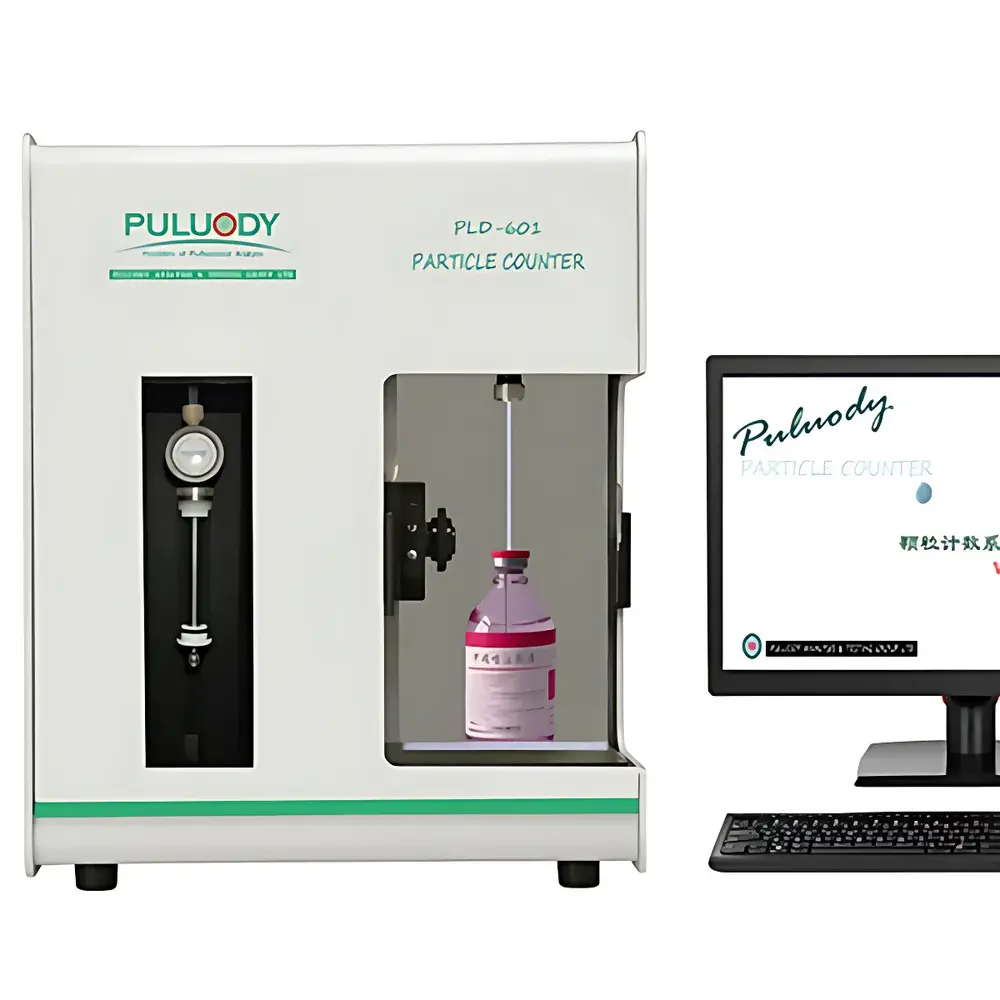
PULUODY PLD-601S Pharmaceutical Insoluble Particle Counter for Plastic IV Container Inner Caps
| Brand | PULUODY |
|---|---|
| Origin | Shaanxi, China |
| Model | PLD-601S |
| Instrument Type | Optical Particle Counter (Light Obscuration Principle) |
| Detection Range | 1–450 µm (optional extension to 0.03–3000 µm) |
| Channel Resolution | 1000 adjustable channels (down to 0.01 µm bin width) |
| Flow Control | Precision metering piston pump + ultra-precise electromagnetic flow regulation |
| Calibration Standards | ISO 21501-4, USP <788>, EP 2.9.19, ChP 2020 Edition 0903, GB/T 11446.9–2013, JJG 1061 |
| Software Compliance | FDA 21 CFR Part 11 (audit trail, electronic signature, role-based 5-level access, data backup/recovery, power-fail protection) |
| Sample Compatibility | Aqueous & non-aqueous sterile solutions, lyophilized powders (after reconstitution), ophthalmic preparations, vaccines, WFI, medical packaging components, infusion devices, terminal filters |
| Operating Temperature | 0–80 °C (fluid), –15–50 °C (ambient) |
| Sampling Flow Rate | 5–150 mL/min |
| Rinse Flow Rate | 5–500 mL/min |
| Counting Accuracy | ±5% typical (per ChP/USP verification protocols) |
| Coincidence Limit | ≤2.5% at 1000 particles/mL |
| Resolution | >95% (ChP-aligned calibration), <10% (ISO 21501-4 aligned) |
| Regulatory Documentation Support | GLP/GMP-compliant test reports, validation templates (IQ/OQ/PQ), metrological traceability via NWMS (National Northwest Metrology Testing Center) and DFKW No. 116 Calibration Station |
Overview
The PULUODY PLD-601S Pharmaceutical Insoluble Particle Counter is an optical particle counter engineered specifically for compliance-driven quality control of parenteral drug products and associated medical packaging components—particularly plastic intravenous (IV) container inner caps. It operates on the light obscuration (LO) principle per ISO 21501-4 and USP , where particles suspended in a liquid stream pass through a focused laser beam, generating transient signal pulses proportional to their cross-sectional area. The eighth-generation dual-laser narrow-beam sensor architecture minimizes scattering artifacts and enhances signal-to-noise ratio across sub-micron to coarse particulate ranges. Designed to meet the stringent requirements of pharmacopoeial monographs—including Chinese Pharmacopoeia (ChP) 2020 Edition General Chapter 0903, USP /, EP 2.9.19, and JP 17—the instrument delivers traceable, reproducible particle counts and size distributions essential for regulatory submissions, process validation, and routine release testing.
Key Features
- Eighth-generation dual-laser narrow-beam sensor with optimized optical path geometry for high-fidelity pulse discrimination and reduced coincidence error.
- Dual-mode precision fluid handling system: metering piston pump for volumetric accuracy (<±1%) and electromagnetic flow regulator for dynamic rate modulation (5–150 mL/min sampling; 5–500 mL/min rinse).
- 1000-channel configurable detection matrix enabling granular analysis from 0.01 µm bin resolution up to 450 µm—with user-defined channel groupings (e.g., 4-, 16-, 64-, or 128-bin configurations) aligned with pharmacopoeial reporting thresholds.
- V8.9 Analytical Software Suite with full 21 CFR Part 11 compliance: role-based five-tier user permissions, immutable audit trail, electronic signatures, automatic data backup/restoration, and power-interruption recovery.
- Integrated calibration management supporting multiple reference standards—polystyrene latex (PSL) spheres, NIST-traceable ISO 21501-4 reference materials, or JJG 1061-certified verification protocols.
- Touchscreen HMI with bilingual (English/Chinese) interface optimized for GMP laboratory workflows; supports custom SOP-driven test sequences and automated report generation in PDF/XLS formats.
Sample Compatibility & Compliance
The PLD-601S is validated for direct analysis of low-viscosity aqueous and organic liquids commonly encountered in pharmaceutical manufacturing and packaging validation. Compatible matrices include: sterile injectable solutions (e.g., saline, dextrose), reconstituted lyophilized powders, ophthalmic formulations, vaccine suspensions, water-for-injection (WFI), purified water (PW), and ultrapure water (UPW). It also supports extractables testing of polymeric IV container inner caps, stoppers, and tubing under controlled leachate conditions per YBB00272004-2015 and GB 8368. All measurement procedures adhere to internationally harmonized standards including USP , EP 2.9.19, ChP 0903, ISO 21510 (for medical device particulate testing), and ISO 11171 (for calibration particle certification). Metrological traceability is maintained through accredited calibration services provided by the National Northwest Metrology Testing Center (NWMS) and the Defense Science & Technology Commission’s Level-1 Particle Calibration Station No. 116.
Software & Data Management
The embedded V8.9 software platform provides end-to-end data integrity assurance for regulated environments. It implements ALCOA+ principles (Attributable, Legible, Contemporaneous, Original, Accurate, Complete, Consistent, Enduring, Available) via timestamped, tamper-evident audit logs recording every instrument action—including method changes, calibration events, user logins, and result exports. Electronic signatures are enforced for critical operations such as report finalization and calibration confirmation. Data export options include CSV, XML, and PDF with embedded metadata (instrument ID, operator, date/time, environmental parameters). System validation documentation—including IQ/OQ/PQ templates, risk assessments, and URS alignment records—is supplied to support client-specific qualification processes under ICH Q9/Q10 and Annex 11 frameworks.
Applications
- Pharmaceutical QC: Routine particulate testing of injectables, biologics, and ophthalmic preparations per compendial methods.
- Packaging component evaluation: Quantitative assessment of extractable particles from IV container inner caps, elastomeric closures, and filter membranes.
- Filter performance validation: Terminal sterilizing filter challenge studies and retention efficiency measurements (e.g., % removal at ≥10 µm, ≥25 µm).
- Water system monitoring: Continuous or batch-wise particle load profiling of WFI, PW, UPW, and clean steam condensate per ASTM D5127 and ISO 8573-4.
- Medical device cleanliness verification: Residue quantification post-cleaning of surgical instruments, catheters, and implantable delivery systems per ISO 13485 and AAMI TIR12.
- Process troubleshooting: Identification of wear debris in pump heads, tubing, or mixing vessels during aseptic processing line qualification.
FAQ
Does the PLD-601S comply with FDA 21 CFR Part 11 requirements for electronic records and signatures?
Yes. The V8.9 software implements full Part 11 functionality including role-based access control, audit trail with immutable timestamps, electronic signature workflows, and data backup/recovery mechanisms.
Can the instrument be calibrated to both ChP and USP standards simultaneously?
Yes. The system supports multi-standard calibration profiles—users may select ChP 2020, USP , or ISO 21501-4 alignment during setup, with corresponding resolution and counting threshold adjustments.
Is third-party metrological certification available for installation qualification?
Yes. Accredited calibration certificates issued by NWMS or DFKW Station No. 116 are provided upon request, meeting ISO/IEC 17025 requirements for traceability and uncertainty reporting.
What sample volume is required for a compliant test per USP ?
Per USP , a minimum of 5 mL per container is recommended; the PLD-601S supports programmable draw volumes from 1–100 mL with volumetric repeatability better than ±1%.
How is particle coincidence error managed at high concentrations?
The instrument applies real-time coincidence correction algorithms and limits maximum count rate to ≤1000 particles/mL (with ≤2.5% error), consistent with ISO 21501-4 Clause 6.3.3.
Related Products



