
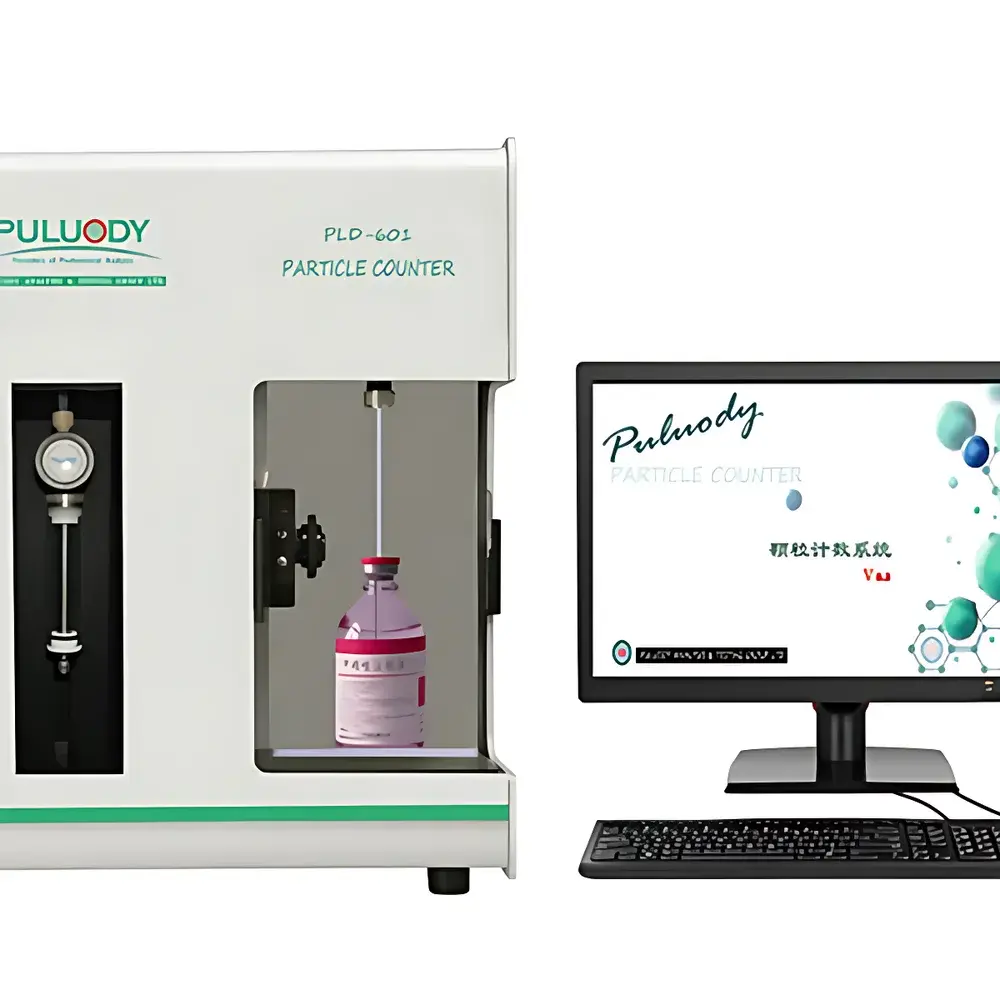
PULUODY PLD-601W Sterile Medical Device Primary Packaging Insoluble Particle Analyzer
| Brand | PULUODY |
|---|---|
| Origin | Shaanxi, China |
| Model | PLD-601W |
| Instrument Type | Optical Particle Counter (Light Obscuration Principle) |
| Detection Range | 1–450 µm (customizable down to 0.1 µm with certified calibration) |
| Channel Resolution | 1000 adjustable size channels |
| Flow Control | Precision metering piston pump + ultra-precise electromagnetic flow regulation |
| Compliance | USP <788>, <789>, <797> |
| Software | V8.9 Integrated Analysis Suite (PC & embedded touchscreen) |
| Sample Temperature Range | 0–80 °C |
| Ambient Operating Range | 0–50 °C |
| Sampling Flow Rate | 5–150 mL/min |
| Rinse Flow Rate | 5–500 mL/min |
| Accuracy | ±5% typical (per ChP) |
| Overlap Error | ≤5% |
| Resolution | >95% (ChP-calibrated), <10% (USP/ISO-calibrated) |
| Calibration Standards | NIST-traceable latex spheres, JJG 1061–2010, or ISO 21501-4 reference materials |
Overview
The PULUODY PLD-601W Sterile Medical Device Primary Packaging Insoluble Particle Analyzer is a high-precision optical particle counter engineered for regulatory-compliant particulate contamination assessment in pharmaceutical and medical device manufacturing environments. It operates on the light obscuration (LO) principle—where particles suspended in liquid media pass through a focused laser beam, generating transient signal pulses proportional to their cross-sectional area. These pulses are digitized and classified across 1000 user-definable size channels (down to 0.1 µm detection threshold), enabling quantitative analysis of particle concentration, size distribution, and cumulative counts per volume unit (e.g., particles/mL ≥10 µm and ≥25 µm per USP ). Designed specifically for primary packaging validation of sterile medical devices—including pouches, trays, and blister packs—the instrument quantifies insoluble particulates liberated during simulated handling, sterilization, or storage, ensuring compliance with global pharmacopoeial requirements for extractables and leachables risk mitigation.
Key Features
- Eighth-generation dual-laser narrow-beam sensor architecture delivering enhanced signal-to-noise ratio and minimized coincidence error (<5%) at high particle concentrations.
- Dual-mode flow control system integrating a precision metering piston pump and ultra-stable electromagnetic flow regulator, maintaining volumetric accuracy within ±1% across 5–150 mL/min sampling range.
- V8.9 analytical software platform compliant with FDA 21 CFR Part 11: full audit trail logging, time-stamped electronic signatures, role-based five-tier access control (Administrator, Supervisor, Analyst, Reviewer, Auditor), and encrypted data backup/recovery protocols.
- 1000-channel resolution with customizable binning—supports simultaneous evaluation against >510 international standards including USP, EP, BP, JP, IP, WHO IntPh, and Chinese Pharmacopoeia methods.
- Embedded color touchscreen interface with optional wireless keyboard/mouse support; bilingual (English/Chinese) operation aligned with global laboratory workflows.
- Integrated thermal management for sample fluid temperature control (0–80 °C), critical for viscosity-sensitive biologics and thermolabile formulations.
Sample Compatibility & Compliance
The PLD-601W accommodates a broad spectrum of liquid matrices relevant to sterile device packaging validation and parenteral quality control: injection water (WFI), sterile saline, glycerol-based solutions, silicone oil lubricants, polymer extractants, and simulated extraction fluids per ISO 10993-12. It supports direct analysis of rinse extracts from Tyvek® pouches, PETG trays, and polyolefin films without filtration or dilution. Regulatory alignment includes full traceability to USP and , EP 10.0 Annex 8, ChP 2020 Appendix 0903, and YBB00272004–2015 for packaging component testing. Calibration is performed using NIST-traceable polystyrene latex standards (PSL) per ISO 21501-4 and verified by national metrology institutes—including the National Northwest Metrology & Testing Center (China) and the Defense Science & Technology Commission First-Level Particle Metrology Station No. 116.
Software & Data Management
The V8.9 software suite provides GLP/GMP-aligned data integrity infrastructure. All measurement events—including sample ID, operator login, calibration history, environmental parameters, and raw pulse data—are immutably timestamped and archived in AES-256 encrypted format. Electronic signatures are PKI-enabled and bound to individual user credentials. Reports generate automatically in PDF/A-1b or CSV formats, with configurable templates for internal QA review, regulatory submission (e.g., ANDA, MA, BLA dossiers), or third-party audit requests. Data restoration preserves original metadata and audit logs, satisfying ALCOA+ principles (Attributable, Legible, Contemporaneous, Original, Accurate, Complete, Consistent, Enduring, Available).
Applications
- Primary packaging validation: quantification of particulates shed from sterile barrier systems (e.g., peel-open pouches, thermoformed blisters) under mechanical stress or accelerated aging.
- Extractables profiling: analysis of rinse solutions from medical device components (catheters, syringes, IV sets) per ISO 10993-12 and USP .
- Filter integrity verification: terminal filter challenge testing using standardized latex suspensions to determine retention efficiency (% removal) across defined size ranges.
- Cleanroom process monitoring: real-time particle load tracking in filling line rinse waters and component wash solutions.
- Raw material qualification: assessment of pharmaceutical excipients, silicone oils, and elastomeric stoppers for pre-sterilization particulate burden.
- Cross-industry extension: semiconductor CMP slurries, electronic-grade ultrapure water (UPW), nanomaterial dispersions, and cosmetic emulsions requiring sub-micron particle enumeration.
FAQ
Does the PLD-601W meet FDA 21 CFR Part 11 requirements for electronic records and signatures?
Yes. The V8.9 software implements full Part 11 functionality—including audit trail generation, electronic signature enforcement, and role-based access control—with cryptographic hashing of all critical data events.
Can the instrument be calibrated to ISO 21501-4 using NIST-traceable standards?
Yes. Calibration is performed using certified polystyrene latex spheres traceable to NIST SRM 1960 and validated per ISO 21501-4 Annex B. Certificate of Calibration includes uncertainty budget and metrological traceability statement.
Is method transfer supported between different pharmacopoeial standards (e.g., USP vs. ChP)?
Yes. The software allows side-by-side channel mapping and automatic recalculation of pass/fail criteria per selected standard, eliminating manual reinterpretation of raw count data.
What maintenance intervals are recommended for the optical sensor and fluidic path?
Sensor cleaning is required after every 50 samples or when baseline noise exceeds 3σ; full fluidic path decontamination is advised weekly using isopropanol and filtered deionized water per SOP PLD-MNT-003.
Is third-party certification available for IQ/OQ/PQ documentation?
Yes. PULUODY partners with accredited service providers—including China National Institute of Metrology (NIM) and SGS—to deliver full GxP-compliant installation, operational, and performance qualification packages.



