

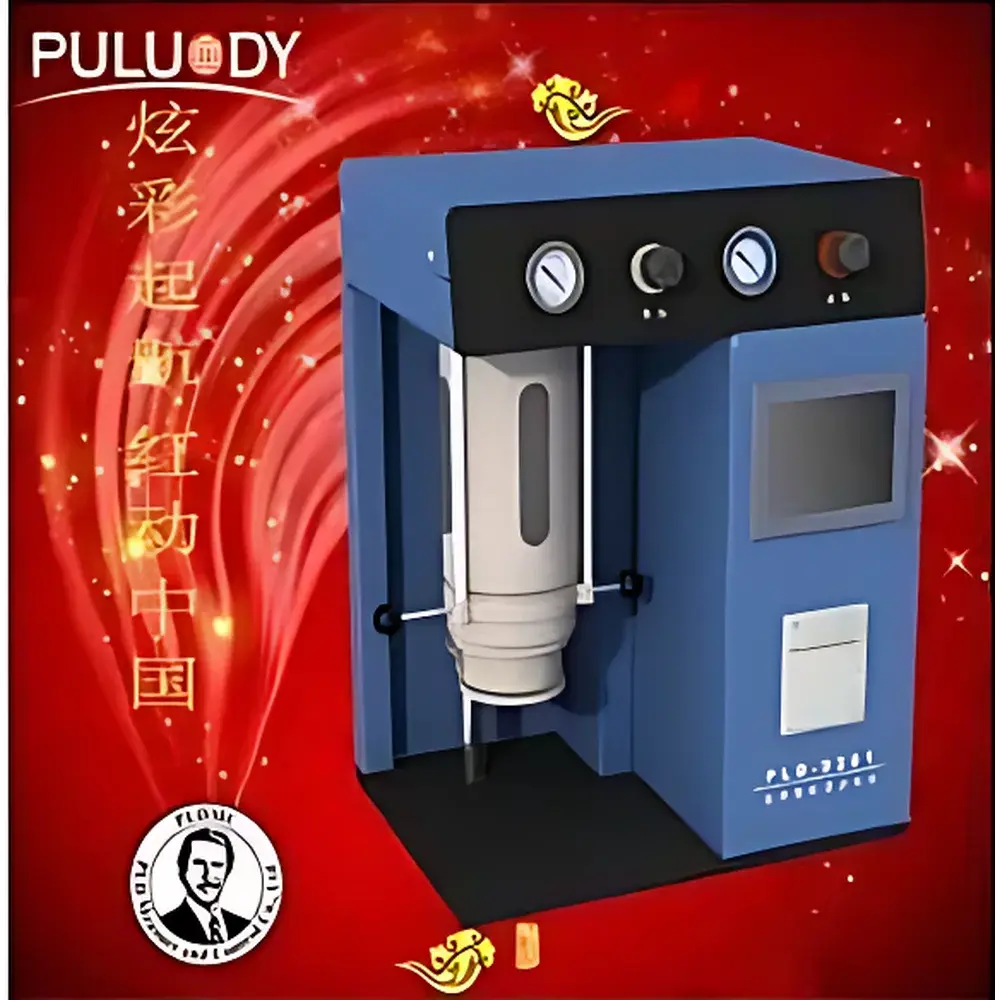
PULUODY PLD-0201 Series Laser-Based Optical Particle Counter
| Brand | PULUODY |
|---|---|
| Origin | Shaanxi, China |
| Manufacturer Type | Direct Manufacturer |
| Instrument Type | Optical Particle Counter |
| Detection Principle | Light Obscuration (LO) / Photometric Blockage |
| Measurement Range | 1 µm to 450 µm |
| Sensitivity | 1 µm (per ISO 4402), 4 µm(c) (per ISO 11171 & GB/T 18854) |
| Number of Adjustable Channels | 8 |
| Coincidence Limit | ≤5% at 10,000 particles/mL |
| Sample Volume Accuracy | ±1% |
| Flow Rate Control | 5–60 mL/min (electromagnetically regulated piston pump) |
| Pressure Range | −0.6 to +0.7 bar (integrated positive/negative pressure pretreatment system) |
| Viscosity Handling | up to 350 cSt |
| Operating Temperature | ambient to 65 °C |
| Ambient Temperature Range | 0–50 °C |
| Power Supply | 220 V AC, 50 Hz, <80 W |
| Calibration Compliance | GB/T 18854–2002 (equivalent to ISO 11171:1999), JJG 066–95 |
| Standards Supported | ISO 4406, NAS 1638, GJB 380, GJB 420, GB/T 14039–2002 |
| Data Output | Real-time particle count per channel, histogram, contamination grade assignment, RS232 interface, built-in thermal printer |
| Software | P6.4 Particle Analysis Suite (embedded & PC versions) |
| Regulatory Traceability | Calibrated and certified by the AVIC Particle Metrology Testing Station (National Defense Science & Technology Industry First-Class Particle Metrology Station No. 116) |
Overview
The PULUODY PLD-0201 Series Laser-Based Optical Particle Counter is an industrial-grade, light obscuration (LO)-principle instrument engineered for quantitative analysis of insoluble particulate contamination in liquid media—primarily hydraulic oils, lubricants, turbine oils, insulating oils, aviation fuels, and polymer solutions. It operates on the photometric blockage principle: as particles suspended in a laminar fluid stream pass through a focused laser beam, they attenuate incident light proportionally to their cross-sectional area. This analog pulse signal is digitized and classified into user-defined size channels (eight programmable thresholds), enabling precise enumeration and sizing across a validated dynamic range of 1 µm to 450 µm. Designed for compliance with international fluid cleanliness standards—including ISO 4406:2017, NAS 1638:2015, and GJB 420B—the PLD-0201 delivers traceable, repeatable, and auditable particle counts essential for predictive maintenance, quality assurance, and regulatory conformance in aerospace, power generation, and heavy machinery sectors.
Key Features
- Sixth-generation narrow-beam laser sensor optimized for high signal-to-noise ratio and long-term optical stability under continuous operation.
- Electromagnetically controlled piston pump ensures constant volumetric flow rate (5–60 mL/min) and precise sample aspiration (±1% volume accuracy), critical for statistical validity in low-concentration or high-viscosity samples (≤350 cSt).
- Integrated dual-pressure pretreatment module supports both vacuum-assisted degassing (−0.6 bar) and pressurized filtration (+0.7 bar), enabling reliable measurement of viscous or volatile fluids without manual pre-treatment.
- Eight fully configurable detection channels with user-definable threshold sizes (2–100 µm default range), supporting multi-standard reporting and custom grading protocols.
- Embedded P6.4 particle analysis firmware with real-time histogram generation, ISO/NAS contamination grade assignment, and automatic pass/fail flagging against stored limit tables.
- Self-cleaning fluidic path with post-analysis rinse cycle minimizes carryover and cross-contamination between samples.
- Full local operation capability: 7-inch capacitive touchscreen interface, physical keypad backup, built-in thermal printer, and onboard storage—no external PC required for routine testing.
Sample Compatibility & Compliance
The PLD-0201 is validated for direct analysis of undiluted mineral oils, synthetic lubricants, phosphate esters, hydrocarbon-based aviation fuels, transformer oils, and aqueous polymer solutions. Its optical design and wetted-path materials (316L stainless steel, fluoropolymer seals) resist chemical degradation from aggressive solvents and high-acidity formulations. The instrument meets metrological traceability requirements per GB/T 18854–2002 (identical to ISO 11171:1999), with calibration verification available through the AVIC Particle Metrology Testing Station (National Defense Science & Technology Industry First-Class Metrology Station No. 116). All firmware and reporting logic enforce strict adherence to ISO 4406:2017 coding conventions and NAS 1638 Class definitions. Optional audit-trail logging and electronic signature modules support GLP/GMP environments compliant with FDA 21 CFR Part 11 when integrated with enterprise LIMS platforms via RS232 serial protocol.
Software & Data Management
The embedded P6.4 Analysis Suite provides full data acquisition, visualization, and export functionality without external dependencies. Users may configure test templates with preset flow rates, sample volumes (1 mL to unlimited), dwell times (minimum 12.5 s), and channel binning schemes. Raw pulse data, cumulative/differential histograms, and ISO 4406/NAS-coded reports are stored internally and exportable via RS232 to CSV or XML formats. The PC version of P6.4 enables advanced statistical evaluation—including trend analysis across time-series datasets, batch comparison overlays, and automated report generation with company branding. All calibration events, user logins, and result modifications are timestamped and logged within the device’s non-volatile memory, satisfying basic ALCOA+ (Attributable, Legible, Contemporaneous, Original, Accurate) data integrity criteria.
Applications
This instrument serves as a core analytical tool in condition monitoring laboratories and QC facilities where fluid cleanliness directly correlates with system reliability. Typical use cases include: incoming inspection of new oil batches against OEM specifications; in-service monitoring of hydraulic systems in wind turbines and aircraft actuators; root-cause analysis of bearing wear debris in gearboxes; certification of filter performance per ISO 16889; validation of cleaning procedures for semiconductor process fluids; and routine surveillance of insulating oil in high-voltage transformers per IEC 60296. Its ability to quantify particles ≥1 µm per ISO 4402 makes it suitable for early-stage contamination detection—well before macroscopic wear initiates—supporting proactive maintenance strategies aligned with ISO 55001 asset management frameworks.
FAQ
What particle size standards does the PLD-0201 support out-of-the-box?
ISO 4406:2017, NAS 1638:2015, GJB 420B, and GB/T 14039–2002 are preloaded. Additional standards (e.g., SAE AS4059F, ASTM D7619) can be imported via configuration file.
Can the instrument measure samples with viscosity above 100 cSt?
Yes—its positive-pressure injection system and heated flow path (up to 65 °C) enable stable analysis of oils up to 350 cSt without dilution or heating artifacts.
Is external computer connectivity mandatory for operation?
No. All core functions—including calibration, testing, grading, and printing—are fully autonomous. RS232 is provided solely for data archival and LIMS integration.
How is calibration traceability established?
Calibration uses NIST-traceable ISO MTD (Medium Test Dust) and latex sphere suspensions per GB/T 18854–2002. Certificate of calibration issued by the AVIC Particle Metrology Testing Station (Station No. 116) is available upon request.
Does the system support multi-user access control?
Yes—password-protected operator levels (Operator, Supervisor, Administrator) govern parameter editing, calibration access, and report deletion privileges.
Related Products



