
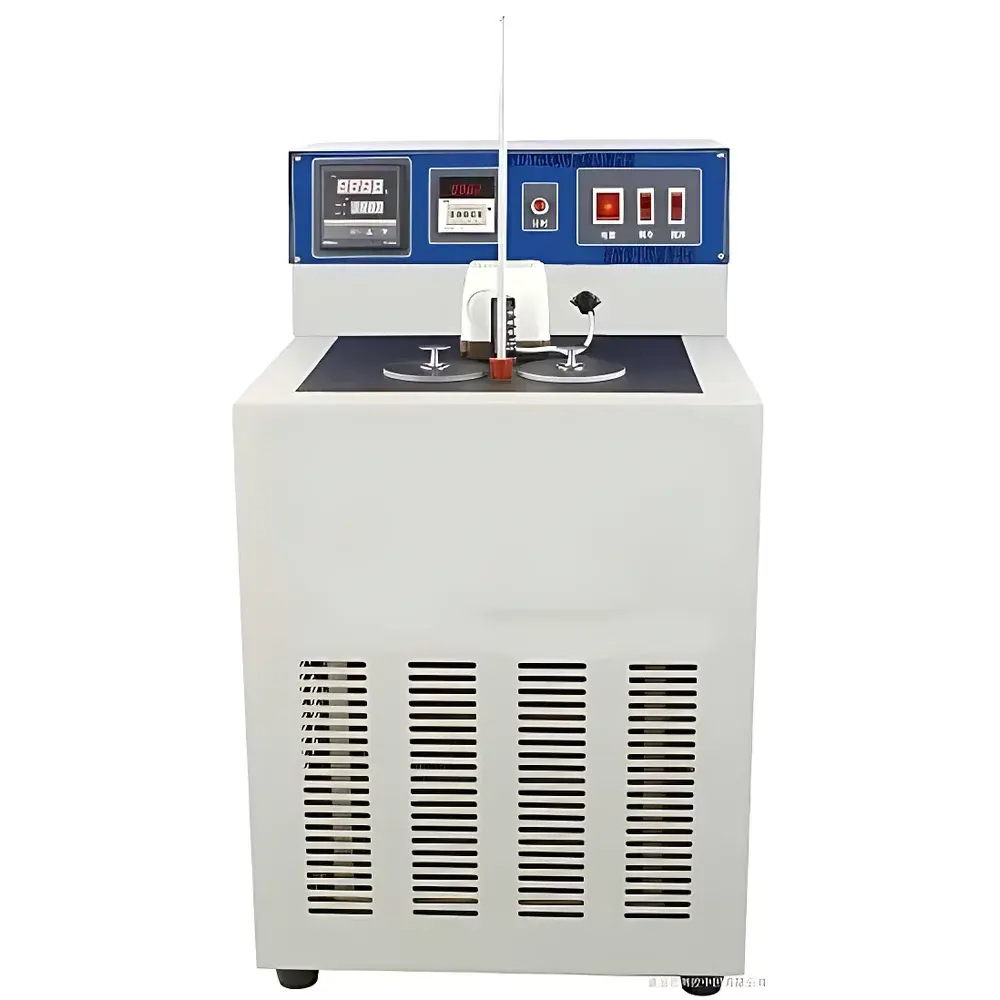
PULUODY PLD-510C Pour Point Tester
| Brand | PULUODY |
|---|---|
| Origin | Shaanxi, China |
| Manufacturer Type | Original Equipment Manufacturer (OEM) |
| Country of Manufacture | China |
| Model | PLD-510C |
| Input Power | <1600 W |
| Power Supply | AC 220 V ±10%, 50 Hz |
| Temperature Control Method | Microcontroller-based digital intelligent control |
| Temperature Range | +30 °C to –68 °C |
| Temperature Stability | ±0.5 °C |
| Cooling Time (30 °C → –68 °C) | ≤100 min |
| Bath Configuration | Dual-sample immersion bath (2-position cold bath槽) |
Overview
The PULUODY PLD-510C Pour Point Tester is a precision-engineered instrument designed for the standardized determination of the pour point of petroleum products—including crude oils, lubricating oils, diesel fuels, and residual fuels—according to internationally recognized test methods. It operates on the principle of controlled stepwise cooling followed by manual or semi-automated visual assessment of flow cessation under defined conditions. The pour point is defined as the lowest temperature at which a sample will still flow under gravity when cooled under specified laboratory conditions (ASTM D97 and GB/T 3535). Unlike cloud point or freeze point measurements, pour point evaluation focuses on macroscopic fluid mobility loss due to wax crystallization and network formation in paraffinic hydrocarbon systems. The PLD-510C integrates a high-efficiency dual-stage refrigeration system with real-time digital temperature monitoring to ensure reproducible thermal profiles across consecutive test cycles.
Key Features
- Intelligent microcontroller-based temperature regulation with digital LED display for precise setpoint adjustment and real-time monitoring
- Dual-position immersion bath design enabling parallel testing of two samples under identical thermal conditions—enhancing throughput and inter-sample comparability
- High-capacity closed-cycle refrigeration unit with optimized evaporator geometry, delivering stable operation from +30 °C down to –68 °C without cryogenic consumables
- Thermal stability of ±0.5 °C maintained across the full operating range, meeting repeatability requirements specified in ASTM D97 Annex A1 and GB/T 3535 Clause 7.2
- Energy-efficient architecture with total input power <1600 W, compliant with IEC 61000-3-2 harmonic emission standards for laboratory equipment
- Robust stainless-steel cold bath housing resistant to corrosion from hydrocarbon solvents and low-temperature condensate accumulation
Sample Compatibility & Compliance
The PLD-510C accommodates standard ASTM D97 sample tubes (40 mm × 300 mm) and GB/T 3535-compatible containers. It supports testing of transparent and opaque petroleum liquids with kinematic viscosities up to 15,000 mm²/s at 40 °C. Instrument validation follows ISO/IEC 17025:2017 principles for testing laboratories, with documented traceability to national temperature standards (e.g., NIM China, NIST SRM 1750a). The system satisfies technical prerequisites for GLP-compliant petroleum product quality control labs, including defined calibration intervals, temperature uniformity mapping reports, and operator-accessible error logging. While not inherently 21 CFR Part 11 compliant, its digital temperature records can be exported in CSV format for integration into validated LIMS environments supporting electronic audit trails.
Software & Data Management
The PLD-510C operates via embedded firmware with no external PC dependency; however, optional RS-232 or USB-to-serial interface enables connection to laboratory data acquisition systems. Temperature ramp profiles, hold times, and final pour point determinations are timestamped and stored in non-volatile memory for up to 500 test cycles. Exported data includes ambient temperature, bath setpoint, actual bath temperature at 3 °C intervals, and user-entered pass/fail judgments per ASTM D97 Section 9.3. All firmware updates are delivered via secure encrypted firmware image files, with version history logged internally. No proprietary software installation is required—raw data conforms to ASTM E1382-15 guidelines for instrument-generated test records.
Applications
- Refinery QC laboratories verifying conformance of finished distillate fuels to ASTM D97, EN 116, and GB/T 3535 specifications
- Lubricant formulation R&D assessing wax inhibition additive efficacy across temperature gradients
- Crude oil custody transfer testing to support pipeline operability modeling and pour depressant dosing optimization
- Third-party certification labs performing accredited testing for ISO 8217 marine fuel compliance
- Educational institutions teaching petroleum physical property measurement fundamentals aligned with API RP 2553 curriculum standards
FAQ
What standards does the PLD-510C directly support?
ASTM D97 (Standard Test Method for Pour Point of Petroleum Products), GB/T 3535 (Petroleum Products — Determination of Pour Point), and ISO 3016 (Petroleum Products — Determination of Pour Point).
Is the instrument suitable for automated pour point detection?
No—it requires manual observation per ASTM D97 Section 9. Visual assessment remains the normative method; no optical or viscosity-sensing auto-detection module is integrated.
Can the cold bath accommodate alternative sample tube geometries?
Only standard 40 mm × 300 mm cylindrical tubes (ASTM D97) or equivalent GB/T 3535 dimensions are supported; custom fixtures are not provided.
What maintenance is required for long-term refrigeration performance?
Annual inspection of refrigerant charge integrity, evaporator coil cleaning, and verification of thermal insulation integrity around the bath chamber are recommended per manufacturer service bulletin PLD-510C-MNT-2023.
Does the unit include calibration documentation?
Yes—a factory calibration certificate traceable to NIM (National Institute of Metrology, China) is supplied, covering temperature accuracy verification at –30 °C, –51 °C, and –68 °C using calibrated platinum resistance thermometers (PRTs).






