
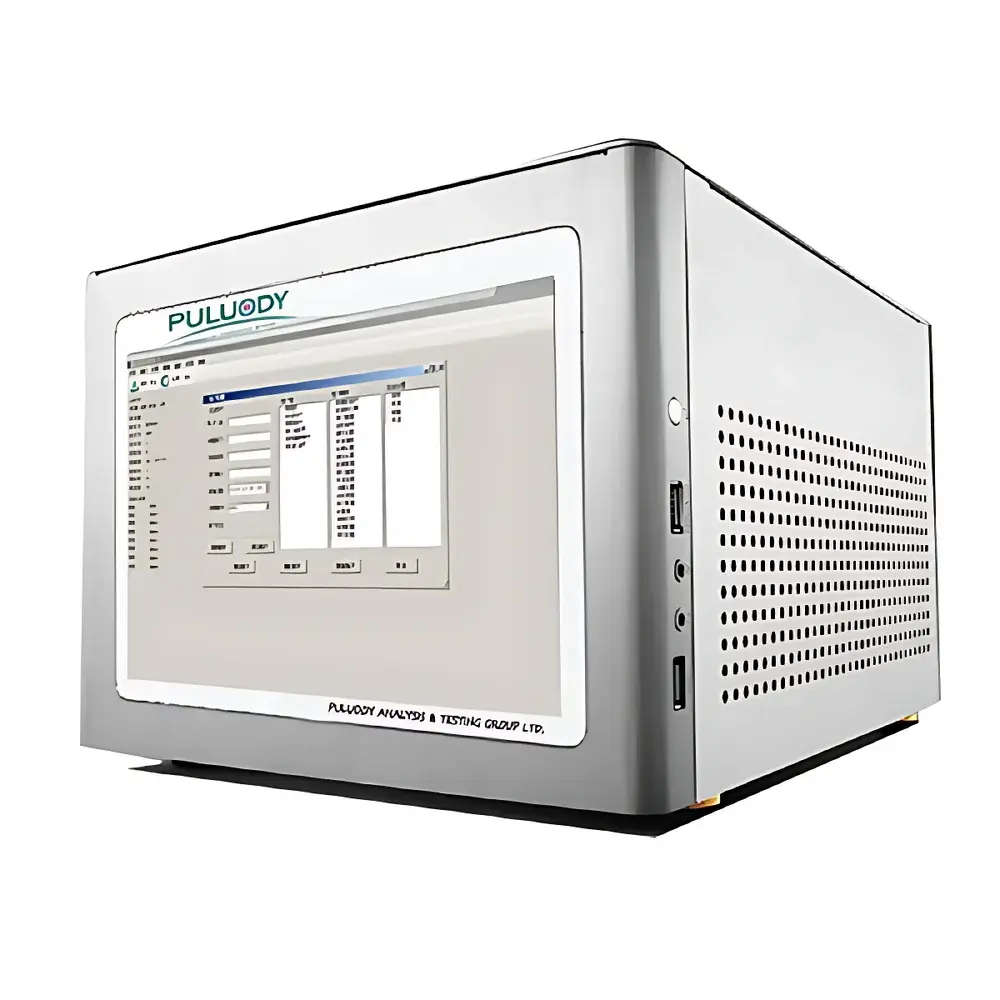

PULUODY PMT-2QL Dual-Laser Online/Offline Liquid Particle Counter for Deionized Water
| Brand | PULUODY |
|---|---|
| Origin | Shaanxi, China |
| Manufacturer Type | Authorized Distributor |
| Product Category | Domestic |
| Model | PMT-2QL |
| Instrument Type | Optical Particle Counter |
| Detection Principle | Dual-laser narrow-beam light scattering |
| Sensor Generation | 8th-generation dual-laser optical sensor |
| Detection Range | 0.1–0.5 µm (standard) |
| Sampling Method | Precision metering piston pump |
| Flow Control | Dual-stage electromagnetic + precision piston pump |
| Accuracy | ±3% typical |
| Volume Accuracy | <±1% |
| Coincidence Limit | 1000 particles/mL (2.5% coincidence error) |
| Output | 4–20 mA analog interface with configurable alarm output |
| Reporting | Particles per mL & ISO 4406 / NAS 1638 contamination code |
| Calibration Standards | JJG 1061, ISO 21501-4, NIST-traceable latex spheres |
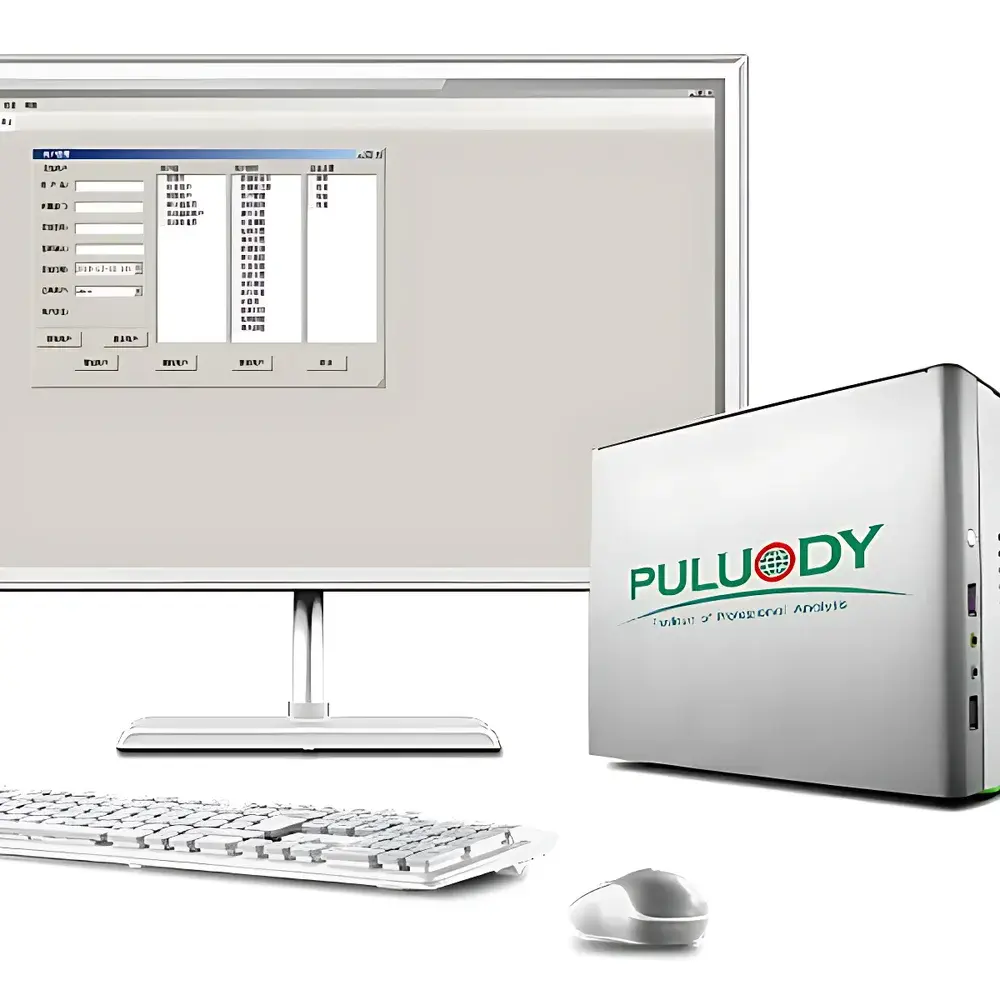
| Software | PULUODY V8.3 Integrated Analysis & Calibration Software (PC + tablet-compatible) |
| Interface | Color LCD touchscreen + optional wireless keyboard/mouse |
| Power Input | 100–265 VAC, 50–60 Hz |
| Compliance | Designed for ISO 8573-4, ASTM F3239, USP <788>, <789>, and semiconductor-grade water monitoring per SEMI F63 |
Overview
The PULUODY PMT-2QL Dual-Laser Online/Offline Liquid Particle Counter is an engineered solution for quantitative particulate contamination assessment in ultra-pure liquid systems—specifically deionized (DI) water, ultrapure water (UPW), cleaning solvents, and low-conductivity process fluids used in semiconductor fabrication, flat-panel display manufacturing, photovoltaic cell production, and advanced electronics assembly. It operates on the principle of dual-laser narrow-beam light scattering, where two spatially separated laser sources illuminate the sample stream simultaneously, enabling high-sensitivity detection of sub-micron particles with minimized optical noise and enhanced signal-to-noise ratio. Unlike single-beam systems, this 8th-generation optical architecture reduces false counts from refractive index fluctuations and bubble interference—critical for DI water with near-zero conductivity and minimal light absorption. The instrument supports both continuous online monitoring (via integrated flow cell and real-time data streaming) and offline batch analysis (using portable sampling modules), making it suitable for cleanroom environmental validation, point-of-use water quality verification, and QC release testing across GMP-compliant facilities.
Key Features
- Dual-laser narrow-beam optical sensing platform optimized for low-refractive-index liquids such as deionized and ultrapure water
- High-precision dual-stage fluidic control: electromagnetically regulated flow path combined with a calibrated piston metering pump for volumetric accuracy better than ±1%
- Configurable detection thresholds: standard 0.1–0.5 µm resolution; extended range options include 1–100 µm or 4–70 µm(c), with user-selectable 0.1 µm(c) counting mode
- Real-time analog output (4–20 mA) with programmable alarm thresholds for integration into SCADA, DCS, or PLC-based process control systems
- ISO 21501-4 and JJG 1061 compliant calibration traceable to NIST-certified latex standards; supports multi-point verification using certified reference materials
- Touchscreen HMI with intuitive workflow navigation; full remote operation capability via PC or iPad using PULUODY V8.3 software suite
Sample Compatibility & Compliance
The PMT-2QL is validated for use with non-viscous, low-turbidity, electrically insulating liquids including deionized water (resistivity ≥18.2 MΩ·cm), semiconductor-grade solvents (e.g., acetone, IPA), aqueous cleaning agents, and polymer-free aqueous suspensions. It meets functional requirements specified in ISO 8573-4 (compressed air purity — Part 4: Solid particle content), ASTM F3239 (Standard Guide for Evaluation of Particulate Contamination in Ultrapure Water Systems), and USP chapters and for injectable-grade water particulate limits. For pharmaceutical and biotech applications, its data integrity framework supports audit trails, electronic signatures, and 21 CFR Part 11–compliant reporting when deployed with validated V8.3 software configurations. All hardware components contacting fluid paths are constructed from chemically inert, USP Class VI–certified materials (e.g., fused silica flow cells, PTFE/PFA tubing) to prevent leaching or surface-induced nucleation.
Software & Data Management
PULUODY V8.3 software provides fully segregated modules for measurement acquisition, calibration management, and statistical reporting—ensuring metrological independence between operational and verification functions. Raw pulse data is stored in vendor-neutral binary format with embedded timestamping, flow rate metadata, and environmental sensor logs (optional temperature/pressure inputs). The system generates compliant reports conforming to ISO 4406:2017 (fluid cleanliness codes), NAS 1638, and custom client-defined templates. Audit trail functionality records all user actions—including parameter changes, calibration events, and report exports—with immutable timestamps and operator identification. Data export supports CSV, PDF/A-2, and XML formats compatible with LIMS integration. Remote firmware updates and diagnostic telemetry are supported over secure TLS-enabled Ethernet or Wi-Fi connections.
Applications
- Real-time UPW loop monitoring in semiconductor fabs (SEMI F63 alignment)
- In-line particle surveillance at point-of-use filters in TFT-LCD and OLED panel manufacturing lines
- Validation of nano-filtration and ultrafiltration membrane performance in pharmaceutical water-for-injection (WFI) systems
- Offline QC testing of DI water storage tanks, distribution loops, and final rinse baths for silicon wafer processing
- Contamination diagnostics in microfluidic device cleaning validation and MEMS packaging environments
- Particulate benchmarking of mobile phase solvents in HPLC and UHPLC systems requiring sub-0.2 µm filtration verification
FAQ
What is the minimum detectable particle size under standard operating conditions?
The PMT-2QL achieves reliable detection down to 0.1 µm in deionized water using its default narrow-beam configuration; detection sensitivity is dependent on fluid refractive index and background noise level.
Can the instrument be integrated into existing factory automation infrastructure?
Yes—it provides 4–20 mA analog output with configurable alarm relays and Modbus TCP/Ethernet/IP protocol support for direct connection to industrial control systems.
Is calibration traceable to international standards?
All calibrations are performed using NIST-traceable polystyrene latex spheres per ISO 21501-4 and verified against national metrology institute protocols (JJG 1061).
Does the system support 21 CFR Part 11 compliance?
When operated with validated V8.3 software configurations—including role-based access control, electronic signatures, and immutable audit trails—the system satisfies key technical requirements of FDA 21 CFR Part 11.
How is coincidence error managed at high particle concentrations?
The dual-laser geometry and pulse-height discrimination algorithm limit coincidence error to ≤2.5% at 1000 particles/mL, with automatic dilution recommendations triggered above defined thresholds.



