
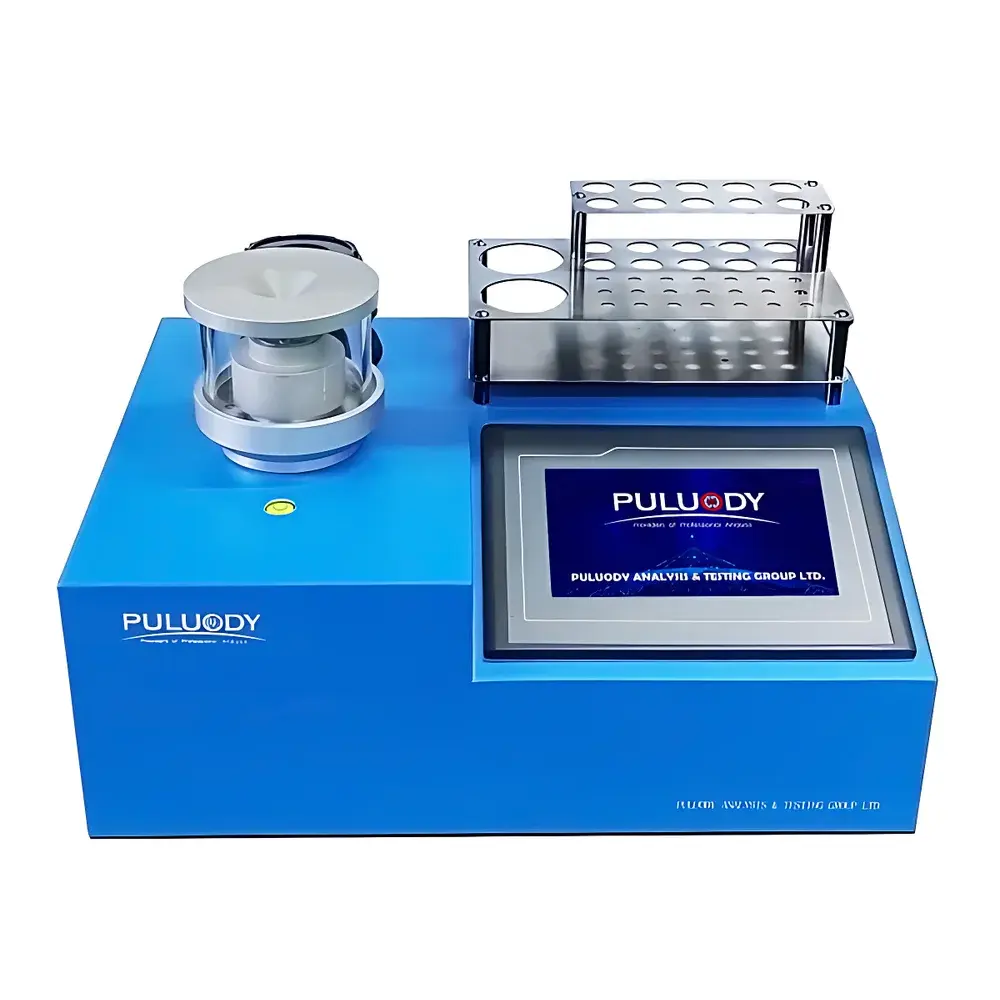
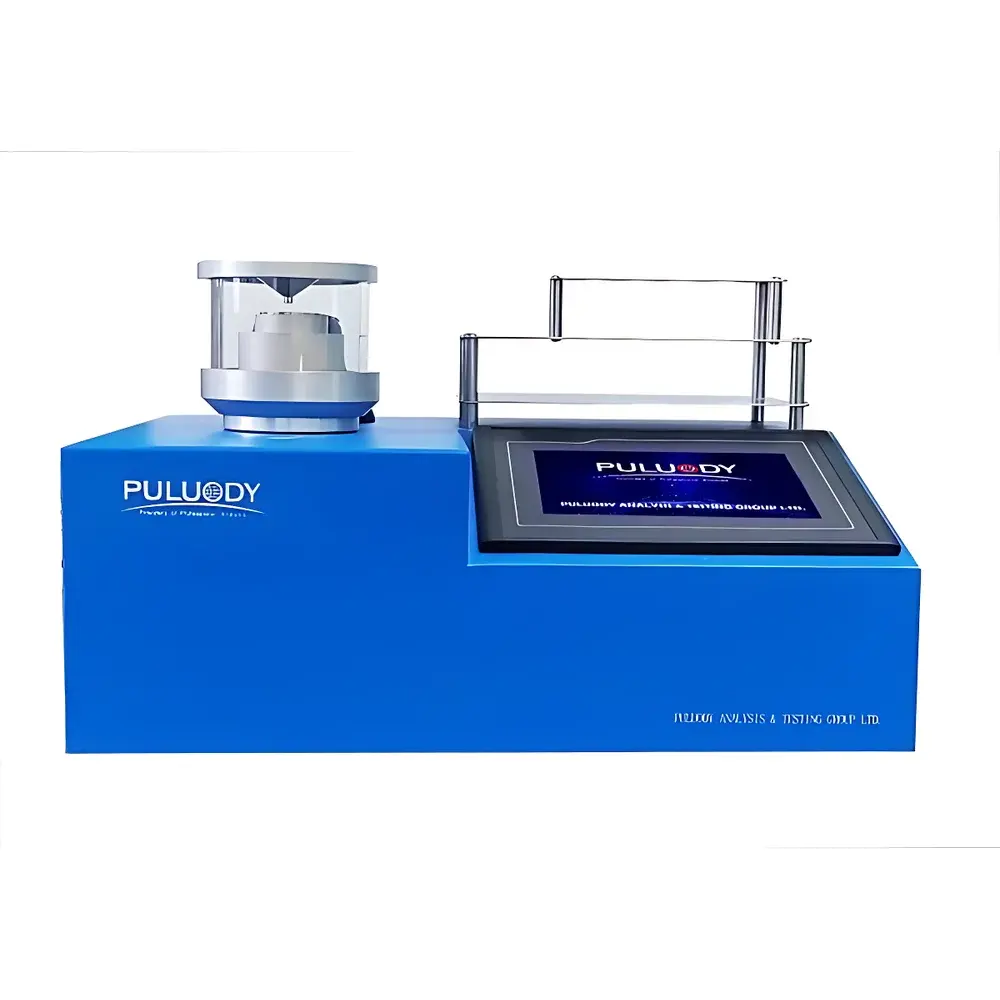
PULUODY PRF-III Rotational Ferrograph Analyzer
| Brand | PULUODY |
|---|---|
| Origin | Shaanxi, China |
| Manufacturer Type | Authorized Distributor |
| Region of Origin | Domestic (China) |
| Model | PRF-III |
| Instrument Type | Optical Particle Counter |
| Magnetic Head Field Strength | 100–1000 Gs (≥600 Gs at peak working point) |
| Deposition Speed | 70 rpm (spectrogram formation), 150 rpm (cleaning/fixation), 200 rpm (drying) |
| Reproducibility | <8% mean error across 8 microscope fields (qualitative), <12% across 4 fields (quantitative) |
| Linear calibration range (optical density vs. debris mass) | 0–55% |
| Oil sample contamination range | 0–3000 ppm |
| Substrate | 55 × 55 × 0.17 mm optical glass slide |
| Control | Four-button tactile interface with real-time RPM and timer display |
| Dimensions | 420 × 310 × 280 mm |
| Power | 220 V, 50 Hz |
Overview
The PULUODY PRF-III Rotational Ferrograph Analyzer is a precision-engineered instrument designed for quantitative and qualitative ferrographic analysis of wear debris in lubricating oils, hydraulic fluids, greases, coolants, and fuels. It operates on the fundamental principle of high-gradient magnetic separation—leveraging controlled rotational motion combined with a precisely calibrated magnetic field to spatially resolve ferromagnetic and paramagnetic wear particles by size and magnetic susceptibility. As the oil sample rotates over a rotating magnetic head, particles are magnetophoretically deposited onto a standardized glass substrate in concentric annular zones: large particles (>10 µm) settle in the inner ring, medium particles (5–10 µm) in the middle ring, and fine particles (<5 µm) in the outer ring. This stratified deposition enables systematic morphological, dimensional, and concentration-based assessment under optical or electron microscopy—providing direct evidence of wear mechanisms (e.g., sliding, fatigue, cutting, or corrosion wear), component degradation status, and incipient failure modes.
Key Features
- Three-zone rotational deposition architecture ensures physically separated, size-resolved particle distribution—enabling unambiguous classification of wear severity and origin.
- High-stability magnetic head with adjustable field strength (100–1000 Gs) and precision mechanical alignment (radial & face runout < ±100 µm) guarantees repeatable particle capture kinetics and minimal positional bias.
- Programmable multi-speed rotation control: 70 rpm for spectrogram formation, 150 rpm for solvent cleaning/fixation, and 200 rpm for centrifugal drying—each phase manually timed except drying (automatically fixed at 2 minutes).
- Uniform 360° deposition geometry achieves statistically representative sampling across ≥50 mm² effective area, with inner-zone coverage ≥10 mm²—critical for low-concentration or low-flow-rate samples.
- Tactile four-button interface with LED digital display provides real-time monitoring of rotational speed and elapsed time during all operational phases.
- Validated reproducibility: <8% mean error across eight microscope fields for qualitative ironogram interpretation; <12% for quantitative particle counts across four fields—meeting ISO 4406:2017 and ASTM D7690-15 guidance for ferrographic consistency.
Sample Compatibility & Compliance
The PRF-III accommodates a broad range of industrial fluids—including mineral- and synthetic-based lubricants, turbine oils, gear oils, hydraulic fluids (ISO L-HM, L-HV), greases (post-extraction), diesel and jet fuels, and water-glycol coolants. Its design supports both routine condition monitoring and research-grade tribological investigation. The system complies with foundational ferrography standards including ASTM D7690-15 (Standard Practice for Ferrographic Analysis), ISO 11500 (Hydraulic fluid — Determination of particulate contamination by automatic particle counting), and aligns with GLP/GMP documentation requirements when integrated with traceable image acquisition and metadata logging. While not FDA 21 CFR Part 11–certified out-of-the-box, its digital imaging subsystem can be configured for audit-trail-enabled operation in regulated environments upon software validation.
Software & Data Management
The PRF-III system integrates with dedicated ferrographic image acquisition and analysis software via USB-connected digital camera and dual-mode optical microscope. Software capabilities include automated particle recognition (based on grayscale thresholding and shape factor algorithms), size-class binning (aligned with ASTM E2454-06 wear particle categories), morphology tagging (lamellar, spherical, curled, cutting), and semi-quantitative optical density mapping. All images are stored with embedded EXIF metadata (date/time, operator ID, sample ID, deposition parameters). Export formats include TIFF (lossless), CSV (particle count per zone), and PDF reports compliant with internal QA/QC templates. Raw data files support third-party statistical analysis (e.g., Weibull distribution fitting for wear progression modeling).
Applications
The PRF-III serves as a cornerstone tool in predictive maintenance programs across heavy-industry sectors where early detection of mechanical wear directly impacts safety, uptime, and lifecycle cost. It is extensively deployed in coal mining (shearer loaders, belt conveyors, hoists), power generation (hydro-turbine governors, steam turbine bearing systems), steel manufacturing (rolling mill gearboxes, continuous caster hydraulics), cement production (kiln drive trains, raw mill gearmotors), marine propulsion (main engine lube systems, reduction gearboxes), and aviation ground support equipment. Specific use cases include: establishing break-in protocols for new machinery; differentiating between normal run-in wear and abnormal fatigue spalling; correlating particle morphology with specific component failures (e.g., bearing cage fracture vs. gear pitting); and supporting root-cause analysis during forensic failure investigations.
FAQ
What types of wear particles can the PRF-III detect?
It detects ferromagnetic and strongly paramagnetic wear debris—primarily iron, steel, nickel, and cobalt alloys—from gears, bearings, cylinders, and hydraulic components. Non-magnetic particles (e.g., aluminum, copper, silicon) are captured only if mechanically entrained or coated with ferrous material.
Is the PRF-III suitable for field deployment or strictly lab-based use?
Its compact footprint (420 × 310 × 280 mm), 220 V / 50 Hz single-phase input, and robust mechanical construction support mobile laboratory integration, though optimal performance requires stable vibration-free mounting and temperature-controlled ambient conditions (15–25°C).
How does the PRF-III differ from analytical ferrographs using linear deposition?
Rotational deposition provides superior particle dispersion uniformity and reduced overlap compared to linear (slide-type) ferrographs—enhancing statistical reliability in low-concentration samples and enabling higher throughput without sacrificing resolution.
Can the PRF-III quantify non-ferrous contaminants like dirt or soot?
While optimized for magnetic wear metals, the system’s optical detection path permits visual identification and approximate sizing of non-magnetic contaminants when co-deposited; however, quantification accuracy is limited without complementary techniques such as ICP-OES or FTIR.
What maintenance is required for long-term calibration stability?
Annual verification of magnetic field homogeneity using a Hall-effect gaussmeter, periodic recalibration of rotational speed via tachometer, and routine cleaning of the magnetic head surface with isopropyl alcohol are recommended. Glass substrates must meet ISO 8573-4 cleanliness specifications prior to use.



