
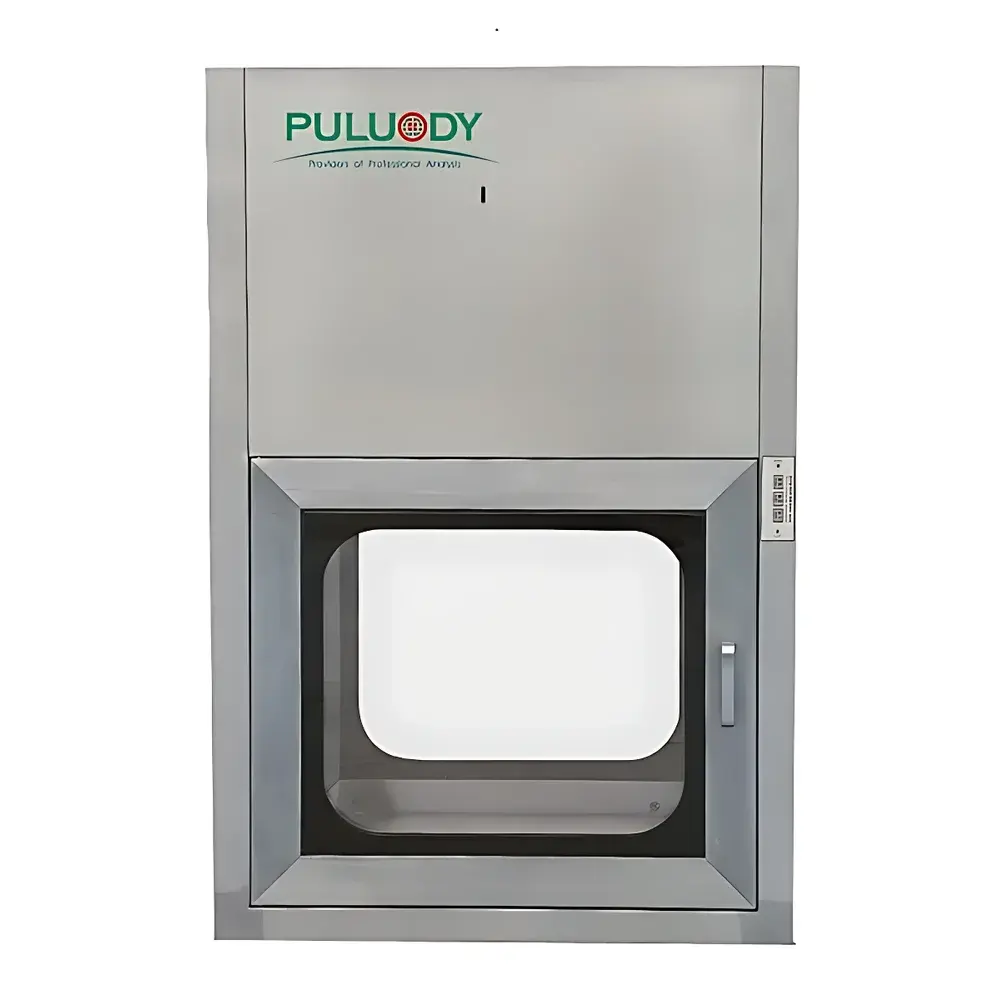
PULUODY PSD-PF100-1A-0.5 Cleanroom Sample Vial Decontamination Chamber (ISO Class 4 & ISO Class 5)
| Brand | PULUODY |
|---|---|
| Origin | Shaanxi, China |
| Model | PSD-PF100-1A-0.5 |
| Dimensions | 360 × 450 × 580 mm |
| Cleanliness Classes | ISO Class 4 (10 particles/ft³ ≥0.1 µm), ISO Class 5 (100 particles/ft³ ≥0.5 µm) |
| Airflow Velocity | 0.25 m/s |
| Vibration Amplitude | ≤3 µm |
| Noise Level | ≤67 dB(A) |
| Power Supply | AC 220 V ±10%, 50 Hz ±1 Hz |
| Operating Temperature | 10–30 °C |
| Relative Humidity | ≤75% RH |
| Lighting | Fluorescent Lamp |
| Sterilization | UV-C Germicidal Lamp |
| Optional Accessories | Pneumatic Rotary Stage (bidirectional), High-Purity Nitrogen Inlet with Particle Filter, Adjustable Gooseneck Nozzle |
Overview
The PULUODY PSD-PF100-1A-0.5 Cleanroom Sample Vial Decontamination Chamber is an engineered solution designed to mitigate cross-contamination risks during the transfer of sampling containers into controlled environments—specifically ISO Class 4 (equivalent to Federal Standard 209E Class 10) and ISO Class 5 (Class 100) cleanrooms. Unlike particle size analyzers or aerosol measurement systems, this unit does not perform analytical characterization; rather, it functions as a pre-entry decontamination station for electronic-grade, pharmaceutical, or semiconductor-grade sample vials, syringes, and small instrumentation components. Its operational principle relies on unidirectional laminar airflow generated by a dual-stage filtration system—comprising a G4 pre-filter and an H14 HEPA filter—to remove airborne particulates ≥0.1 µm and ≥0.5 µm respectively. The chamber maintains stable laminar flow at 0.25 m/s across the work surface, ensuring consistent particle scavenging without turbulence-induced re-entrainment. Structural integrity is ensured through a fully welded steel frame with electrostatic powder coating, while the work surface is fabricated from 304 stainless steel for corrosion resistance and ease of cleaning under cGMP-compliant protocols.
Key Features
- Two-tiered air filtration architecture: G4 coarse filter + H14 HEPA filter (≥99.995% efficiency at 0.1 µm), certified per EN 1822-1
- Laminar airflow uniformity validated across full work area (velocity deviation <±10% per ISO 14644-3)
- Integrated UV-C germicidal lamp (254 nm) with safety interlock to prevent operator exposure during operation
- Low-vibration design: mechanical resonance damped to ≤3 µm peak-to-peak amplitude, minimizing disturbance to sensitive micro-contamination protocols
- Modular gas interface: standardized 6 mm push-to-connect fitting for high-purity nitrogen (≥99.999% N₂) with inline 0.01 µm particulate filter
- Optional bidirectional pneumatic rotary stage (±180° rotation, 0.5° incremental positioning) for uniform surface exposure during gas purging
- Acoustically optimized enclosure: noise emission limited to ≤67 dB(A) at 1 m distance, suitable for shared laboratory environments
Sample Compatibility & Compliance
The chamber accommodates standard sampling vessels including 2–50 mL glass or polymer vials (e.g., ASTM D4176-compliant containers), crimp-top serum vials, and low-particulate syringes. It supports both horizontal and vertical airflow configurations to align with facility-specific cleanroom layout requirements. All materials in contact with the work environment comply with USP for plastic components and ASTM F800 for stainless steel surfaces. The unit meets ISO 14644-1:2015 for airborne particle concentration classification and is compatible with ISO 14644-2:2015 surveillance testing protocols. For regulated environments, optional audit-trail-capable digital loggers (not included) may be integrated to record UV runtime, airflow status, and door-open events—supporting GLP/GMP documentation requirements per FDA 21 CFR Part 11 when paired with validated software.
Software & Data Management
The PSD-PF100-1A-0.5 operates via a dedicated embedded control panel with tactile membrane switches and LED status indicators—no external PC or proprietary software is required. Real-time monitoring includes UV lamp operational hours, cumulative runtime, and door-open event logging (non-volatile memory). Optional RS-485 Modbus RTU interface enables integration into centralized facility monitoring systems (e.g., Siemens Desigo, Honeywell Experion) for remote status verification and alarm forwarding. Data export is limited to CSV-formatted event logs via USB port; no cloud connectivity or SaaS platform dependency is implemented—ensuring data sovereignty and cybersecurity compliance in highly regulated labs.
Applications
- Prefilling decontamination of sampling vials prior to entry into ISO Class 4/5 cleanrooms used in semiconductor wafer fabrication
- Pre-analysis preparation of containers for ICP-MS, TOC, or trace metal analysis where sub-ppt contamination thresholds apply
- Debris mitigation for vials used in biopharmaceutical process validation studies requiring ISO 14644-1 Class 5 environments
- Supporting ASTM E2934-22 (Standard Guide for Cleanroom Contamination Control) through documented pre-entry particle reduction workflows
- Facilitating USP particulate matter testing by eliminating ambient particulate carry-in during sample handling
FAQ
Does this unit meet ISO 14644-1 certification requirements for Class 4 and Class 5 environments?
Yes—the chamber’s laminar airflow performance, particle removal efficiency, and structural sealing have been verified per ISO 14644-3 test methods and support routine classification per ISO 14644-1:2015 Annex B.
Can the UV-C lamp be operated independently of the airflow system?
No—UV irradiation is interlocked with fan operation to ensure simultaneous air filtration and surface sterilization; the lamp automatically deactivates if airflow drops below 0.20 m/s.
Is nitrogen purge functionality validated for residual oxygen reduction?
The nitrogen inlet is designed for inerting and particle displacement—not for O₂ depletion; users requiring oxygen-sensitive applications must validate residual O₂ levels using independent sensors.
What maintenance intervals are recommended for filter replacement?
G4 pre-filters should be inspected monthly and replaced every 3–6 months depending on ambient dust load; H14 HEPA filters require annual integrity testing (DOP/PAO scan) and replacement every 2–5 years based on pressure drop monitoring.
Is the stainless steel work surface electropolished?
No—it features a #4 brushed finish per ASTM A480; electropolishing is available as a custom option (PSD-PF100-1A-0.5-EP) with lead-time extension.



