
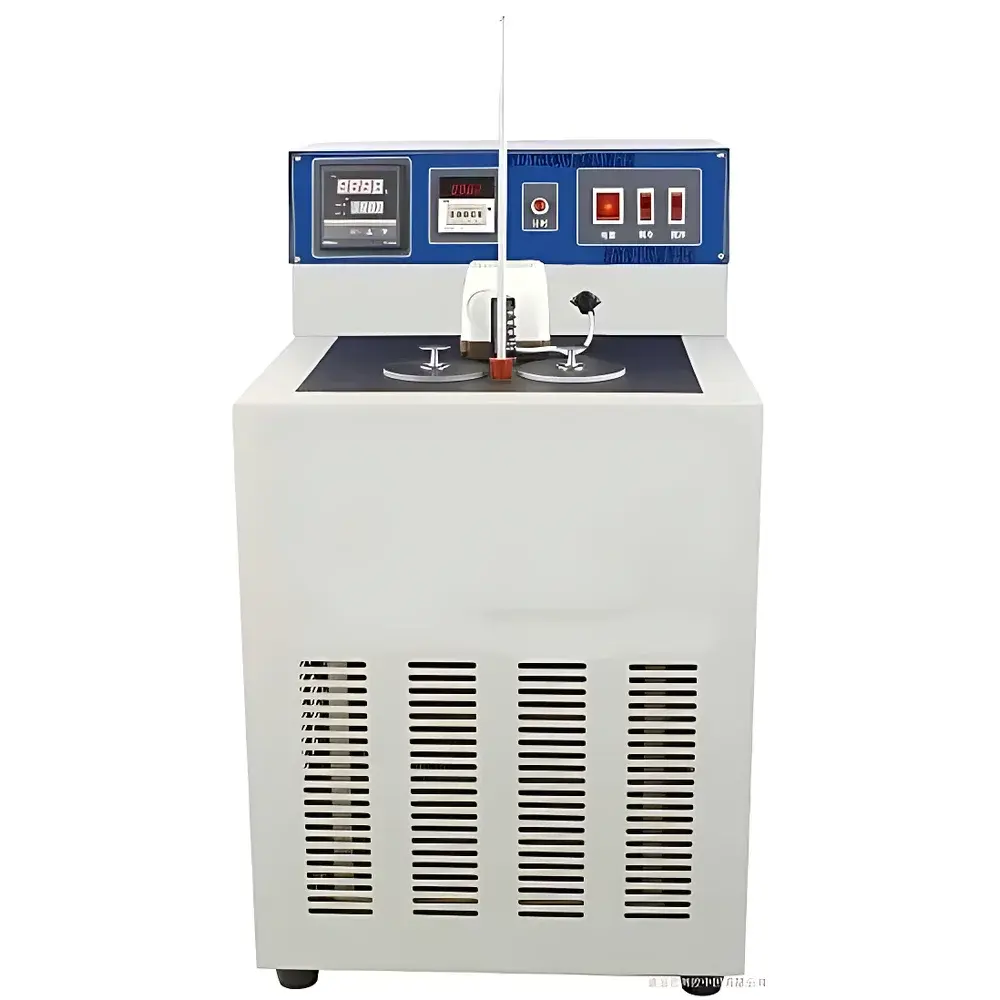
PULUODY PLD-3535E Multi-Function Petroleum Low-Temperature Property Tester (Pour Point, Cloud Point, Pour Point & Cold Filter Plugging Point Analyzer)
| Brand | PULUODY |
|---|---|
| Origin | Shaanxi, China |
| Manufacturer Type | Original Equipment Manufacturer (OEM) |
| Country of Manufacture | China |
| Model | PLD-3535E |
| Power Input | <1600 W |
| Supply Voltage | AC 220 V ±10%, 50 Hz |
| Temperature Control Method | Microcontroller-Based Digital PID Control |
| Temperature Range | +30 °C to –38 °C |
| Temperature Stability | ±0.5 °C |
| Cooling Time (30 °C → –38 °C) | ≤100 min |
| Bath Configuration | Dual-Position Single-Bath Design |
| Compliance Standards | GB/T 3535, GB/T 510, GB/T 6986, SH/T 0248, ASTM D97, ASTM D2500, ASTM D5853, ASTM D6371 |
Overview
The PULUODY PLD-3535E Multi-Function Petroleum Low-Temperature Property Tester is a rigorously engineered laboratory instrument designed for the standardized determination of critical low-temperature behavior parameters in crude oils, distillates, lubricants, and other hydrocarbon-based fluids. It operates on the physical principles of thermal phase transition detection—specifically, the identification of temperature thresholds at which petroleum products undergo observable macroscopic changes during controlled cooling: cloud formation (cloud point), cessation of flow under gravity (pour point), wax crystallization onset affecting filterability (cold filter plugging point, CFPP), and solidification (freeze point or congealing point). The system implements a dual-position single-bath architecture with integrated refrigeration and precision digital temperature control, enabling sequential or parallel testing per ASTM and GB standard protocols without hardware reconfiguration.
Key Features
- Integrated dual-function cold bath: One thermally uniform stainless-steel bath accommodates two independent test vessels, supporting concurrent or staggered analysis while maintaining traceable thermal homogeneity across both positions.
- High-efficiency closed-cycle refrigeration system: Utilizes a hermetically sealed compressor coupled with an optimized evaporator head to achieve stable sub-zero operation down to –38 °C with minimal thermal drift.
- Digital microcontroller-based PID temperature regulation: Ensures real-time adaptive control with ±0.5 °C accuracy over the full operating range (+30 °C to –38 °C), validated against NIST-traceable reference thermometers.
- Intuitive digital temperature display and interface: Front-panel LED readout provides continuous monitoring of bath temperature, setpoint, and elapsed cooling time; no external PC required for basic operation.
- Standard-compliant mechanical design: Bath geometry, sample tube dimensions, cooling rate profiles, and observation methodology fully conform to ASTM D97 (pour point), ASTM D2500 (cloud point), ASTM D5853 (CFPP for diesel), and GB/T 6986/GB/T 3535/GB/T 510 test specifications.
- Energy-optimized thermal architecture: Total power consumption remains below 1600 W during continuous operation at minimum temperature, reducing facility load and operational cost.
Sample Compatibility & Compliance
The PLD-3535E is validated for use with liquid petroleum products including but not limited to: No. 1 and No. 2 diesel fuels, jet fuels (Jet A, Jet A-1), heating oils, lubricating base stocks, and light crude fractions. Sample volume requirements align with ASTM and GB standards—typically 30–50 mL per test vessel. All operational procedures support GLP-compliant documentation when paired with external lab information management systems. Instrument design incorporates mechanical safeguards to prevent condensation ingress into control electronics and ensures stable thermal gradients during extended low-temperature holds. While the unit itself does not carry CE or UL certification, its electrical architecture complies with IEC 61010-1 safety requirements for laboratory equipment, and all temperature control firmware adheres to deterministic timing constraints essential for regulatory repeatability.
Software & Data Management
The PLD-3535E operates as a stand-alone benchtop instrument with embedded firmware controlling all thermal cycles and user inputs. For laboratories requiring electronic recordkeeping, optional RS-232 or USB-to-serial interfaces enable connection to LIMS or custom data acquisition platforms. When integrated with compliant software, the system supports audit-trail generation—including operator ID, test start/end timestamps, setpoint history, and actual bath temperature logs—at one-second resolution. Such configurations meet foundational requirements for FDA 21 CFR Part 11 compliance when deployed within validated workflows, provided appropriate access controls, electronic signatures, and data integrity validation are implemented at the host system level.
Applications
This analyzer serves core quality assurance and formulation development functions across upstream, midstream, and downstream petroleum operations. Refineries employ it to verify cold-flow performance of finished diesel blends prior to dispatch; pipeline operators use pour point data to assess winter-grade fuel suitability for northern transit corridors; lubricant manufacturers rely on cloud point consistency to ensure additive package stability; and independent testing labs apply it for contract analysis supporting ISO 8217 marine fuel certification. Its multi-parameter capability reduces cross-instrument calibration burden and eliminates inter-unit variability that can arise when using discrete single-test devices.
FAQ
Does the PLD-3535E require external cooling water or cryogenic gases?
No—this instrument is self-contained and uses only ambient air for heat rejection; no chiller, dry ice, or liquid nitrogen is needed.
Can the same sample be used sequentially for cloud point and pour point tests?
Yes, provided the sample is reheated to specified conditioning temperature between tests and cooled at the prescribed rate per ASTM D2500 and D97 respectively.
Is calibration verification supported by the instrument?
The unit includes dedicated calibration mode for offset adjustment using certified reference thermometers; full calibration certificates are issued upon request with traceability to national metrology institutes.
What maintenance intervals are recommended for long-term reliability?
Compressor oil and refrigerant levels should be verified annually; evaporator fins require quarterly cleaning; temperature sensor calibration is recommended every six months in high-throughput environments.
Are replacement parts and technical documentation available internationally?
Yes—PULUODY maintains global spare parts inventory and provides English-language operation manuals, calibration guides, and troubleshooting matrices directly to end users and authorized service partners.





