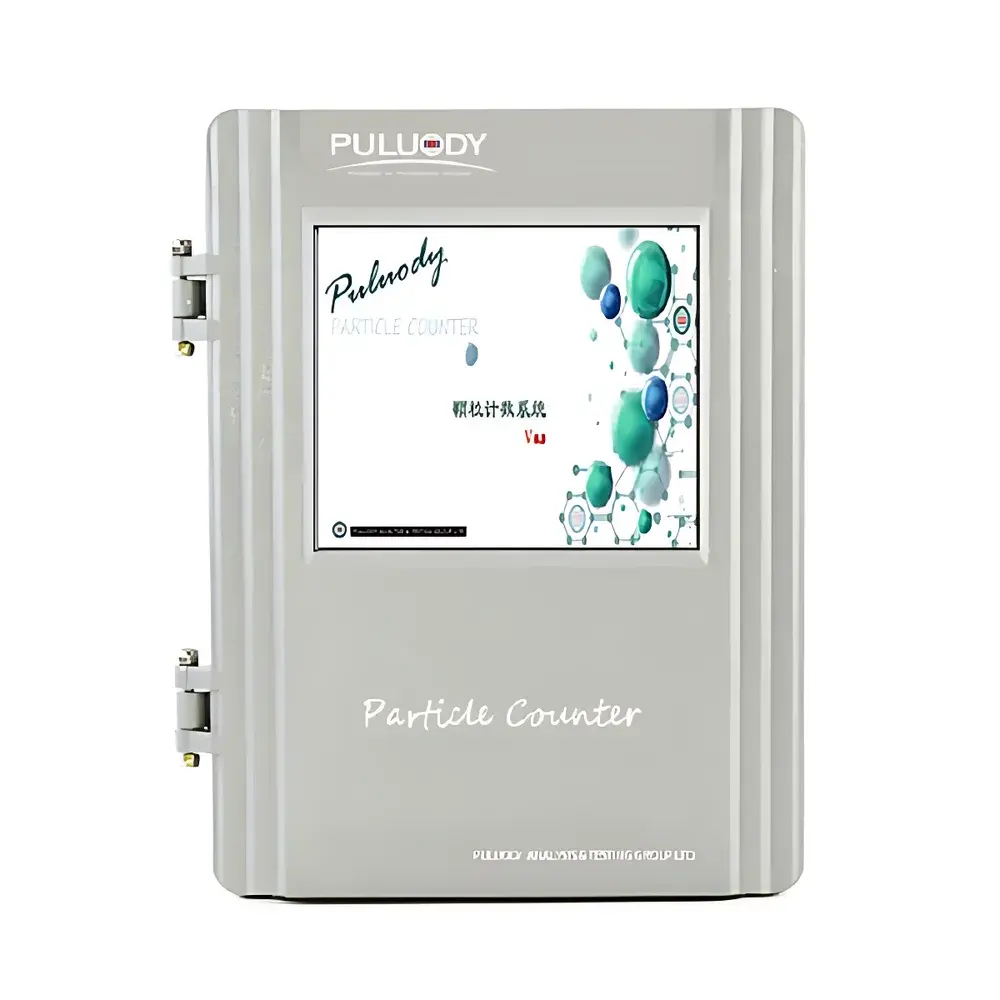
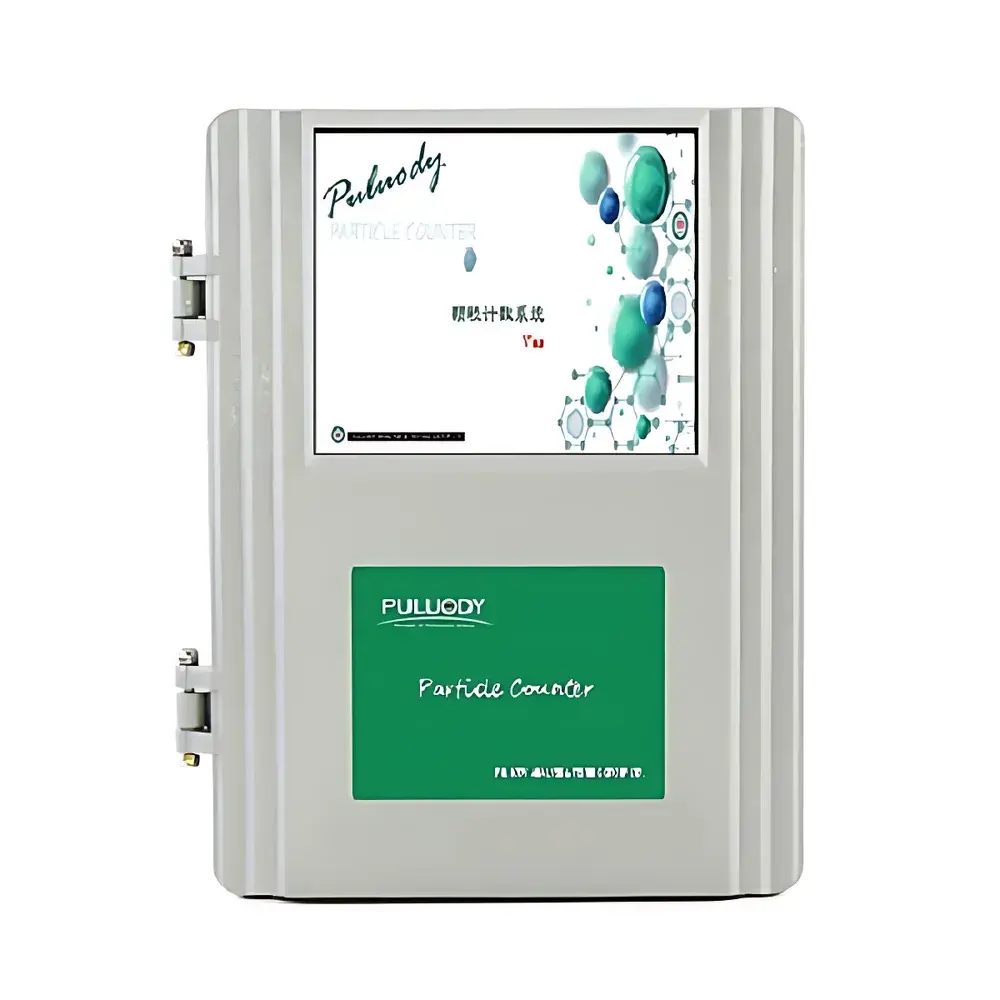
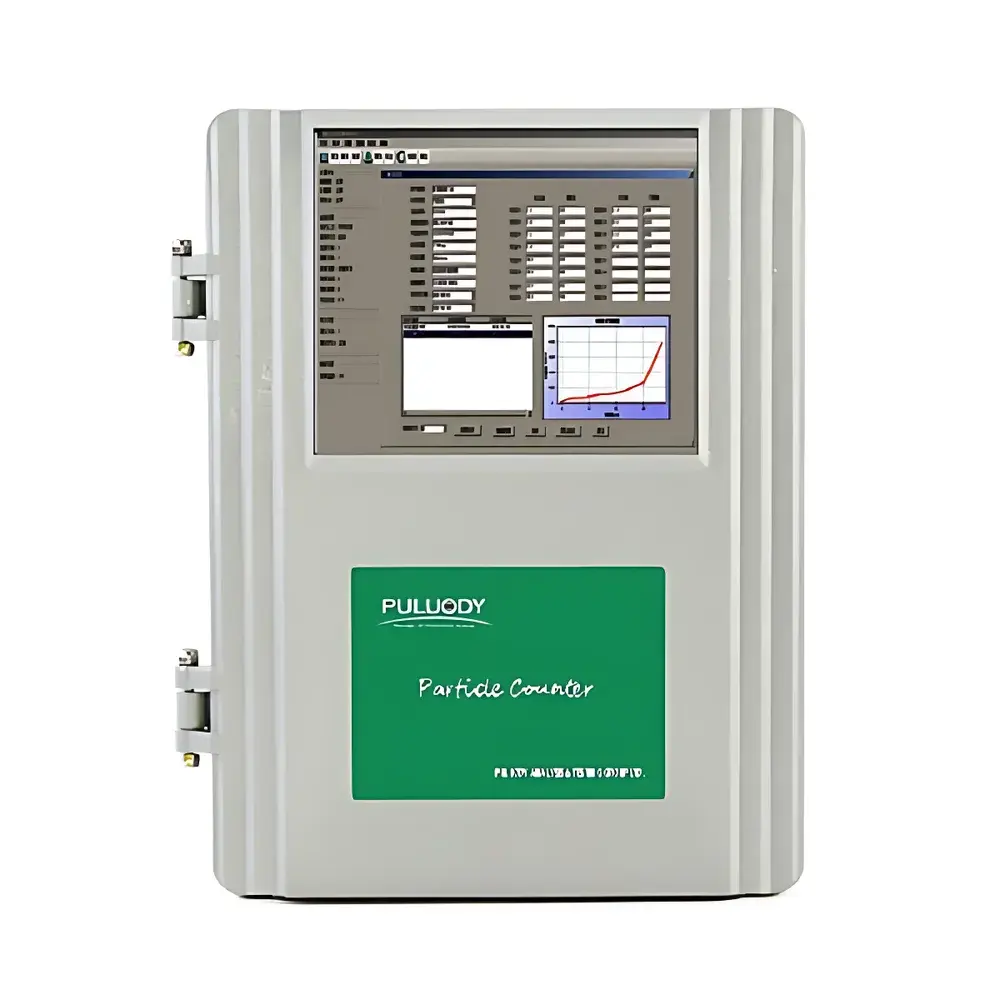
PULUODY OPC-2300A Online Waterborne Particle Counter
| Brand | PULUODY |
|---|---|
| Origin | Shaanxi, China |
| Manufacturer Type | Authorized Distributor |
| Country of Origin | China |
| Model | OPC-2300A |
| Detection Principle | Light Obscuration (LO) with Dual-Laser Narrow-Beam Technology (7th Generation) |
| Sensor Options | A (2–100 µm), B (1–150 µm), C (1–450 µm), H (0.1–1.0 µm), I (0.2–2.0 µm), J (0.5–50.0 µm), K (2–750 µm / 2–800 µm / 5–1000 µm), L (40–1000 µm / 10–2000 µm), N (50–1000 µm), M (100–2000 µm) |
| Sizing Range (Standard) | 1–100 µm, 2–125 µm, 2–250 µm, 5–500 µm |
| Channel Resolution | 0.1 µm |
| Resolution | 10% (per ISO 21501-4) |
| Accuracy | < ±3% typical (NIST-traceable latex standard calibration) |
| Coincidence Error | ≤5% at 999,999 particles/mL |
| Maximum Detectable Concentration | 9,999,999 particles/mL |
| Sampling Interval | 5 s – 9 h (programmable) |
| Calibration Standards | NIST-traceable polystyrene latex (PSL) spheres, AC fine test dust, MTD (Medium Test Dust) |
| Operating Pressure | 0–0.6 MPa (standard) |
| Flow Rate | 6–500 mL/min |
| Output Interfaces | RS-232, 4–20 mA analog, optional Ethernet/Modbus TCP |
| Display | Integrated LCD with membrane keypad |
| Environmental Rating | IP65 enclosure |
Overview
The PULUODY OPC-2300A Online Waterborne Particle Counter is an industrial-grade, real-time liquid particle monitoring system engineered for continuous, unattended operation in critical water treatment and process fluid environments. Based on the internationally recognized light obscuration (LO) principle—also known as the optical blockage or photoelectric blocking method—the instrument detects individual particles suspended in aqueous media by measuring transient reductions in laser beam intensity as particles pass through a precisely defined sensing zone. This seventh-generation dual-laser narrow-beam detection architecture delivers enhanced signal-to-noise ratio, improved pulse stability, and reduced sensitivity to refractive index variation compared to single-source configurations. Designed specifically for municipal and industrial water applications—including drinking water production, wastewater reclamation, beverage processing, pharmaceutical water systems (PW/WFI), and membrane filtration validation—the OPC-2300A meets foundational requirements for particulate contamination surveillance per ISO 21501-4, USP , and ASTM F312-18. Its robust mechanical construction and pressure-rated wetted path enable direct integration into pressurized distribution loops without bypass or dilution.
Key Features
- Modular sensor configuration supporting up to 10 interchangeable optical detection modules (H–M series), enabling application-specific range selection from 0.1 µm to 2000 µm
- Programmable sampling interval (5 seconds to 9 hours) with synchronized timestamping and auto-triggered alarm thresholds
- Integrated pressure regulation (0–31.5 MPa option) and flow control (6–500 mL/min) for stable hydrodynamic conditions across variable line pressures
- On-device LCD interface with membrane keypad for local configuration, real-time histogram display, and cumulative count trending
- Dual-output capability: isolated RS-232 serial communication for SCADA/HMI integration and 4–20 mA analog output compatible with DCS and PLC analog input cards
- IP65-rated aluminum alloy housing with corrosion-resistant wetted materials (316L stainless steel, fused silica flow cell, EPDM seals)
- Embedded calibration management supporting NIST-traceable PSL sphere verification, AC fine dust qualification, and MTD-based performance validation
Sample Compatibility & Compliance
The OPC-2300A is validated for use with low-viscosity, optically transparent aqueous streams including potable water, filtered process water, ultrapure water (UPW), reverse osmosis permeate, and clean-in-place (CIP) rinse solutions. It is not intended for highly turbid, opaque, or viscous fluids (e.g., sludge, glycol blends, or emulsions) without pre-filtration or dilution. Regulatory alignment includes support for data integrity frameworks required under FDA 21 CFR Part 11 (when paired with compliant software), GLP/GMP audit readiness via full electronic audit trail, and conformance with ISO 21501-4 for calibration traceability and resolution reporting. Optional firmware modules allow user-defined pass/fail logic per USP particle limits (e.g., ≥10 µm and ≥25 µm thresholds) or custom binning schemes aligned with internal quality standards.
Software & Data Management
The OPC-2300A operates with embedded firmware and supports external host integration via ASCII protocol over RS-232 or Modbus TCP (optional). The included PULUODY ParticleView™ desktop application provides comprehensive data visualization: real-time scatter plots, time-series concentration charts, differential and cumulative size distributions, and automated report generation (PDF/CSV). All raw pulse data—including amplitude, width, and transit time—is retained with microsecond timestamping for retrospective analysis. Audit logs record all configuration changes, calibration events, and alarm activations with operator ID and UTC timestamps. For enterprise deployment, the device integrates natively with OSIsoft PI System, Siemens Desigo CC, and Honeywell Experion PKS via standard OPC UA drivers.
Applications
- Continuous integrity monitoring of ultrafiltration (UF) and reverse osmosis (RO) membranes in municipal water plants
- Validation of final filter performance in pharmaceutical water-for-injection (WFI) distribution loops
- Early detection of biofilm shedding or colloidal iron breakthrough in groundwater treatment systems
- Quantitative assessment of cleaning efficacy in CIP validation for beverage bottling lines
- Trend analysis of particle load dynamics during coagulation/flocculation optimization trials
- Supporting microbial risk assessment via correlation of sub-2 µm particle counts with heterotrophic plate count (HPC) surrogates
- Real-time feedback control for automatic backwash scheduling in granular media filters
FAQ
What particle sizing standards does the OPC-2300A comply with?
The instrument adheres to ISO 21501-4 for calibration methodology, resolution verification, and uncertainty reporting. It supports configurable binning per USP , EP 2.2.17, and internal SOPs.
Can the OPC-2300A be installed directly into a high-pressure main distribution line?
Yes—models equipped with the integrated pressure regulator operate continuously at up to 31.5 MPa. Standard units are rated to 0.6 MPa and require external pressure reduction for higher-line applications.
Is the device suitable for detecting biological particles such as bacteria or spores?
It detects physical particulates ≥0.1 µm; however, morphological identification requires orthogonal techniques (e.g., ATP assay, flow cytometry). Sub-2 µm counts may correlate with bacterial abundance but do not confirm viability or taxonomy.
How often must the system be recalibrated?
Annual calibration is recommended per ISO/IEC 17025 guidelines. Field verification using PSL reference standards should occur before each critical campaign or after maintenance.
Does the OPC-2300A support remote firmware updates and diagnostics?
Firmware updates require local USB connection or RS-232 upload. Remote diagnostics are available via Modbus TCP-enabled gateways with secure VLAN segmentation.
Related Products