
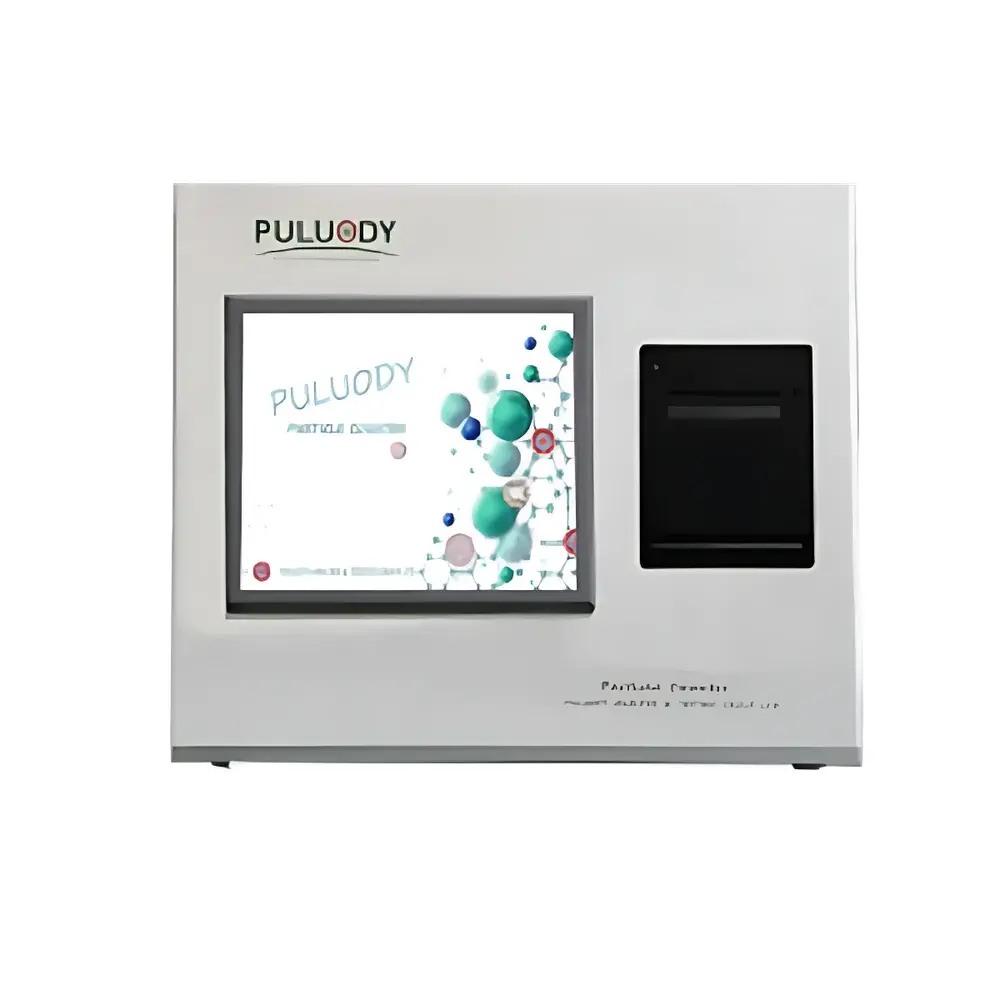
PULUODY DPC-1513 Laser Particle Size & Shape Analyzer for Oilfield Re-injection Water
| Brand | PULUODY |
|---|---|
| Model | DPC-1513 |
| Origin | Shaanxi, China |
| Instrument Type | Laboratory Laser Diffraction & Flow Imaging Hybrid Analyzer |
| Dispersion Method | Dry & Wet Dispersion |
| Measurement Range | 1 nm – 2000 µm |
| Repeatability | <5% (D50) |
| Measurement Time | ≤30 s per sample |
| Detection Principle | Laser Diffraction (ISO 13320 compliant) + Hydrodynamic Focusing Flow Imaging (ISO 13321 compatible) |
| Sample Introduction | Static cuvette & recirculating wet dispersion unit |
| Software Platform | Windows-native, bilingual (EN/CN), 20 report templates |
| Compliance | SY/T 5329–2012, Q/SY 01004–2016, SY/T 6596–2016, SY/T 5523–2016 |
| Power Supply | AC 220 V ±10%, 50 Hz, 300 W |
Overview
The PULUODY DPC-1513 Laser Particle Size & Shape Analyzer is a dual-mode, laboratory-grade instrument engineered for precise, traceable characterization of suspended particulate matter in oilfield re-injection water systems. It integrates two complementary physical measurement principles—laser diffraction (LD) and hydrodynamic focusing flow imaging (HFFI)—to deliver both statistically robust size distribution data and individual particle morphological metrics (e.g., aspect ratio, circularity, convexity). The LD module operates in strict accordance with ISO 13320:2020, enabling rapid, ensemble-based analysis across a continuous dynamic range from 1 nm to 2000 µm. The HFFI module employs laminar sheath-flow hydrodynamics to align particles in single file within the optical focal plane, coupled with high-speed CMOS imaging and real-time pixel-based projection area quantification—supporting equivalent-area diameter (xEA), equivalent-sphere volume diameter (xEV), and shape descriptors per particle. This hybrid architecture eliminates reliance on Mie theory assumptions for non-spherical or polydisperse contaminants common in produced water, thereby improving metrological confidence in compliance-critical reporting.
Key Features
- Dual-principle architecture: Simultaneous or selective operation of ISO-compliant laser diffraction and calibrated flow imaging modules
- Modular sensor configuration: Selectable nanoscale (1–10,000 nm), microscale (0.02–2000 µm), or full-range (1 nm–2000 µm) measurement modes
- Re-injection water–optimized optics: Seventh-generation dual-laser narrow-beam detector with thermal drift compensation and >10,000-hour service life
- Hydrodynamic focusing cell: Dual-channel microfluidic design ensuring laminar sheath-to-sample flow ratio ≥5:1 for consistent particle alignment and minimal image blur
- Integrated sample handling: Dual-path introduction system—static quartz cuvette (for low-volume, low-concentration samples) and recirculating wet dispersion unit (with ultrasonic deagglomeration and programmable flow rate control)
- Automated workflow engine: Fully scripted sequence covering auto-alignment, background acquisition, concentration optimization, signal capture, statistical validation, report generation, and system flush
- Electrical–hydraulic isolation: Physically segregated fluidic and electronic compartments to suppress electromagnetic interference and ensure long-term signal stability
Sample Compatibility & Compliance
The DPC-1513 is validated for aqueous suspensions containing inorganic fines (e.g., clay, silt, iron sulfide), organic aggregates, corrosion byproducts, and biocidal precipitates typical of upstream water management streams. Its measurement protocols directly support regulatory and operational standards mandated for injection water quality control—including SY/T 5329–2012 (Recommended Water Quality Indices for Clastic Reservoirs), Q/SY 01004–2016 (Gas Field Water Re-injection Technical Specification), SY/T 6596–2016 (Gas Field Water Injection Requirements), and SY/T 5523–2016 (Analytical Methods for Oilfield Water). All software-generated reports include audit-ready metadata (operator ID, timestamp, instrument serial number, calibration status, raw data checksums) and are structured to satisfy GLP-aligned documentation requirements. Optional 21 CFR Part 11 compliance packages provide electronic signature support, role-based access control, and immutable audit trails for regulated QA/QC laboratories.
Software & Data Management
The embedded Windows-native software suite supports both English and Chinese UI localization and features a modular architecture compliant with ASTM E2911–22 (Standard Guide for Data Exchange in Particle Characterization). It includes an integrated database with relational schema for sample history, method versioning, and calibration log tracking. All raw diffraction patterns and image stacks are stored losslessly in HDF5 format; processed results export to CSV, PDF, PNG, and XML (ISO/IEC 11179-compliant metadata schema). Twenty standardized report templates cover cumulative distributions (D10, D25, D50, D75, D90, D97, D100), interval histograms, shape parameter histograms (circularity, aspect ratio), specific surface area estimation, and comparative overlay plots. Batch processing mode enables unattended multi-sample analysis with automatic outlier detection based on ISO 13320 repeatability thresholds.
Applications
- Monitoring suspended solids in produced water prior to filtration and re-injection to prevent formation damage and injectivity decline
- Quantifying efficiency of coagulation/flocculation units and membrane pre-treatment stages
- Characterizing iron sulfide (FeS) particle morphology to assess scaling propensity and corrosion mechanism pathways
- Validating performance of electrocoagulation and advanced oxidation process (AOP) effluents
- Supporting root-cause analysis of wellbore plugging incidents via retrospective particle fingerprinting
- Generating input parameters for reservoir simulator models requiring grain-size distribution boundary conditions
FAQ
What measurement principles does the DPC-1513 employ, and how do they differ in application?
It combines laser diffraction (for rapid, statistically representative ensemble sizing) and hydrodynamic focusing flow imaging (for single-particle morphology and irregular shape quantification). Diffraction is preferred for routine QC; imaging is deployed when particle shape or agglomeration state critically impacts injectivity or filtration behavior.
Is the instrument suitable for field deployment or strictly for laboratory use?
The DPC-1513 is designed as a benchtop laboratory instrument with environmental operating limits of 0–40 °C and requires stable AC power. It is not rated for hazardous area (ATEX/IECEx) or mobile platform integration.
How is data integrity ensured during regulatory audits?
All analytical sessions generate time-stamped, digitally signed records including raw sensor outputs, calibration certificates, operator credentials, and method parameters. Optional 21 CFR Part 11 add-on enables full electronic record compliance with audit trail, electronic signatures, and data immutability controls.
Can the system analyze opaque or highly absorbing particles commonly found in oilfield water?
Yes—the dual-laser optical path and adjustable gain amplification allow reliable detection of carbonaceous fines, FeS, and MnO2 particulates without requiring refractive index assumptions that compromise accuracy in traditional Mie-based instruments.
What maintenance intervals are recommended for sustained ISO-compliant performance?
Optical alignment verification every 90 days; detector sensitivity calibration annually using NIST-traceable polystyrene latex standards; fluidic path cleaning after each sample series using manufacturer-specified solvent protocol; full system validation per ISO/IEC 17025 every 12 months.



