
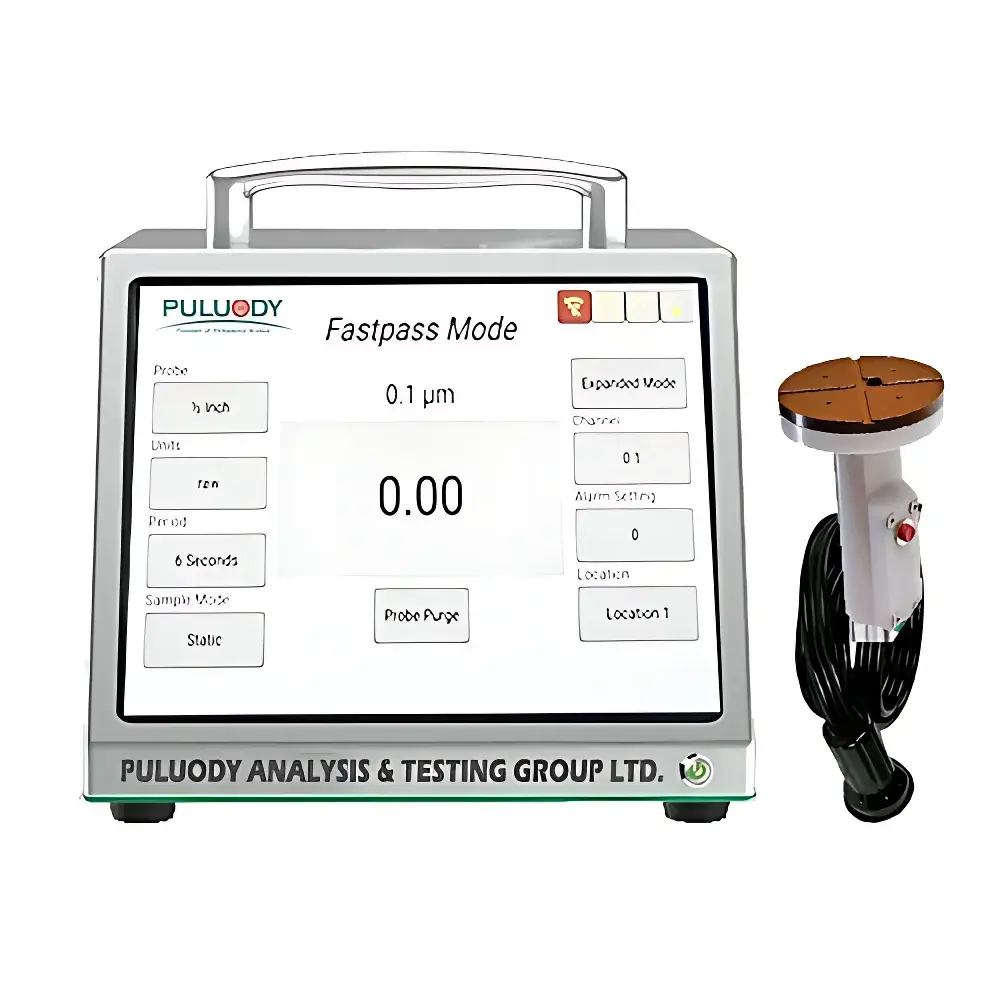
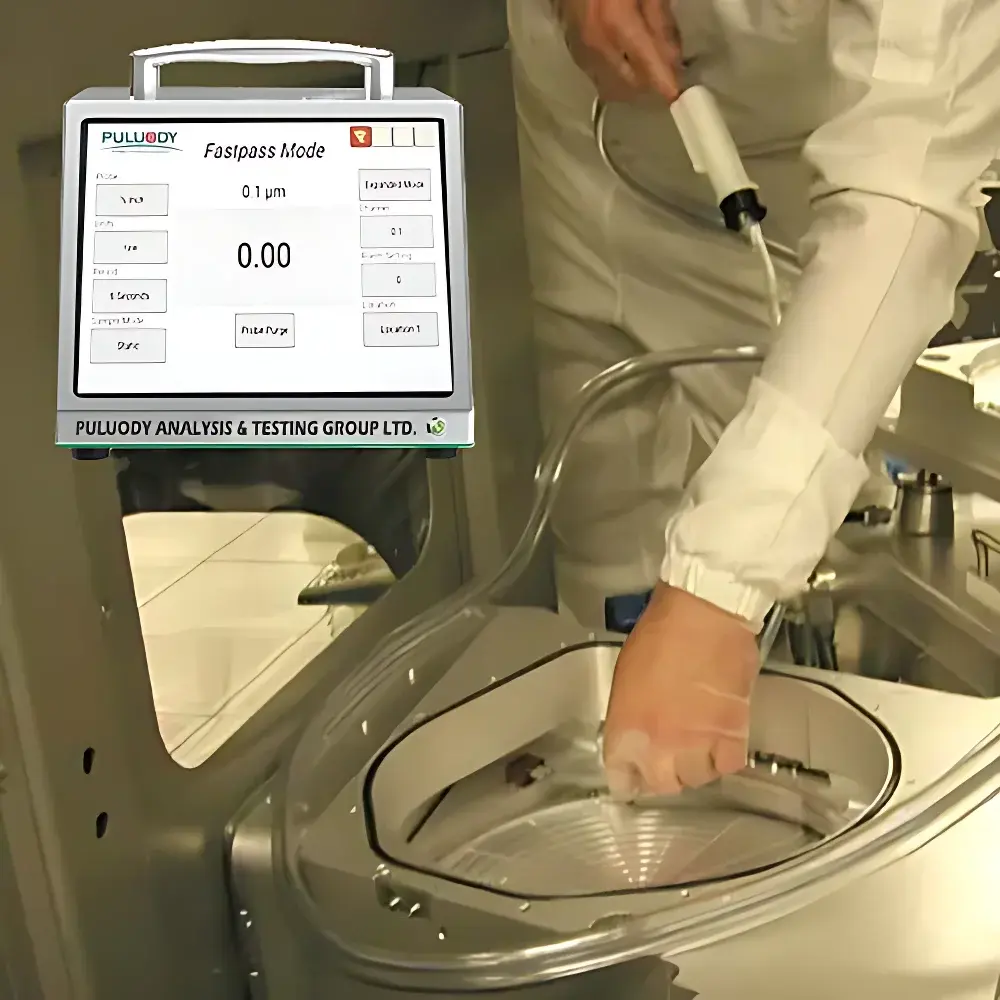
PULUODY Surface Particle Counter P-III+
| Brand | PULUODY |
|---|---|
| Origin | Shaanxi, China |
| Manufacturer Type | Authorized Distributor |
| Country of Origin | China |
| Model | P-III+ |
| Price | USD 105,000 (FOB) |
| Particle Size Channels | A: 0.3, 2.5, 10 µm |
| B | 0.3, (0.5/1.0/2.5/5.0), 10 µm |
| C | 0.3, 0.5, 1.0, 2.5, 5.0, 10 µm |
| D | 0.5, 1.0, 1.5, 2.0, 2.5, 3.0 µm |
| E | 0.5, 1.0, 3.0, 5.0, 10.0, 25.0 µm |
| F | 0.1, 0.2, 0.3, 0.5, 1.0, 5.0 µm |
| Size Accuracy | ≤ ±30% |
| Concentration Accuracy | ≤ ±30% |
| Repeatability | ≤ ±10% FS |
| Coincidence Error | ≤ 5% |
| Flow Rates | 2.83 L/min and 28.3 L/min (selectable) |
| Sampling Duration | 3–60 s (programmable) |
| Operating Temperature | −40 to 120 °C |
| Environmental Operating Range | 5–45 °C, ≤90% RH (non-condensing) |
| Power Supply | AC 100–240 V, 50/60 Hz |
| Compliance | ISO 21501-4, JIS B 9921, ISO 14644-1, ISO 14644-9 |
| Data Interfaces | RS232, RS485, LAN, USB |
| Audit Trail & User Access Control | Yes |
| Detection Modes | Count, Mass, Net Efficiency |
| Alarm Outputs | Configurable count/mass thresholds |
| Storage | Unlimited real-time/timed logging |
| Optional Accessories | Straight probe (UK4400302), 90° probe (UK4400304), Multi-functional probe (UK4400301) |
Overview
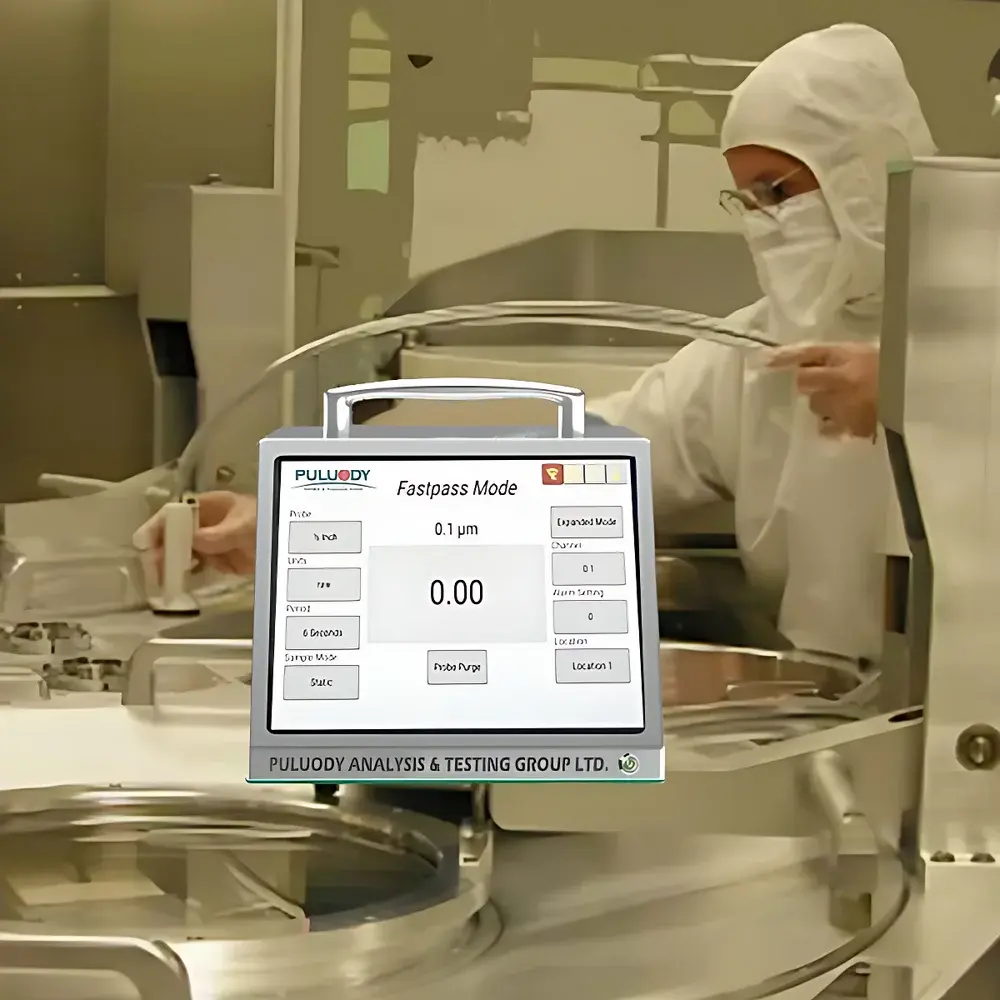
The PULUODY Surface Particle Counter P-III+ is a high-precision, portable optical particle counter engineered for quantitative surface contamination monitoring in controlled environments. It operates on the principle of light scattering detection—where particles deposited on or suspended near surfaces are sampled via isokinetic air aspiration, illuminated by a stable laser diode, and classified in real time according to calibrated scattering cross-sections. Unlike traditional airborne particle counters, the P-III+ integrates surface-adapted sampling geometry and dynamic flow compensation to enable direct, non-destructive assessment of particulate loading on critical substrates—including wafers, photomasks, optical lenses, and medical device components. Its design supports both static surface scanning and dynamic in-situ monitoring during tool idle periods or chamber purge cycles, delivering traceable, repeatable data aligned with cleanroom process validation requirements.
Key Features
- Multi-channel size resolution: Six configurable particle sizing matrices (A–F) support application-specific calibration—ranging from ultrafine sub-0.1 µm detection (Matrix F) to coarse 25 µm verification (Matrix E), enabling compliance with semiconductor front-end, flat-panel display, and Class 100/ISO 5 cleanroom protocols.
- Dual-flow sampling architecture: Selectable 2.83 L/min (for ISO 14644-1 compliance) or high-volume 28.3 L/min mode (for rapid surface clearance verification), both maintaining laminar, isokinetic aspiration across probe geometries.
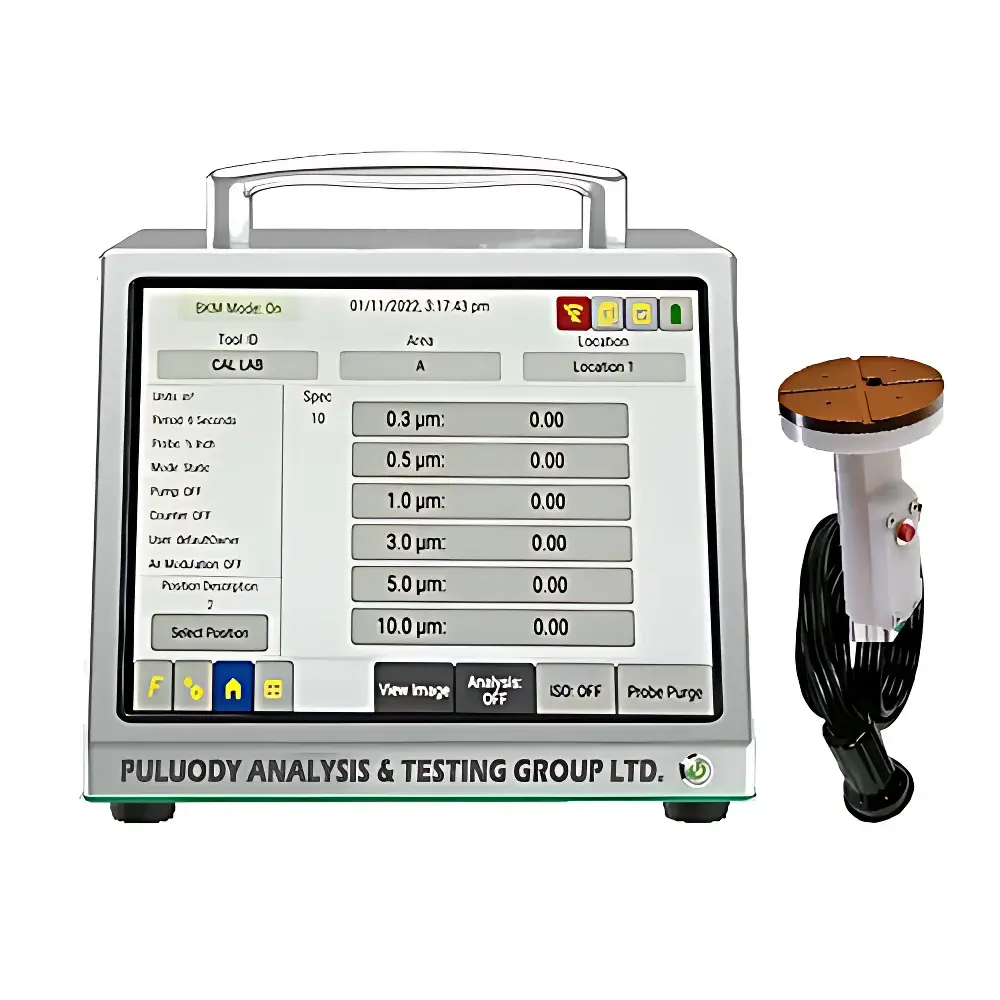
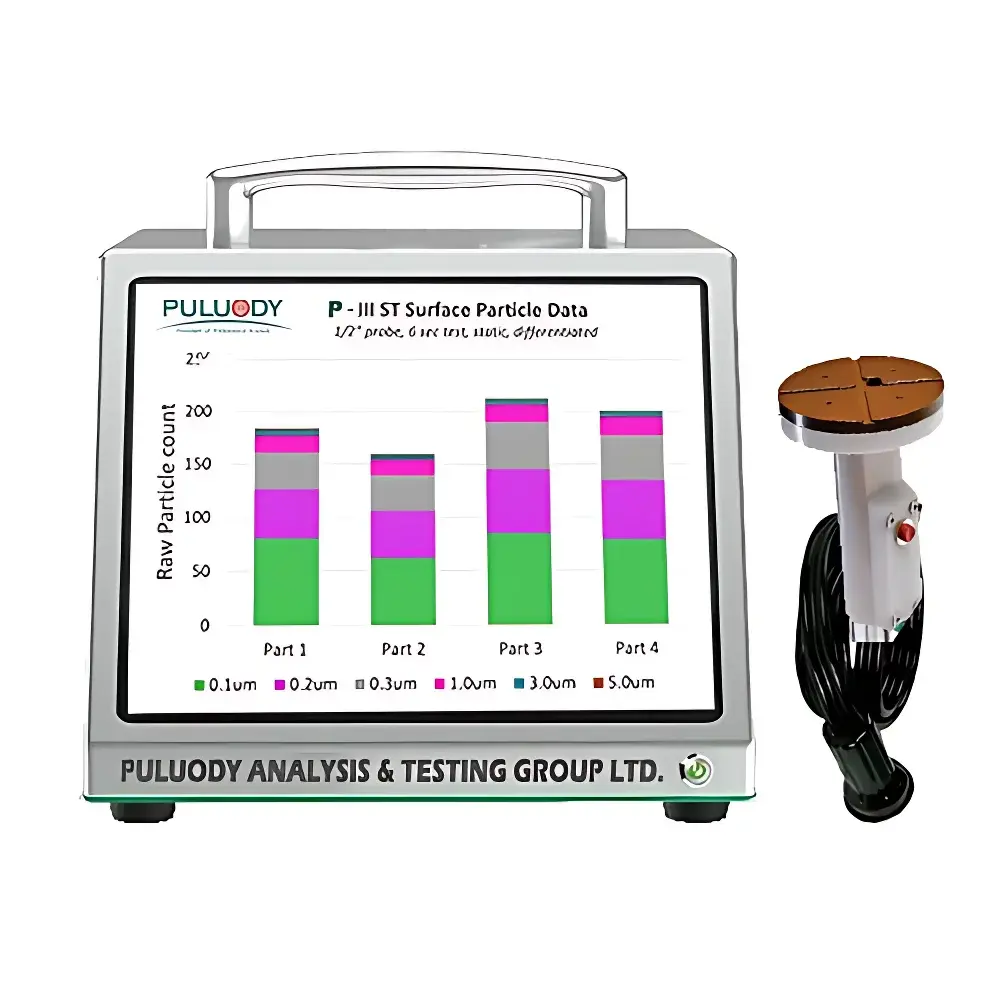
- 7-inch capacitive touchscreen interface: Embedded Linux OS with intuitive navigation, real-time histogram visualization, and on-device report generation—including timestamped particle counts per channel, cumulative distributions, and pass/fail status against user-defined limits.
- Hot-swappable dual-battery system: Enables uninterrupted operation during extended PM windows or multi-station audits—battery replacement requires no system reboot or calibration interruption.
- Regulatory-ready firmware architecture: Built-in 21 CFR Part 11-compliant audit trail, role-based user authentication (admin/operator/viewer), electronic signature support, and immutable event logging for GLP/GMP-aligned quality systems.
Sample Compatibility & Compliance
The P-III+ accommodates diverse surface topographies and material classes through interchangeable probes: a straight probe (UK4400302) for planar substrates, a 90° angled probe (UK4400304) for recessed chambers or robotic end-effectors, and a multi-functional probe (UK4400301) supporting simultaneous particle + temperature + humidity acquisition. All configurations maintain NIST-traceable calibration per ISO 21501-4 Annex D and JIS B 9921. The instrument satisfies ISO 14644-9 requirements for surface particle measurement methodology—including sampling distance control, electrostatic discharge mitigation, and background subtraction algorithms—and is routinely deployed for wafer fab tool qualification, photolithography cluster certification, and ISO Class 3–5 cleanroom surface release testing.
Software & Data Management
Data export is supported via USB mass storage, Ethernet (TCP/IP), or serial interfaces (RS232/RS485). The included PULUODY Surface Analysis Suite (v4.2+) provides automated report templating (PDF/CSV/XLSX), statistical process control (SPC) charting, historical trend comparison, and deviation alerting. Raw logs retain full metadata—including operator ID, probe type, environmental conditions, and firmware version—to satisfy FDA audit readiness expectations. Optional integration with MES/CMMS platforms is enabled via Modbus TCP or custom REST API endpoints, allowing particle count events to trigger preventive maintenance workflows or batch hold notifications.
Applications
- Semiconductor manufacturing: Wafer surface cleanliness verification pre-lithography, post-etch, and after wet cleans; reticle and pellicle inspection; track-in/out validation for FOUPs and SMIF pods.
- Advanced packaging: Die attach surface residue screening, underfill cavity contamination checks, and bump height uniformity correlation studies.
- Medical device assembly: ISO 13485-compliant final packaging line surface monitoring, catheter lumen particle shedding assessment, and implant-grade stainless steel passivation verification.
- Optics & photonics: Anti-reflective coating defect mapping, laser cavity mirror contamination tracking, and AR/VR display panel defect root-cause analysis.
- Aerospace & defense: Avionics housing interior particulate baselines, turbine blade cooling hole inspection, and conformal coating adhesion integrity validation.
FAQ
Does the P-III+ require annual recalibration?
Yes—certified recalibration per ISO/IEC 17025 is recommended annually or after 2,000 operating hours, using NIST-traceable polystyrene latex (PSL) standards and certified reference surfaces.
Can it measure particles on non-planar or textured surfaces?
Yes—when used with the 90° probe or multi-functional probe, the system maintains consistent aspiration velocity and standoff distance across curved, grooved, or micro-structured surfaces, provided surface roughness Ra < 0.8 µm.
Is remote monitoring supported?
Yes—via optional Ethernet connectivity and PULUODY Cloud Connect, enabling real-time dashboard viewing, threshold-based SMS/email alerts, and centralized fleet management across multiple fabrication sites.
What is the minimum detectable particle size under standard configuration?
0.1 µm (Matrix F, with optional high-sensitivity optics module); default factory configuration supports 0.3 µm as the lowest validated channel per ISO 21501-4.
How does the instrument handle electrostatic interference during sampling?
All probes integrate grounded conductive housings and ion-neutralizing airflow paths; optional integrated ionizer module (P-III+/ION) suppresses surface charge buildup on insulating substrates such as quartz or SiO₂.



