
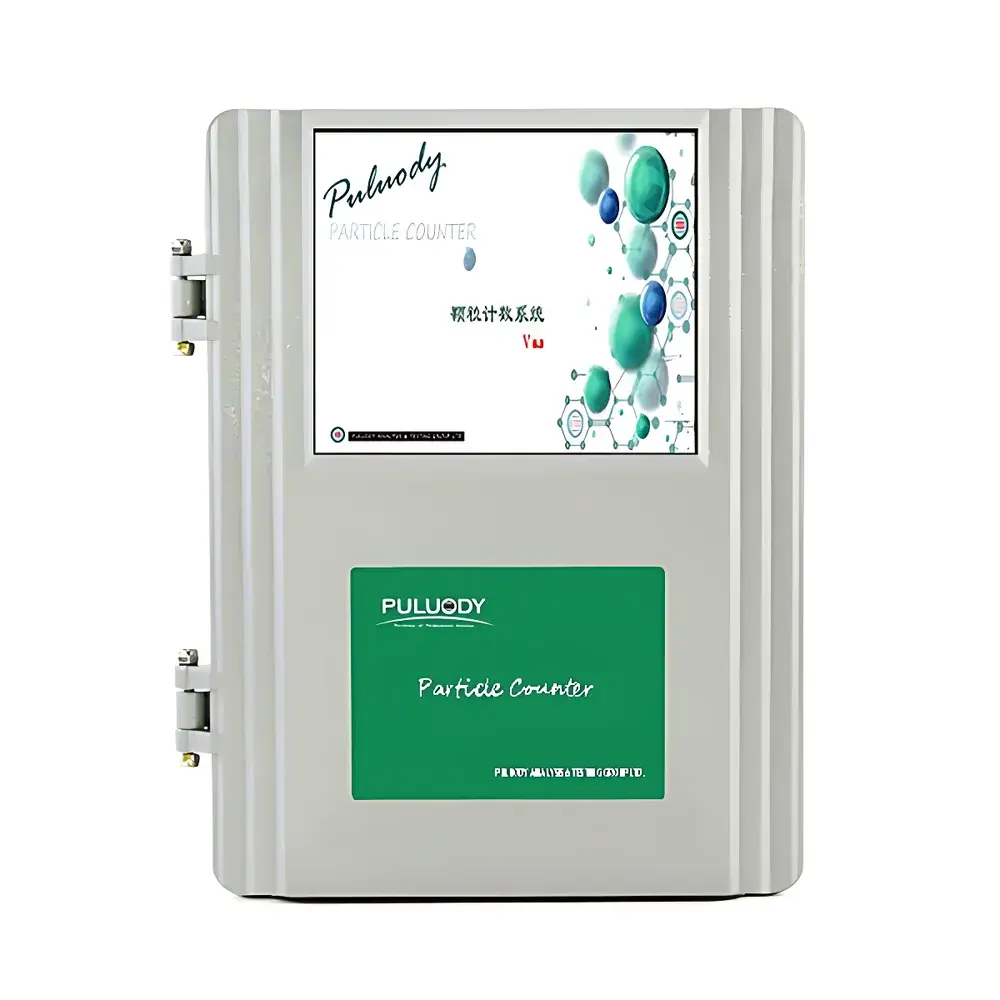
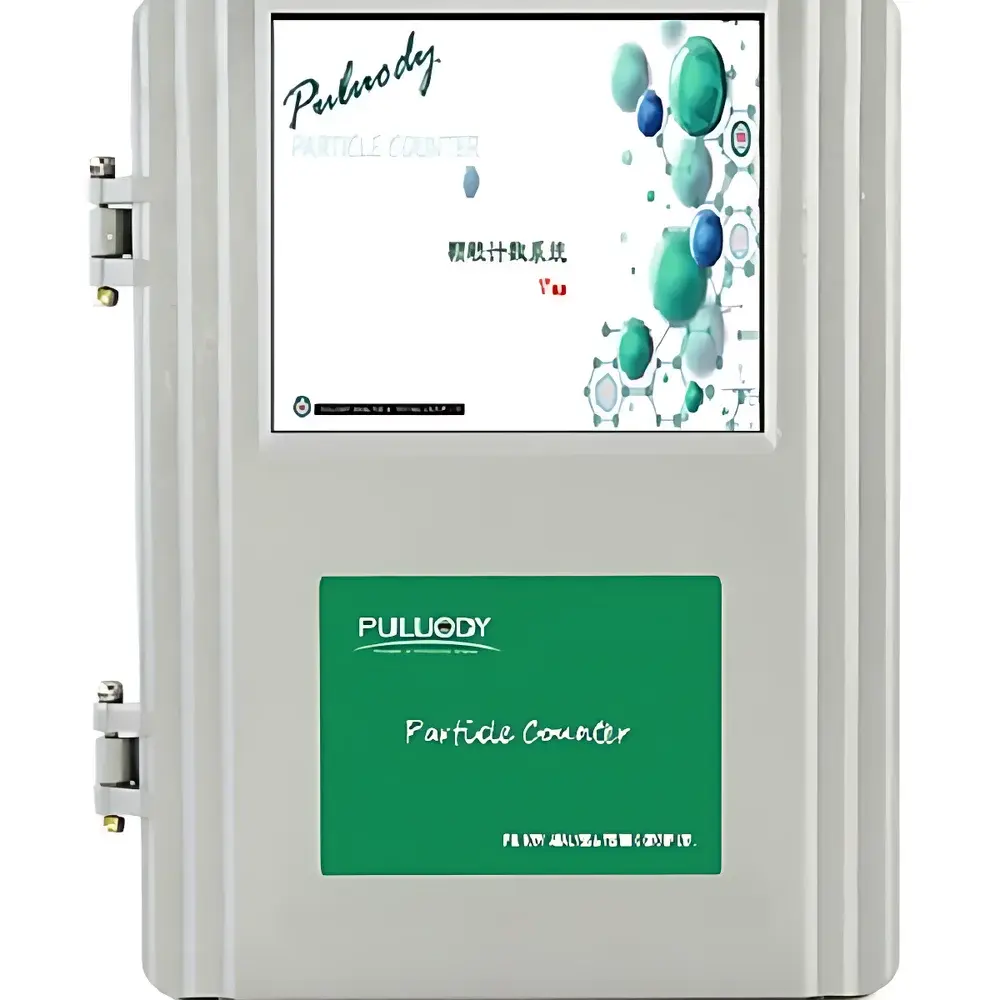
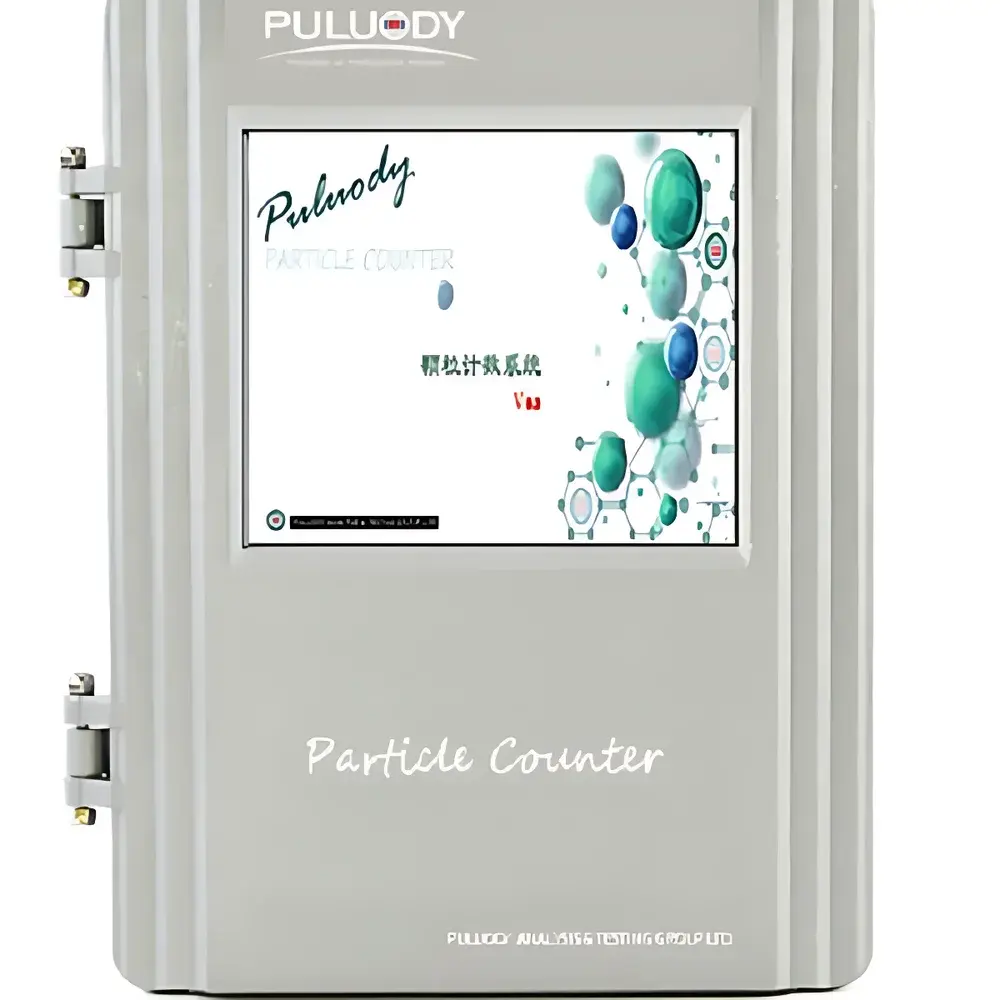
PULUODY OPC-2300A Online Liquid Particle Counter
| Brand | PULUODY |
|---|---|
| Origin | Shaanxi, China |
| Manufacturer Type | Authorized Distributor |
| Country of Origin | China |
| Model | OPC-2300A |
| Instrument Type | Optical Particle Counter (Light Obscuration Principle) |
| Detection Principle | Eighth-Generation Dual-Laser Narrow-Beam Light Obscuration |
| Sensor Range | 2–750 µm (configurable to 5–1000 µm) |
| Resolution | 0.1 µm |
| Resolution Accuracy | ≤10% |
| Measurement Accuracy | <±3% typical |
| Coincidence Error | ≤5% |
| Maximum Detectable Concentration | 9,999,999 particles/mL |
| Sampling Interval | 5 s – 9 h |
| Operating Pressure | 0–0.6 MPa (standard) |
| Flow Rate | 6–500 mL/min |
| Fluid Temperature Range | −10 °C to +80 °C |
| Output Interfaces | 4–20 mA analog, RS232/RS485 digital |
| Data Storage | Unlimited (onboard + external export) |
| Calibration Standards | NIST-traceable latex spheres, AC fine test dust, MTD |
| Reporting | Particles per mL + ISO 4406 / NAS 1638 / SAE AS4059 contamination codes |
Overview
The PULUODY OPC-2300A Online Liquid Particle Counter is an industrial-grade optical particle counter engineered for continuous, real-time monitoring of suspended particulate contamination in aqueous process streams. It operates on the light obscuration (LO) principle—where particles passing through a focused dual-laser beam induce measurable reductions in transmitted light intensity—and leverages the eighth-generation narrow-beam dual-laser detection architecture developed by PULUODY Analytical Testing Group (UK). This design enhances signal stability, minimizes noise from fluid turbulence or bubble interference, and delivers high reproducibility across dynamic flow conditions. Unlike offline laboratory counters, the OPC-2300A integrates directly into pressurized water circuits—such as municipal drinking water distribution lines, membrane filtration skids, beverage bottling rinse loops, or pharmaceutical purified water (PW) systems—enabling unattended, long-term trending of particle load, size distribution, and contamination dynamics without manual sampling or system interruption.
Key Features
- True online operation with pressure-rated wet-end assembly (0–0.6 MPa standard; optional 31.5 MPa rating with integrated pressure-reduction valve)
- Dual-laser narrow-beam optical sensor optimized for aqueous media, delivering improved signal-to-noise ratio and reduced coincidence error (≤5%) at high concentrations
- Configurable detection range: selectable calibration channels covering 2–750 µm or extended 5–1000 µm, with user-defined binning across up to 1000 size channels (e.g., 8/16/32 fixed bins)
- High-resolution sizing capability: 0.1 µm resolution with ≤10% counting resolution accuracy per ISO 21501-4
- Robust industrial enclosure rated for harsh environments: IP65 ingress protection, wide operating temperature (−10 °C to +80 °C), and chemically resistant wetted materials (316L SS, FKM, quartz flow cell)
- Multi-mode output: isolated 4–20 mA analog signal for DCS/SCADA integration, plus RS232/RS485 serial interface supporting Modbus RTU protocol
- On-device LCD display with membrane keypad for local configuration, real-time histogram viewing, and alarm status monitoring
- Embedded firmware supports automatic contamination grading per ISO 4406:2017, NAS 1638, and SAE AS4059 Rev. E—enabling direct compliance reporting without post-processing
Sample Compatibility & Compliance
The OPC-2300A is validated for use with low-viscosity, optically transparent aqueous fluids—including potable water, ultrapure water (UPW), filtered process water, beverage base solutions, and cleaning-in-place (CIP) rinse water. It is not intended for opaque, highly turbid, or viscous liquids (e.g., glycol solutions, slurries, or emulsions) where light transmission falls below operational thresholds. Calibration follows traceable protocols using NIST-certified polystyrene latex (PSL) microspheres, ISO Fine Test Dust (AC), or Multi-Size Test Dust (MTD), ensuring metrological consistency aligned with ISO 21501-4 and USP . The instrument supports audit-ready data integrity features—including time-stamped event logs, user-access control levels, and non-volatile memory with write-protection—making it suitable for GLP and GMP-regulated environments where FDA 21 CFR Part 11 compliance is required (when paired with validated software and procedural controls).
Software & Data Management
The OPC-2300A ships with PULUODY’s integrated embedded firmware and optional PC-based analysis suite (OPC-View v3.x). Firmware handles real-time particle classification, concentration calculation, contamination code assignment, and alarm triggering based on user-defined thresholds (e.g., >100 particles/mL >5 µm in PW loop). All raw count data—including timestamp, channel bin assignments, and flow-corrected concentration—are stored indefinitely onboard and exportable via USB or serial interface in CSV/Excel-compatible format. The software supports statistical trend analysis (e.g., moving averages, delta-change alerts), overlay of multiple historical runs, and automated report generation compliant with ISO 14644-1 cleanroom water monitoring requirements. For enterprise deployment, RESTful API support enables integration with MES/LIMS platforms and cloud-based condition monitoring dashboards.
Applications
- Real-time integrity verification of ultrafiltration (UF), nanofiltration (NF), and reverse osmosis (RO) membranes in municipal and industrial water treatment plants
- Continuous monitoring of purified water (PW) and water-for-injection (WFI) systems in pharmaceutical manufacturing, per EU GMP Annex 1 and USP
- Early detection of filter breakthrough or microbial shedding in beverage production—especially critical for sterile fill operations in breweries and soft drink facilities
- Performance validation of cartridge filters, bag filters, and depth filters during qualification (IQ/OQ/PQ) and routine maintenance
- Trending of wear debris and corrosion particulates in closed-loop cooling towers or boiler feedwater systems
- Supporting risk-based water system assessments per PDA Technical Report No. 29 and ASTM D7284 for biofilm-associated particle release
FAQ
Can the OPC-2300A be used for non-aqueous fluids such as hydraulic oil or solvents?
No. The optical design, calibration standards, and wetted material compatibility are specifically optimized for aqueous systems. For hydrocarbon or organic solvent applications, refer to PULUODY’s OPD series of oil particle counters.
Does the device meet ISO 4406:2017 certification requirements for reporting?
Yes—the firmware performs automatic classification and coding per ISO 4406:2017 Annex A (using ≥4 µm(c) and ≥6 µm(c) thresholds) and stores full-size-distribution data required for third-party validation.
Is field recalibration possible without returning the unit to a service center?
Yes. Users may perform on-site verification and adjustment using certified PSL reference suspensions and the built-in calibration wizard; full traceable recalibration requires factory service.
What is the minimum detectable particle concentration, and how is background noise managed?
The lower limit of quantitation is 1 particle/mL at ≥2 µm, achieved via dual-laser baseline stabilization and adaptive thresholding algorithms that suppress electronic and fluidic noise.
How does the system handle air bubbles or transient flow disturbances?
The dual-laser architecture enables differential signal discrimination: bubbles produce symmetric, low-duration attenuation across both beams, while solid particles generate asymmetric, longer-duration signals—enabling robust bubble rejection without sacrificing sensitivity.



