
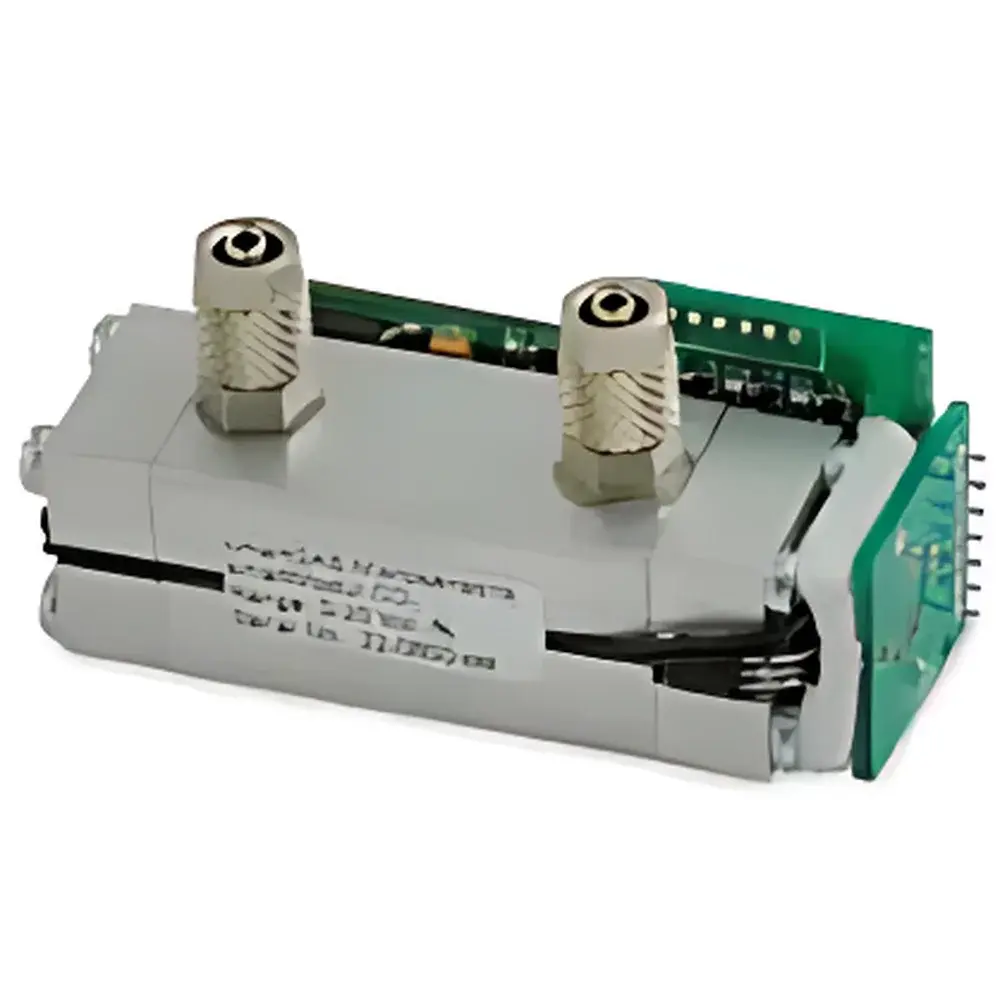
SmartGas CO2 Sensor SM-CDT (NDIR Dual-Wavelength Dual-Beam Infrared Gas Sensor)
| Brand | SmartGas |
|---|---|
| Origin | Germany |
| Technology | NDIR (Non-Dispersive Infrared) |
| Principle | Dual-Wavelength Dual-Beam Spectrophotometry |
| Measurement Range | 0–5000 ppm (standard HVAC configuration) |
| Output | MODBUS RTU (RS-485) and 4–20 mA analog |
| Lifetime | ≥10 years |
| Cross-Sensitivity | Negligible to common interferents (e.g., CO, CH₄, NO₂, H₂O vapor) |
| Operating Temperature | –10 °C to +50 °C |
| Enclosure Rating | IP65 |
| Compliance | CE, RoHS, EMC Directive 2014/30/EU |
| Calibration | Factory-calibrated |
Overview
The SmartGas SM-CDT is a high-stability, non-dispersive infrared (NDIR) carbon dioxide sensor engineered for continuous, maintenance-free monitoring in demanding environmental and industrial applications. Based on dual-wavelength dual-beam photometric architecture, it employs two precisely modulated infrared channels: one at the characteristic CO₂ absorption band (4.26 µm), and a second reference channel at a non-absorbing wavelength. This differential measurement strategy inherently compensates for optical drift caused by LED aging, dust accumulation on optical windows, or detector responsivity shifts—eliminating the need for frequent field recalibration. Unlike electrochemical CO₂ sensors, which suffer from limited lifespan, humidity-dependent output, and cross-sensitivity to acidic gases, the SM-CDT delivers long-term repeatability (<±2% FS over 12 months) and intrinsic immunity to chemical poisoning. Its solid-state design, absence of consumables, and factory-traceable calibration align with ISO/IEC 17025-aligned manufacturing practices and support compliance with EN 13779 (ventilation for non-residential buildings) and ASHRAE Standard 62.1.
Key Features
- Dual-wavelength dual-beam NDIR optics with integrated temperature compensation for stable baseline performance across –10 °C to +50 °C ambient ranges
- 10-year operational lifetime validated under accelerated aging tests per IEC 60721-3-3 Class 3K5
- Zero-point drift <±20 ppm/year; span drift <±1% FS/year — enabling extended calibration intervals in HVAC and IAQ deployments
- Simultaneous digital (MODBUS RTU over RS-485) and analog (4–20 mA, 2-wire) outputs for seamless integration into BMS, PLC, and SCADA systems
- Compact form factor (Ø24 mm × 85 mm) with low power consumption (<120 mW typical), suitable for battery-powered or energy-harvesting nodes
- IP65-rated housing with anti-reflective, hydrophobic optical window coating to resist condensation and particulate deposition
Sample Compatibility & Compliance
The SM-CDT is optimized for gaseous sampling in ambient air and process streams with CO₂ concentrations ranging from 0–5000 ppm (HVAC mode) or optionally 0–100% (industrial purity analysis). It exhibits negligible interference from CO, CH₄, SO₂, NO₂, and water vapor up to 95% RH (non-condensing), verified per ISO 12039 Annex C. The sensor meets CE marking requirements under the Electromagnetic Compatibility Directive 2014/30/EU and RoHS 2011/65/EU. While not intrinsically safe certified, its low-energy design permits use in Zone 2 hazardous locations when installed per IEC 60079-14. For regulated environments—including pharmaceutical cleanrooms, food processing facilities, and university research labs—the device supports audit-ready documentation packages compliant with FDA 21 CFR Part 11 (when paired with validated MODBUS data loggers) and GLP traceability protocols.
Software & Data Management
SmartGas provides the free PC-based configuration tool “GasConfig Pro” for parameter setup, firmware updates, and real-time diagnostics via USB-to-RS485 adapter. All MODBUS registers—including CO₂ concentration (holding register 40001), temperature (40003), signal quality index (40005), and diagnostic flags—are fully documented in the open MODBUS Application Protocol v1.1b specification. Integration with cloud platforms (e.g., AWS IoT Core, Siemens Desigo CC, Schneider EcoStruxure) is supported through standard Modbus TCP gateways. Data logging integrity is preserved via hardware timestamping and CRC-16 frame validation. Optional firmware extensions enable automatic zero-point verification using periodic ambient-air purging cycles—fully configurable without external hardware.
Applications
- Intelligent HVAC control in commercial buildings, schools, hospitals, and multiplex cinemas to optimize ventilation rates per ASHRAE 62.1 demand-controlled ventilation (DCV) guidelines
- Real-time CO₂ monitoring in vertical farms and greenhouse climate control systems for photosynthetic efficiency optimization
- Process gas purity verification in ammonia synthesis, urea production, and CO₂ recovery units within fertilizer and cement plants
- Indoor air quality (IAQ) dashboards in smart office ecosystems and university campus management platforms
- Environmental monitoring networks for urban air quality stations requiring long-term unattended operation
FAQ
What is the recommended calibration interval for the SM-CDT in HVAC applications?
For installations meeting ISO 16000-23 indoor air sampling conditions, annual verification against a traceable NIST-certified gas standard is sufficient. Factory calibration remains valid for 24 months under normal operating conditions.
Can the SM-CDT be used in high-humidity environments such as swimming pool halls?
Yes — the optical path is sealed and coated with hydrophobic nanolayer; however, condensation on external surfaces must be prevented via proper mounting orientation and thermal management.
Does the sensor require warm-up time before delivering stable readings?
Stabilization occurs within 60 seconds after power-on; full accuracy per datasheet specifications is achieved within 5 minutes.
Is MODBUS register mapping available for third-party BMS integration?
Yes — complete register definitions, exception code handling, and polling examples are provided in the publicly available “SM-CDT MODBUS Protocol Manual Rev. 3.2”.
How does the dual-beam architecture improve long-term reliability compared to single-beam NDIR sensors?
By continuously referencing the detector’s baseline response against a non-absorbing wavelength, optical degradation effects are mathematically subtracted in real time—reducing total error contribution from optical drift by >90% versus conventional single-beam designs.
Related Products







