
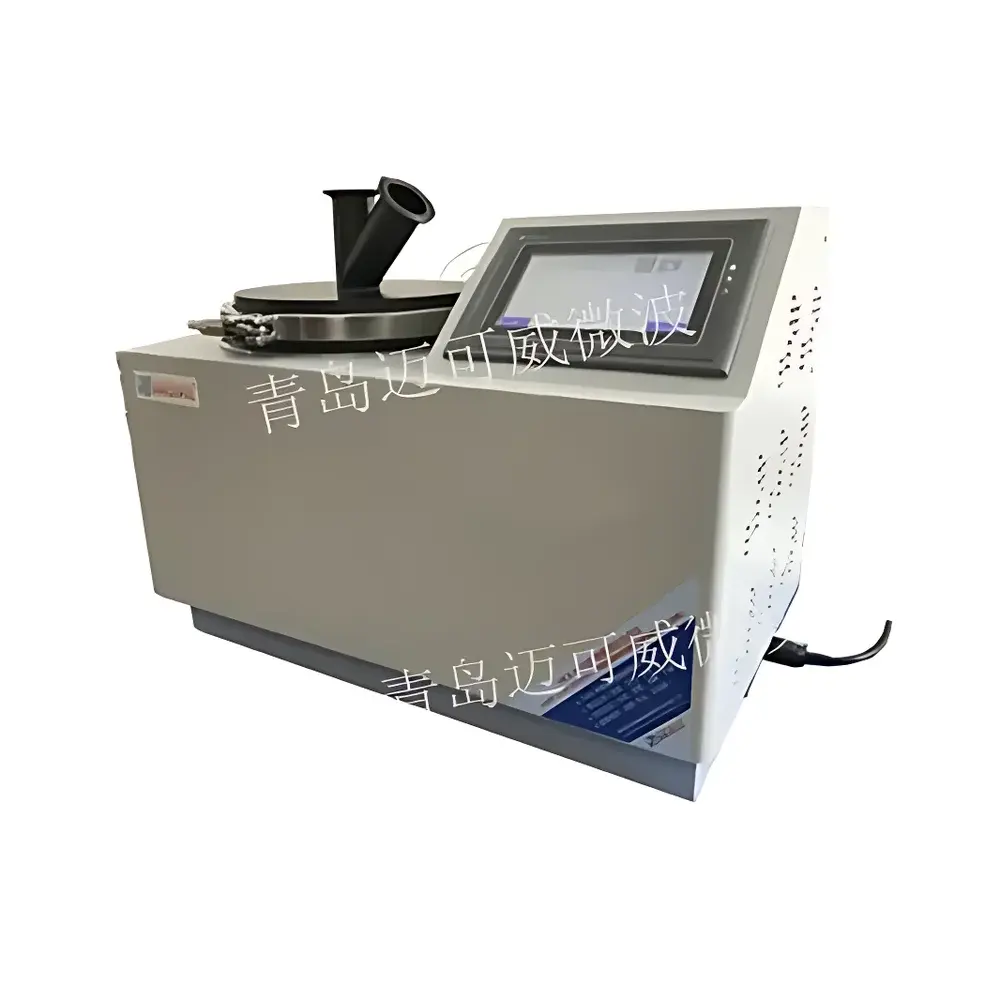
MakeWave MKM-H1AB Single-Mode Focused Microwave Synthesizer
| Brand | MakeWave |
|---|---|
| Origin | Shandong, China |
| Manufacturer Type | Direct Manufacturer |
| Model | MKM-H1AB |
| Temperature Range | 0–250 °C (infrared non-contact or axial fiber-optic probe) |
| Pressure Range | 0–3 MPa (pipeline pressure sensor) |
| Microwave Power | 0–600 W, continuously adjustable |
| Frequency | 2450 MHz |
| Stirring Modes | Mechanical stirring (Function A) / Magnetic stirring (Functions A & B) |
| Reaction Volume | 1 L |
Overview
The MakeWave MKM-H1AB Single-Mode Focused Microwave Synthesizer is an engineered platform for precision-controlled microwave-assisted chemical synthesis and reaction optimization. Unlike multimode cavity systems, it employs a cylindrical TM010 single-mode resonant cavity, delivering highly uniform electromagnetic field distribution, exceptional energy density, and reproducible load coupling characteristics. This architecture ensures deterministic microwave energy delivery—critical for kinetic studies, mechanistic investigations, and scalable reaction development. The system supports both ambient-pressure reflux and sealed-vessel high-pressure synthesis (up to 3 MPa), enabling controlled gas-phase participation (e.g., H2, CO, O2) and solvent-free or low-solvent transformations. Designed for rigorous laboratory environments, it serves synthetic organic chemistry, inorganic coordination chemistry, materials science (e.g., MOF synthesis, nanoparticle crystallization), pharmaceutical process R&D, natural product extraction, and catalysis research.
Key Features
- Single-mode TM010 resonant cavity (1 L volume) with CNC-machined, fully welded 316L stainless steel construction and multi-layer PFA fluoropolymer lining—resistant to aggressive reagents, thermal cycling, and corrosion up to 250 °C.
- Continuous-wave microwave generation at 2450 MHz with closed-loop PID-controlled frequency modulation; 0–600 W power output adjustable in 1 W increments—eliminating pulsed operation for stable thermal profiles.
- Dual temperature monitoring: axial fiber-optic probe (0–250 °C, ±0.5 °C accuracy) for direct reaction mixture measurement; or non-contact infrared pyrometry (0–300 °C, emissivity-compensated) for vessel surface tracking.
- High-fidelity pressure sensing via calibrated pipeline transducer (0–3 MPa, ±0.02 MPa full-scale), integrated with real-time overpressure interlock and passive rupture-disk safety.
- Hybrid agitation architecture: selectable mechanical stirring (torque-controlled, 0–600 rpm) for viscous or heterogeneous media; or magnetic stirring (0–1200 rpm) compatible with both atmospheric and pressurized vessels (Functions A and B).
- Industrial-grade PLC control system with 7-inch color touchscreen HMI; real-time plotting of temperature, pressure, power, and time; onboard data logging (≥10,000 points per run) with USB export in CSV format.
Sample Compatibility & Compliance
The MKM-H1AB accommodates diverse reactor configurations: standard 250 mL open reflux vessels (Function A), and 80 mL thick-walled quartz or Hastelloy C-276 high-pressure reactors rated to 3 MPa/250 °C (Function B). It complies with IEC 61000-6-3 (EMC emission limits) and GB 4706.21 (Chinese national safety standard for microwave appliances), with measured microwave leakage <5 mW/cm² at 5 cm distance. All control logic adheres to SIL-2 functional safety principles; audit trails, user access levels, and electronic signature support align with GLP and FDA 21 CFR Part 11 readiness requirements for regulated laboratories.
Software & Data Management
The embedded control firmware enables multi-segment method programming (up to 10 steps per protocol), including ramp-hold-cool sequences with independent setpoint control for temperature, pressure, and power. Experimental metadata—including operator ID, timestamp, calibration logs, and hardware status—is automatically appended to each dataset. Exported CSV files are structured for direct import into LIMS platforms or statistical analysis tools (e.g., JMP, MATLAB). Optional Ethernet interface supports Modbus TCP integration for centralized lab automation networks.
Applications
- Accelerated synthesis of heterocycles, peptides, and organometallic complexes under reproducible thermal conditions.
- High-pressure hydrothermal synthesis of metal oxides, phosphates, and perovskites with controlled nucleation kinetics.
- Gas-liquid-solid triphasic reactions (e.g., hydrogenations, carbonylations) using integrated gas inlet valves and back-pressure regulators.
- Extraction of thermolabile phytochemicals from botanical matrices without thermal degradation.
- Reaction calorimetry via dynamic power-temperature correlation modeling for enthalpy estimation.
- Method transfer from discovery-scale microwave synthesis to kilo-lab batch reactors via boundary condition mapping.
FAQ
What distinguishes single-mode from multimode microwave synthesis?
Single-mode cavities establish a defined electromagnetic standing wave pattern, enabling precise spatial localization of energy and predictable coupling with small-volume samples—essential for quantitative kinetic analysis and method reproducibility across labs.
Can the MKM-H1AB be used for air-sensitive reactions?
Yes—when equipped with Function B high-pressure reactors and optional inert gas purging manifold, it supports Schlenk-line-compatible operations under N2 or Ar atmosphere.
Is fiber-optic temperature measurement validated against reference standards?
Each fiber-optic probe is factory-calibrated traceable to NIST SRM 1484 (blackbody radiator); users may perform in situ verification using certified melting point standards (e.g., KNO3, 334 °C).
How is data integrity ensured during long-duration experiments?
The PLC executes cyclic redundancy checks (CRC-32) on all logged parameters; power-loss recovery resumes from last stable checkpoint without data corruption.
Does the system support external trigger inputs for synchronized instrumentation?
Yes—TTL-compatible digital I/O ports allow synchronization with FTIR spectrometers, Raman probes, or automated sampling systems for in situ reaction monitoring.
Related Products



