
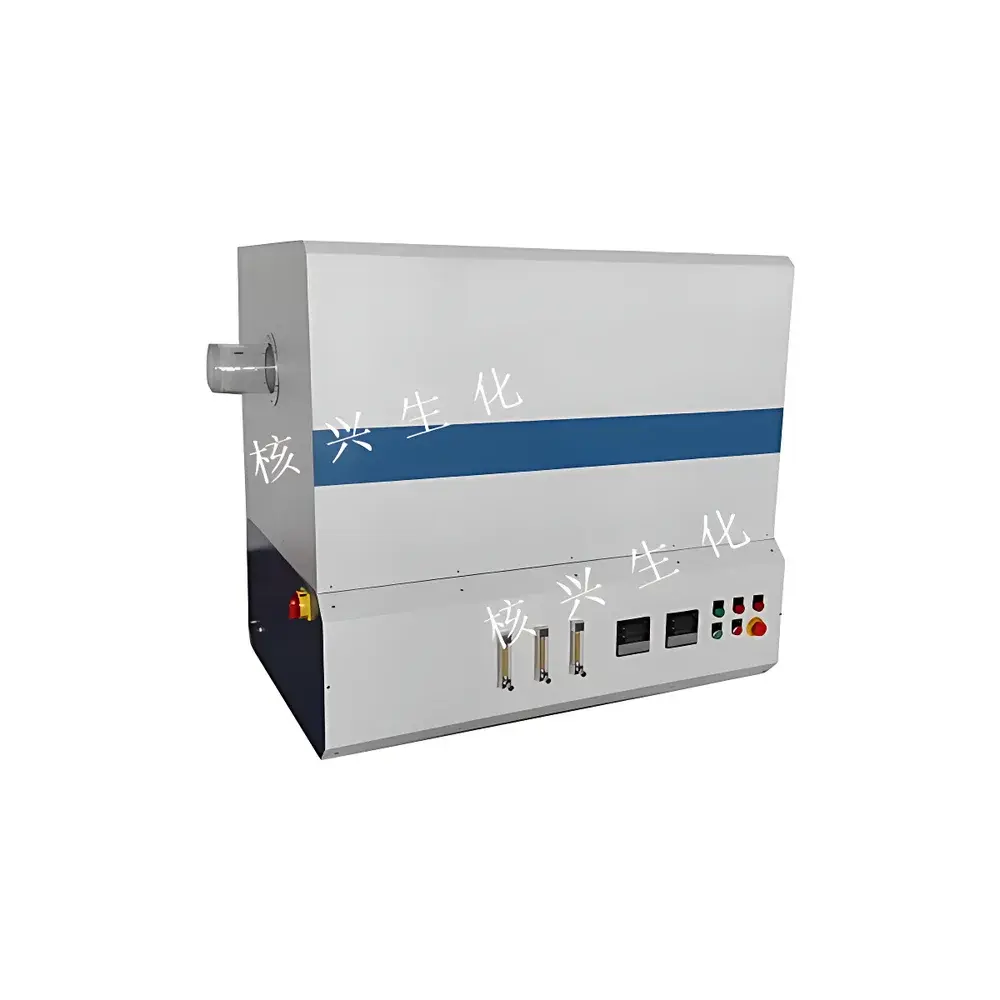
HEXING BIOCHEMICAL HXO-T50 Dual-Zone High-Temperature Oxidation Furnace for Tritium (³H) and Carbon-14 (¹⁴C) Sample Preparation
| Brand | HEXING BIOCHEMICAL |
|---|---|
| Origin | Shandong, China |
| Model | HXO-T50 |
| Power Supply | 220 V ±10 V, 50 Hz ±1 Hz |
| Total Power | 3000 W |
| Temperature Range | 0–1200 °C |
| Control System | PLC-based touchscreen interface with dual-zone 20-segment programmable ramp/soak profiles |
| Heating Tube Dimensions | Ø50 mm × 900 mm |
| Sample Holder | Ceramic boat |
| Temperature Sensing | Type K thermocouples, accuracy ±1 °C |
| Oxidation Configuration | Multi-gas inlet with independent mass flow control (O₂, air, CO₂/O₂ mix), dual-stage condensation for H₂O(³H) capture, tandem alkaline absorption traps for CO₂(¹⁴C) recovery |
Overview
The HEXING BIOCHEMICAL HXO-T50 is a purpose-engineered dual-zone high-temperature oxidation furnace designed for quantitative liberation and recovery of organically bound tritium (³H) and carbon-14 (¹⁴C) from solid and semi-solid environmental and biological matrices. It operates on the principle of controlled oxidative pyrolysis—subjecting samples to precisely regulated thermal decomposition in an oxygen-rich atmosphere to convert organically bound ³H into recoverable H₂O vapor and organically bound ¹⁴C into CO₂ gas. This enables subsequent radiochemical quantification via liquid scintillation counting (LSC) or accelerator mass spectrometry (AMS). The system is engineered for reproducible, complete combustion across diverse sample types—including plant tissue, animal tissue, soil, graphite, polymers, and other combustible organic materials—within activity ranges spanning environmental background levels up to intermediate-level radioactive waste (ILW) characterization requirements.
Key Features
- Dual independent temperature zones with separate PID controllers and over-temperature cut-off protection, enabling staged thermal treatment (e.g., low-temperature dehydration followed by high-temperature oxidation).
- Uniform radial and axial heating profile achieved through optimized resistive coil geometry and internal reflector design; eliminates cold spots and ensures complete oxidation of heterogeneous samples.
- Maximum operating temperature of 1200 °C with standard operation at 750 °C—sufficient for quantitative conversion of refractory organic carbon and C–H bonds without catalyst degradation.
- Integrated dual-stage condensation train: first stage at 0–4 °C for quantitative H₂O(³H) collection; second stage at sub-zero temperatures (optional chiller) for residual moisture capture.
- Tandem alkaline absorption system (e.g., NaOH or Carbo-Sorb® E) for quantitative CO₂(¹⁴C) trapping, with pressure-balanced flow design to prevent channeling or breakthrough.
- Multi-gas manifold supporting simultaneous or sequential introduction of O₂, synthetic air, or catalytic gas mixtures (e.g., O₂ + CO₂), each with independent mass flow controllers (MFCs) calibrated for 0–1000 mL/min range.
- PLC-driven touchscreen HMI with 20-segment programmable temperature ramps, dwell times, and gas-switching logic—fully traceable and exportable for audit compliance.
Sample Compatibility & Compliance
The HXO-T50 accommodates samples loaded in standardized ceramic boats (max. dimensions compatible with Ø50 mm × 900 mm quartz or alumina tube), supporting masses up to 10 g dry weight depending on organic content and ash yield. It meets methodological requirements specified in multiple national radiation safety and analytical standards, including EJ/T 1008–1996 (“Sampling and Measurement of ¹⁴C in Air”), GB 14883.2–2016 (“Determination of Tritium in Foods”), GB 18871–2001 (“Basic Standards for Ionizing Radiation Protection and Safety of Radiation Sources”), and GB 6249–2011 (“Radiation Protection Requirements for Nuclear Power Plants”). Its architecture supports GLP-compliant operation when paired with validated SOPs, electronic logbooks, and instrument calibration records traceable to NIM (National Institute of Metrology, China).
Software & Data Management
The embedded PLC controller logs real-time temperature, gas flow rates, pressure differentials, and program stage status to internal non-volatile memory. Data export is supported via USB or RS-485 to external LIMS or laboratory data management systems. All control parameters—including setpoints, ramp rates, hold durations, and gas valve actuation sequences—are password-protected and version-stamped. Audit trail functionality complies with principles aligned with FDA 21 CFR Part 11 for electronic records where local regulatory frameworks apply, provided user-defined access controls and electronic signatures are implemented externally.
Applications
- Environmental monitoring: ³H and ¹⁴C analysis in vegetation, soil cores, sediment, and bioindicators near nuclear facilities or legacy sites.
- Decommissioning and waste characterization: quantification of residual organically bound radionuclides in graphite moderators, ion-exchange resins, and polymer-lined components.
- Food and agricultural safety: regulatory testing of crops, dairy products, and animal feed following accidental or routine releases.
- Radioecological research: metabolic tracer studies using ³H-thymidine or ¹⁴C-glucose in controlled lab-scale experiments.
- Method validation and interlaboratory comparison programs requiring robust, reproducible sample oxidation prior to LSC or AMS.
FAQ
What sample types are compatible with the HXO-T50?
Solid and semi-solid organic matrices including plant tissue, animal tissue, soil, peat, charcoal, plastics, rubber, and irradiated graphite—provided they are non-explosive and do not release halogenated or sulfur-containing gases under oxidation.
Is the system suitable for regulatory reporting under Chinese national standards?
Yes—the thermal performance, gas handling, and documentation capabilities align with the procedural requirements of EJ/T 1008–1996, GB 14883.2–2016, and GB 18871–2001 for ³H and ¹⁴C determination in environmental and food matrices.
Can the furnace operate under inert or reducing atmospheres?
No—the HXO-T50 is specifically engineered for oxidative combustion; inert or reducing gas configurations are not supported and would compromise ³H/¹⁴C recovery efficiency.
What maintenance is required for long-term reliability?
Routine inspection of thermocouple integrity, quartz tube annealing cycles, MFC calibration verification every 6 months, and replacement of absorption reagents prior to saturation—documented per manufacturer’s maintenance log template.
Is remote monitoring or integration with SCADA possible?
Yes—via Modbus RTU over RS-485, enabling integration into centralized facility monitoring systems for temperature, power consumption, and operational status telemetry.



