
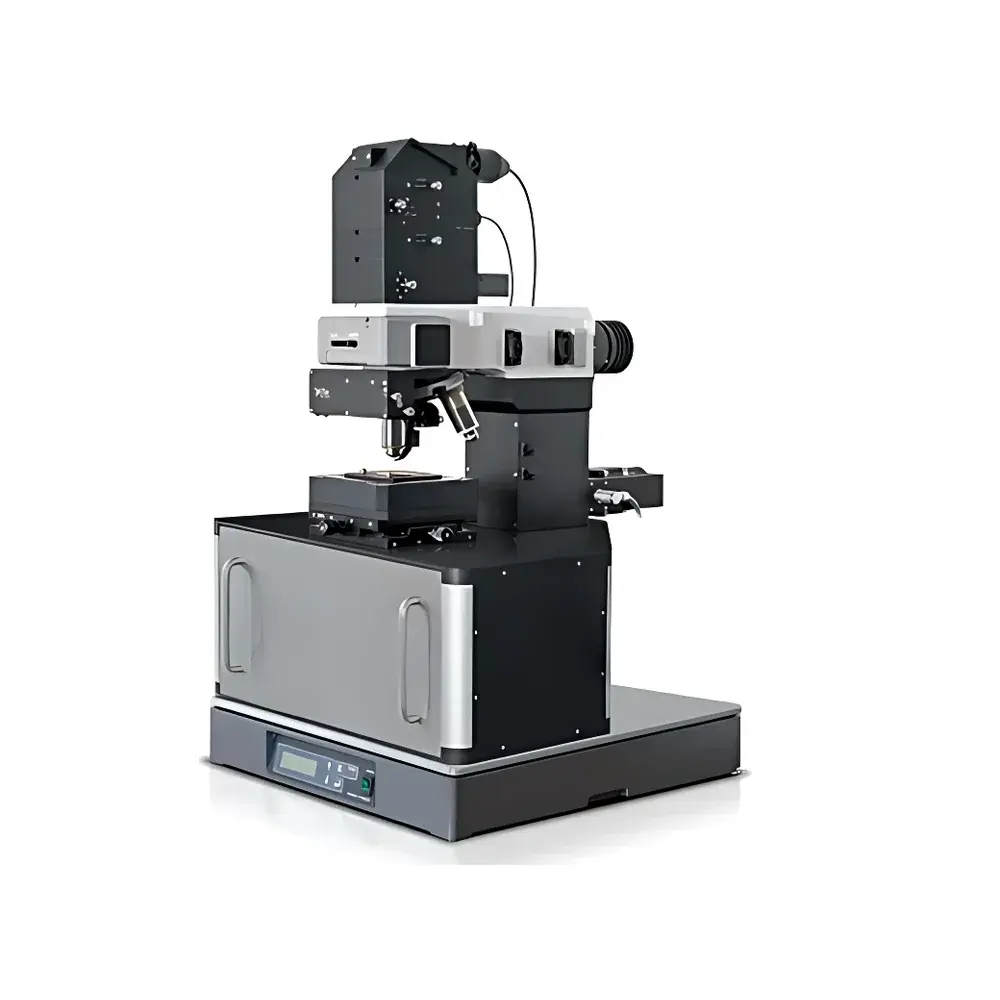
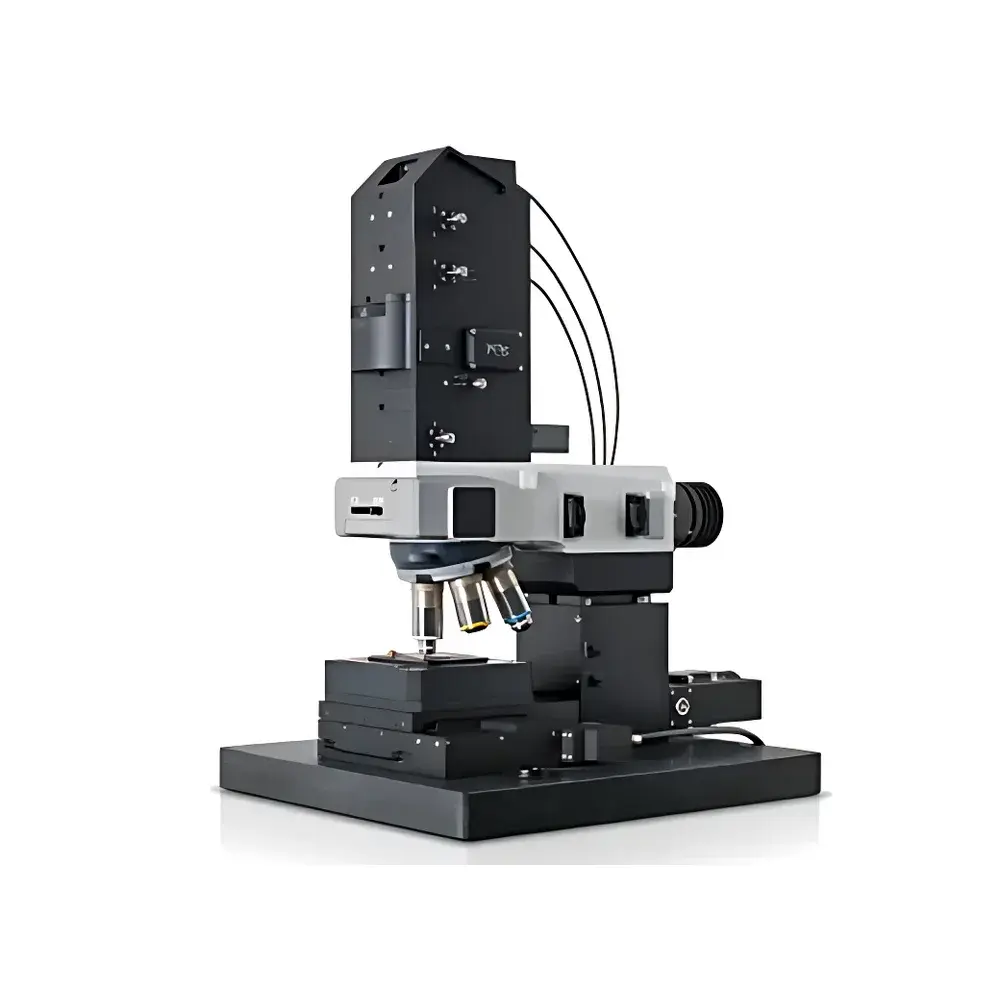
WITec alpha300 RS Integrated Confocal Raman and Scanning Near-Field Optical Microscope
| Brand | WITec |
|---|---|
| Origin | Germany |
| Model | alpha300 RS |
| Instrument Type | Confocal Raman Microscope with Integrated Scanning Near-Field Optical Microscopy (SNOM) |
| Spectral Range | 90–9000 cm⁻¹ |
| Spectral Resolution | ≤0.2 cm⁻¹ |
| Spatial Resolution | Lateral 350 nm, Axial 800 nm |
| Minimum Wavenumber | 10 cm⁻¹ |
| Spectral Reproducibility | ≤±0.02 cm⁻¹ |
Overview
The WITec alpha300 RS is a fully integrated, research-grade correlative microscopy platform that unifies confocal Raman spectroscopy, scanning near-field optical microscopy (SNOM), and atomic force microscopy (AFM) within a single, mechanically stable optical architecture. Engineered for nanoscale chemical and structural characterization, the system operates on two complementary physical principles: (1) confocal Raman scattering—where monochromatic laser excitation induces inelastic photon scattering, yielding vibrational fingerprints of molecular bonds—and (2) aperture-based SNOM, which bypasses the diffraction limit by coupling evanescent optical fields via a metallized fiber probe scanned in close proximity (<10 nm) to the sample surface. This dual-modality design enables simultaneous or sequential acquisition of chemically specific hyperspectral maps (Raman) and sub-diffraction topographic–optical contrast (SNOM), without repositioning the specimen. The alpha300 RS retains full functional parity with the standalone alpha300 R (Raman) and alpha300 S (SNOM) systems, including all optical paths, detector configurations, and mechanical degrees of freedom—ensuring measurement traceability across modalities.
Key Features
- Single-platform integration of confocal Raman imaging, SNOM (top-illumination/bottom-collection, bottom-illumination/top-collection, and probe-collection configurations), and multi-mode AFM (contact, lateral force, tapping, and advanced modes)
- Motorized objective turret enabling rapid, alignment-preserving switching between Raman and SNOM optical pathways—no manual realignment or sample translation required
- UHTS (Ultra-High Throughput Spectrograph) series fiber-coupled spectrometers optimized for low-light Raman detection; >70% throughput across UV–VIS–NIR spectral bands with aberration-corrected imaging optics
- True confocal pinhole-based depth sectioning with axial resolution down to 800 nm; spectral reproducibility maintained at ≤±0.02 cm⁻¹ over extended acquisition periods
- Full compatibility with WITec’s proprietary Piezo-driven high-speed scanning stages and EMCCD detectors for ultrafast Raman imaging (up to 1300 spectra/sec under optimized conditions)
- Modular illumination options: Köhler-transmitted brightfield, darkfield, DIC, polarized, and total internal reflection (TIR) illumination for enhanced SNOM contrast
Sample Compatibility & Compliance
The alpha300 RS accommodates a broad range of solid-state and thin-film samples—including 2D materials (e.g., graphene, transition metal dichalcogenides), semiconductor nanostructures, polymer blends, biological membranes, and catalytic surfaces—without requiring conductive coating or vacuum environments. Its open optical design supports custom environmental cells (temperature-controlled stages, gas chambers, electrochemical cells) for in situ and operando measurements. All Raman data acquisition and processing workflows comply with analytical traceability requirements defined in ISO/IEC 17025 and support audit-ready metadata logging per GLP/GMP guidelines. Software-generated reports include instrument configuration logs, calibration certificates (wavenumber and intensity), and raw spectral headers compliant with ASTM E1840 and USP spectral data integrity standards.
Software & Data Management
Data acquisition, real-time visualization, and post-processing are managed through WITec’s proprietary Project software suite (v6.x), which provides native support for multidimensional hyperspectral datasets (x, y, z, λ, t). The software implements automated spectral preprocessing (cosmic ray removal, baseline correction using asymmetric least squares, peak deconvolution), multivariate analysis (PCA, cluster analysis, MCR-ALS), and correlative overlay of Raman chemical maps with SNOM amplitude/phase images and AFM topography. All user actions—including parameter changes, region-of-interest definitions, and processing steps—are recorded in an immutable audit trail satisfying FDA 21 CFR Part 11 requirements for electronic records and signatures. Raw data are stored in vendor-neutral HDF5 format with embedded metadata, ensuring long-term archival integrity and third-party tool interoperability (e.g., Python-based SciPy/NumPy pipelines).
Applications
- Correlative nanoscale mapping of strain distribution and layer stacking order in exfoliated graphene flakes via G-peak position shifts (Raman) overlaid with plasmonic near-field enhancement patterns (SNOM)
- In situ monitoring of electrochemical reactions at electrode interfaces using time-resolved Raman imaging combined with TIR-SNOM for interfacial field confinement
- Chemical identification and phase segregation analysis in polymer nanocomposites below the optical diffraction limit—resolving filler–matrix interphases at ~350 nm lateral resolution
- Photonic crystal defect mode localization and cavity Q-factor quantification through SNOM-guided Raman hotspot targeting
- Label-free subcellular organelle identification in fixed tissue sections using Raman fingerprinting, validated against SNOM-enhanced autofluorescence contrast
FAQ
What distinguishes the alpha300 RS from conventional confocal Raman microscopes?
The alpha300 RS uniquely integrates SNOM functionality into a Raman platform, enabling direct correlation of vibrational spectra with sub-200-nm optical features—unattainable with diffraction-limited optics alone.
Can the system perform simultaneous Raman and SNOM acquisition?
No—due to fundamental incompatibilities in illumination geometry and signal collection pathways, Raman and SNOM modes operate sequentially; however, co-registration accuracy is maintained at <50 nm via shared coordinate referencing and piezo-stage feedback.
Is the system compatible with cryogenic or vacuum environments?
The base configuration is ambient-air compatible; optional vacuum-compatible stages and cryo-stages (down to 4 K) are available as factory-engineered add-ons with recalibrated optical alignments.
How is spectral calibration verified during long-term operation?
Automated daily calibration routines use internal neon and argon emission lines; drift-compensated wavenumber referencing is applied to all acquired spectra using the built-in calibration standard module.
Does the software support batch processing of large hyperspectral datasets?
Yes—Project software includes parallelized scripting (via Python API) for automated batch correction, classification, and statistical reporting across hundreds of gigabytes of spectral cubes.
Related Products



